Saturday, August 13, 2011

Iron Maiden Commentary - Part Eight


No Prayer For The Dying (1990)

I suppose nothing good lasts forever. This album was released during a time of upheaval for Iron Maiden, and it shows. If you recall, guitarist Adrian Smith left the band after Seventh Son of a Seventh Son out of creative differences with band leader Steve Harris. Fellow guitarist Dave Murray stuck around, but Smith was replaced by Janick Gers, who is a solid guitarist but it would take several albums before he came into his own. After the fantastical bombast of Seventh Son, No Prayer for the Dying was a deliberate step back towards "stripped down" metal...which kind of baffles me. After all, Smith was the one complaining and he left? So why did they still feel compelled to regress like this?

Wanting to tone down the synth/keyboards is defensible (though they are still heard on a few of these tracks), but something else definitely got lost in the process. The riffs are weaker, the songs are shorter and much less complex, and singer Bruce Dickinson suddenly decided he wanted his voice to be less operatic and much raspier. It's humorous just how unpopular this affectation turned out to be with the fanbase - this approach completely negates all the strengths of Bruce's voice, and everyone knew but him.

"Tailgunner" is a song about aerial warfare, following in the footsteps of "Aces High." The comparison really hurts this song. "Tailgunner" has about one tenth of that song's energy, though raspy Bruce does make an amusing pun involving Dutch aircraft ("Nail that Fokker"). This is not a bad song by any means...it's just okay, which is a good way to describe this entire album.

If a solid track like "Holy Smoke" appeared on one of the "Golden Age" albums, it probably would not have ranked among the best songs. On this album, however, it's easily the best. Perhaps still seething over the Religious Right protests against "The Number of the Beast", Iron Maiden delivers a scathing, hilarious takedown of televangelism. Adding to the humor is that the song is actually narrated by Jesus himself ("I died on the cross...that ain't funny, but my so-called friends are making me a joke"). Despite the venom, the song is deliriously upbeat, the musical equivalent of giving the middle finger with a big grin. With its catchy riffs and impressive solo, it's a shame that the quality of this song proves to be an exception rather than the rule.

"No Prayer For The Dying" is a ballad that can't really decide if it wants to remain a ballad. The guitar work is nice and the lyrics seem sincere, though Bruce attempts to apply his new style to meet the needs of an emotional song like this...with mixed results. About halfway through, the song explodes out of nowhere and throws out some insane solos. It's not bad, just a bit unexpected. This song isn't bad, but it doesn't feel particularly polished.

With "Public Enema Number One," Iron Maiden beat Blink 182 by several years when it came to puns involving buttsecks. The title might be lame, but this song is okay. As usual, raspy Bruce grows tiresome quickly but the instruments fare pretty well. "Fates Warning" has a very cool intro, but Bruce's vocals drag it down. Jeez, why the hell did he think this was ever a good idea? These songs still have a lot of what makes Maiden appealing, including some nice solos in this one...but the songs themselves just don't turn out to be very memorable.

Hey wow, is that actual atmosphere? "The Assassin" has a nice Arabic vibe to it and gets into the psychological elements of assassination. The killer stalks the intended victim and tries to get inside his head. The song definitely has a lot of cheese (towards the end, Bruce just starts shouting "Assassin!" over and over) but all the elements come together reasonably well.

"Run Silent, Run Deep" is definitely one of the better tracks on the album. A tale of submarine warfare, it does a masterful job of conjuring up some claustrophobic atmosphere and Bruce actually cleans up his vocals for the chorus. I particularly like the ending, where the instruments calm down and the chorus rings out one more time to haunting effect.

You know Iron Maiden's in a bit of a rut when they have to trot out Charlotte the Harlot once again. She's not mentioned by name in "Hooks in You," but her address (22 Acacia Avenue) is referred to early on. The song is basically a series of terrible puns about sadomasochism and I'm not even sure what it has to do with Charlotte (some fans dispute whether this is really part of her storyline). The instruments make a valiant effort to salvage this song (it actually has some of the album's better riffs) and it almost works. Almost.

Still, "Hooks in You" is Beethoven compared to the awful "Bring Your Daughter to the Slaughter." A super-cheesy tale of deflowering virgins, this easily has the worst lyrics of the band's entire career. "Unchain your back door and invite me around," Bruce growls. Get it? He's going to pound your daughter in the ass, LOL. Everything about it is just dumb, including the cover where Eddie is apparently on a date with Jessica Rabbit. Raspy Bruce also has the writing credit for this song and once boasted to journalist Mick Wall that he wrote it in three minutes. It shows, buddy. In part because it was attached to the soundtrack for A Nightmare on Elm Street 5, this is actually the highest-charting single of the band's career, despite it winning a well-deserved Golden Raspberry. Still, the commerical success meant that this turd would be guaranteed to appear on all future greatest hits compilations. I can't stand this song, and I hate that the chorus is catchy enough to make me want to sing along despite hating it.

At five and a half minutes, "Mother Russia" is the album's longest song...a far cry from the previous albums. It turns out to have the best instrumental work on the whole album, especially the haunting introduction and middle section. The lyrics are a salute to the Russian people and the impending end of Communism there. It doesn't exactly feel like a deep exploration of the country's history and I wouldn't be surprised if Russian listeners felt patronized. This song wouldn't be out of place on one of the Golden Age albums...kind of a shame it got stuck here.

________________________________________

Overall Strengths: This is still Iron Maiden, and there are some solid songs here. The acerbic social commentary in "Holy Smoke" is a nice new addition to the band's bag of tricks.

Overall Weaknesses: Very weak when compared to all of its predecessors. Bruce's odd vocal style is mostly off-putting. "Bring Your Daughter to the Slaughter" is just fucking terrible.

Recommended Tracks
Holy Smoke
The Assassin
Run Silent, Run Deep
Mother Russia


Next: The turmoil within Iron Maiden continues as the band releases the varied, wildly inconsistent "Fear of the Dark."

Tuesday, August 2, 2011

Iron Maiden Commentary - Part Seven


Seventh Son of a Seventh Son (1988)

If I'm forced to choose, this is probably my favorite Iron Maiden album. The last of the "Golden Age" albums, it is often underrated in comparison to Powerslave or The Number of the Beast, but still has a strong contigent of the fanbase advocating on its behalf. It is the band's only "concept album" and adapts folk tales about how great power was supposedly gained by a seventh son, provided that his father is also a seventh son. Unlike some other famous concept albums like Pink Floyd's The Wall or Queensryche's Operation Mindcrime, the album's storyline is not detailed and the tracks form a loose narrative at best, leaving a lot open for interpretation. It's entirely possible to enjoy the entire album without having any clue about the overarching story.

The new sounds introduced on Somewhere in Time continue to evolve, this time with a real keyboard played by Michael Kenney. The album delivered big hits for the band and still stands as one of their best, but the more fantastical direction that the band was going in began to alienate guitarist Adrian Smith, who also had some solo projects he wanted to pursue. He stuck around for the "7th Tour of a 7th Tour," but left shortly before the band began work on the next album.

"Moonchild" begins with a brief acoustic segment followed by a lengthy keyboard intro. In terms of this story, the song is from Satan's point of view as he boasts about how the impending birth of the fabled seventh son will present him with an opportunity to take advantage of his power and corrupt humanity. Amusing to note that this song, which is actually narrated by the Devil, did not attract anywhere close to the same level of controversy as "The Number of the Beast." Just goes to show that those morons only read the song title and don't bother with the actual lyrics. Context is for sinners and elitists, right? Anyway, this is a fun, catchy song with some insane solos and some really hammy vocals from Bruce - check out that hardcore cackle at the end.

"Infinite Dreams" is a mature look at spirituality from the point of view of the first Seventh Son - let's call him "The Father," for simplicity's sake. He's been having awful nightmares. Despite how frightening they are, he is also intrigued because these dreams might also offer some insight into the afterlife, a topic which has clearly troubled him. "You tell me you're a nonbeliever...or a spiritualist, well me I'm neither." So, basically an agnostic, but one who would really like to know "what side we're on." It's a captivating song with great work from all the band members. I especially like a section in the middle where Nicko busts out some solid drum rolls.

The part that "Can I Play With Madness" has in the album's narrative is tough to figure out. This much we know - the Father has decided to speak with a psychic about his prophetic dreams and he's not very happy with what he's told. The odd chorus is what's tough to interpret. The Father looks into the crystal ball and says "There's no vision there at all," but the psychic seems to be arguing that this is the whole point and that the Father is just "too blind to see." Is this a subtle admission that this prophet believes that clarivoyance doesn't exist? When pressed by the Father, the prophet gets vindictive and "predicts" that his customer is going to Hell. A strange story, but the overall upbeat feel of the song turned it into a hit single for the band.

The most popular track off this album would prove to be "The Evil That Men Do," and it's not hard to see why. This is a snarling beast of a song, four minutes of balls-to-the-wall metal that begins with a badass riff and then kicks your ass with sheer momentum. Storywise, it depicts the death of the Father, but his seventh son (we'll call him just "The Son") has been conceived. We're not really told how he dies, but given the title, it seems safe to assume that it was agents of the Devil. Having the Father out of the way could make it easier to control the Son's power, after all. As he dies, he realizes that "beyond is where I learn," and the knowledge that he will finally find the answer to his existential questions provides some final comfort. A true Maiden classic, but the "repetition problem" takes a bit of a toll on the lyrics. The band must have really liked the sound of rhyming "edge" with "ledge," because it shows up about a dozen times in the song.

The massive, ten-minute "Seventh Son of a Seventh Son" depicts the birth of the title character. The other six sons gather as the family is told of the power this mystic child will have - specifically, the power of healing and the "second sight." Drowning in atmosphere, the song immediately brings to mind images of a dark ritual and the first half features some epic vocals from Bruce, who holds an inhumanly long note at one point. The second half is all instrumental and boasts some fine riffs and solos. The work from the rhythm guitar is so good, it's likely to take your mind off the actual solos at a few points.

"The Prophecy" is a slower, progressive piece that opens with a soothing keyboard melody and ends with a soft acoustic outro. The Son is now an adult and has become a bit of a Cassandra figure. He has visions of an imminent catastrophe but the villagers around him dismiss his claims. The Son claims that "Lucifer smiles, looks on and waits," implying that the disaster is his work. When the calamity strikes the village and takes a harsh toll, the villagers begin to blame the Son, who they should have listened to in the first place. God, people are idiots.

The next song, "The Clairvoyant" is a haunting masterpiece that kicks off with a phenomenal bass intro from Steve Harris. The Son has become frightened by the extent of his powers, which he fears he will no longer be able to control. By the end of the song, something dreadful has happened because the final verse is narrated by someone else who describes how the Son, despite the psychic power, "couldn't foresee his own demise." What exactly killed him? We're never given specifics. The song does reference reincarnation at the end, implying that perhaps another Seventh Son of a Seventh Son will emerge someday. This is a great song that was eventually released as a single, though it never got quite as popular as it deserves to be.

Definitely not to be confused with the hit song by Billy Joel, "Only the Good Die Young" provides a cynical finale to the album. The Son seems to be speaking from the afterlife and has nothing but withering contempt for the society that failed to recognize his powers. He marvels at how the people can accept the more absurd aspects of organized religion but can't buy his mystic powers - "Walking on water, are miracles all you can trust? So I think I'll leave you, with your bishops and your guilt." A friend of mine once said this song sounded like something from one of the Mega Man games, and it was such an astute/amusing observation that those games cross my mind every time I hear it. The end brings back the acoustic bit from "Moonchild," perhaps implying another impending clash between good and evil. "So until next time...have a good sin."

_______________________________________

Overall Strengths: A brilliant album that is consistently satisfying to listen to from start to finish. The storyline does not overpower the music, but still adds layers of depth.

Overall Weaknesses: Uh...it ends too soon? Sorry, I can't come up with much.

Recommended Tracks
Moonchild
The Evil That Men Do
Seventh Son of a Seventh Son
The Clairvoyant


Next: The Golden Age comes to an abrupt end with "No Prayer for the Dying."

Saturday, July 23, 2011

Iron Maiden Commentary - Part Six


Somewhere in Time (1986)

After three albums of universally acclaimed metal glory, Iron Maiden decided to experiment. Somewhere in Time is the band's first album to feature synthesizers, manned by bassist and creative leader Steve Harris. While the synth is not nearly as excessive as other music to come out of the 1980s, the addition earned an ambivalent response from fans and would gradually cause tension in the band as well. It's worth noting that the most successful single off this album has no synth at all.

This album doesn't have the same kind of prestige as the rest of the "Golden Age" material, though the passage of time (there's a bit of irony) has been kind to it. The synth isn't the only thing that's different. The subject matter and lyrics are often surprisingly upbeat - the usual "war is hell" stuff is notably absent. However, this may not have been a negative in the end...that same big single I mentioned in the first paragraph is by far one of Maiden's most hopeful songs. As for the synth, Harris would slowly refine his skill with this powerful tool over the years and eventually switch to a real keyboard.

The epic intro to "Caught Somewhere in Time" lets you know immediately what you're in for. While the synth element does place this song a bit more firmly in the 80s than some of the band's other material from this era, I still think it sounds pretty cool. This song has a blindingly fast drum part (in general, Nicko gets a real workout on this album) and a quality sing-along chorus. I'm not sure the 7-minute length is totally justified, but it's a good listen.

"Wasted Years" is the only track from this album that has achieved the sort of fame even close to some of the band's past hits. The opening riff, fast and menacing, is legendary among metal enthusiasts, though what's also worth noting is how non-menacing the song turns out to be. The narrator wonders if he's truly making the most of every moment, only to realize that there are no "wasted years," and worrying about that will just make you miss the "golden" ones. The upbeat chorus could just as easily be transplanted to a classic rock piece, though then you probably wouldn't have that awesome riff. The uplifting lyrics shouldn't work so well with that intimidating guitar sound, but somehow the whole song just comes together.

There's a lot going on in "Sea of Madness," maybe too much. The guitar and especially the bass are going non-stop and Nicko doesn't seem to ever remove his foot from the kick drum. It always feels like this song should be more memorable, but it never seems to make much of an impression on me. Lyrically, it's definitely the downer in this group of tracks. The narrator looks at the insanity all around him and just...walks away. There's only so much bullshit you can deal with before it just gets to be too much, which is a theme that would return many times in Iron Maiden's work.

The epic "Heaven Can Wait" never became a single, but has become beloved within the Maiden fandom. The emotional, evocative lyrics depict a man in the throes of a near-death experience. He gets right to the gates of heaven before deciding that it can "wait for another day" and returning to life. During live shows, the band capitalizes on the song's feel-good vibe by inviting a group of fans onstage to participate in the irresistable sing-along section about halfway through the song. Good luck trying to stay in a bad mood after listening to this one.

For whatever reason, songs with very long titles don't inspire confidence. So when I looked at this album's track list and found "The Loneliness of the Long Distance Runner," I thought "what the hell kind of title is that? Good luck making that work." Well, that shows how little I know. This consistently underrated song is one of the album's best and another track that can really lift your spirits. All the instruments work together to conjure up the feeling of sprinting and watching scenery fly past. The lyrics work off the obvious metaphor for perseverance that can be derived from a long-distance race. "Must be so determined and push myself on" applies to all of life, not just a marathon.

"Stranger in a Strange Land" is a cool mid-tempo song that nicely balances the synth with the rest of the instruments. It tells the story of an Arctic explorer who is eventually frozen in ice and discovered in the future by scientists. The song was another single off the album, which is hardly surprising with the catchy riff and singing in the chorus. Interesting to note the repeated use of the phrase "brave new world," a concept which clearly resonated with the band for decades after this album was released.

Iron Maiden may be able to make seemingly mundane things like getting older or running sound totally epic with their musical style, but "Deja Vu" is pushing it. Never mind that some parts are a little too similar to "..Long Distance Runner," the lyrics combined with Bruce's singing go way into unintentional humor territory. Is having vague recollections of past events really this epic? When I'm listening to this and I hear Bruce sing "Ever had a conversation that you realize that you've had before? ISN'T IT STRAAAAANGE?!" I can't help but laugh. Maybe I'm being a bit too mean. This is still a good song, just impossible to take seriously.

Iron Maiden has never played the eight and half minute "Alexander the Great" live, which has mystified fans for decades. The closest they got was Bruce singing the chorus through the kazoo as a gag during one of the concerts. It's a bit of a shame, since I suspect the absolutely tremendous instrumentation would carry over very well on stage. Just try not to get pumped up by the gentle, epic introduction. It definitely matches a song like "Rime of the Ancient Mariner" in terms of atmosphere, but not even close in terms of lyrics. In fact, there's a surprising lack of poetry and imagination in them. It's just a list of names, places and battles. It might make a decent study guide to Hellenistic history, but I would think they would try harder given that this is one of the most legendary warriors of all time. That said, the instruments are absolutely on fire for this one and are able to make up the difference.

_______________________________________

Overall Strengths: The synth often adds interesting textures to the music and some of the songs reveal the band's surprising prowess at crafting uplifting songs.

Overall Weaknesses: Perhaps not quite as superb as some of its predecessors. The reasons for this vary among fans, but I personally would cite lyrical inconsistency. The writing for a few songs is paper-thin.

Recommended Tracks
Wasted Years
Heaven Can Wait
The Loneliness of the Long Distance Runner
Alexander the Great


Next: The band produces an epic concept album with "Seventh Son of a Seventh Son."

Thursday, July 14, 2011

Iron Maiden Commentary - Part Five


Powerslave (1984)

For the third time in a row, we have a revered album speculated by some fans to be Iron Maiden's absolute best. Seeing a pattern? This era of their discography isn't called the "golden age" for nothing. Powerslave kicks off with two of Maiden's most famous songs, and ends with one of their most respected epics, and the longest song they ever wrote. Aside from the songs generally being longer, the band didn't change much of what worked from Piece of Mind.

In discussions of this album, it becomes clear that the list of tracks is a bit polarized. Half of the eight songs are all-time classics. The other half...well, none of them are bad, but they're not on the same level. I personally don't find this album as easy to listen to all the way through as some of the band's other work. I'm always skipping ahead to get to the great stuff. Still, the quality of the best tracks on here easily makes it one of the band's best.

Album openers don't get much better than the thrilling "Aces High," a rip-roaring tribute to the English pilots who defended London from Nazi bombers during the Battle of Britain. You won't find the band's signature anti-war commentary here (that's saved for the next track), just an exciting song filled with nerdy details about ME-109's and "guns sending flack." The instruments are unusually well-synched, even for Maiden, and the vocals soar higher and higher during the chorus just like one of those planes. One of the band's all-time best.

The title of "2 Minutes to Midnight" is a reference to a "doomsday clock" utilized by Cold War scientists as a symbolic method to predict just how close the world was to nuclear annihilation. Midnight would be the end times, and the scientists set the clock at 23:58 when the USA and Russia both tested out hydrogen bombs. Armed with another classic riff and a blistering chorus (listen to those harmonies!), this is one of the angriest songs Iron Maiden has ever written. Anti-war themes are consistent throughout their work, but I don't know if they ever released another song with this much frothing-at-the-mouth contempt. The lyrics have a furious poetry and hit hard - "As the madman play on words and make us all dance to their song, to the tune of starving millions to make a better kind of gun." The ending warns that "midnight...is all night." Let's hope it never comes to that.

After that amazing one-two punch comes "Losfer Words (Big Orra)," the fourth and final instrumental track in their career. Like the others the band did earlier, this song is entertaining but nothing to blow your mind. The next song, "Flash of the Blade," has a badass riff going for it and not much else. The subject matter is very similar to "Sun and Steel," with a medieval Europe setting instead of Japan. Not quite as catchy, though.

"The Duellists" is yet another song about sword-fighting...two in a row? Really? This one has a creative instrumental section in the middle, but overall goes on for too long, has a bit too much cheese in its chorus, and doesn't wind up being especially memorable. Next up is "Back in the Village," which is actually a sequel to "The Prisoner." Unfortunately, it doesn't really capture the thrill of its predecessor. The bouncy riff and drums can get you banging your head, but something just doesn't click. I think it's Bruce's vocals, which are unusually nasal in this song. However, it does end with a very cool outro that leads into...

"Powerslave." We're past the album's iffy middle section and from here on out, we're good. The album's title song is awesomely ominous, with a bizarre vocal melody and a superb three-chord riff that precedes each chorus. The lyrics depict the thoughts of a spoiled Pharaoh who has to face the reality of death, something no amount of money or influence will prevent. I've also heard many times that this is a metaphor for the band's resentment about being slaves to record companies. I'm not sure I buy that; Maiden's not the type to let anything get in the way of their creative expression. But the lyrics to this are almost an afterthought, because the real selling point of this song is the phenomenal middle section. In the span of a couple minutes, you get a slow guitar solo, a faster solo, a section that highlights the bass, yet another guitar solo, and a drum solo. It's truly incredible and if I'm driving while this part is playing, I have to be careful or else I'll be at 90 mph and not even realize it. This song is a perfect demonstration of another thing I really appreciate about the band...the rhythm support during solos. During the solos, pay attention to what the other guitar is doing...and what Nicko is doing on drums. It's a large part of the reason these solos are so effective.

Only one more song? Don't worry, you're going to get your money's worth. "Rime of the Ancient Mariner" is 13 minutes and 34 seconds of brilliance and still the longest song the band has ever written. If you remember Samuel Taylor Coleridge's elaborate poem from high school English class, you will be surprised at just how solid an adaptation this epic is. The song explores the core themes and motifs of the poem and is a hell of a lot more entertaining, if I may be so bold. After the busy first few minutes, we get a chilling section the middle where Steve Harris's bassline evokes the Mariner's lonely voyage on the sea. Meanwhile, Bruce actually reads a passage from the poem out loud to eerie effect. After following that up with some powerful vocals and one of his highest screams ever (no matter how hard I try, I can't hit it), we sprint to the finish line with solid solos and a return to the style of the intro. It was easily the most thrilling and evocative composition of the band's career at this point and still has few equals. Now this is how you end an album.

_____________________________________

Overall Strengths: This album's best songs are some of the finest songs Iron Maiden has ever done. "Rime of the Ancient Mariner" justifies buying the whole album itself, never mind how great some of the other stuff is.

Overall Weaknesses: Half the album is phenomenal, the other half...is just okay. Not the most consistent set of tracks in the band's catalogue. Picking four tracks to recommend probably shouldn't be this easy.

Recommended Tracks
Aces High
2 Minutes to Midnight
Powerslave
Rime of the Ancient Mariner


Next: The band begins to experiment with new sounds on "Somewhere in Time"

Tuesday, July 5, 2011

Iron Maiden Commentary - Part Four


Piece of Mind (1983)

With Nicko McBrain replacing the departing Clive Burr on drums, the classic Iron Maiden line-up is complete for this album. We're still firmly in the band's "golden age" here...and many Maiden fans feel that while The Number of the Beast always gets more attention, this album is actually better and may be the band's best. Of course, nearly all of these "golden age" albums have a crowd that will place them at the top of the heap, so make of that what you will.

What is definitely significant about Piece of Mind is that the band has fully adjusted from the departure of original vocalist Paul Di'Anno and established its signature style. The scruffy tales of street violence are long gone - most of the subject matter here is rooted in mythology, history or literature. There is also more experimentation going on in terms of structure (most evident in "Revelations" and "To Tame A Land"), and that progressive undercurrent will continue to mature throughout the band's entire career.

Note: Corporate bullshit at YouTube is giving me a hard time about using these songs in playlists, even though they still can be shared individually. Yeah, it's completely and utterly stupid, but that's the commercial music industry for you. I had this entry up with one video for each song, but that looked sloppy. So instead, the song titles will link to the YouTube video. I'll miss the playlists too, but that's the shitty card we were dealt.

"Where Eagles Dare" opens with an awesome drum roll that introduces the world to Nicko. The story of a daring wartime rescue mission, half of this song is devoted to a long instrumental section (gunfire sounds are tossed in for another bit of flavor). Lest you think Bruce Dickinson has gotten the short shrift, he closes out the song with a mighty high note. This song kicks some serious ass.

"Revelations" is an odd mid-tempo song that takes many listens to sink in. I can't really figure out if it's supposed to be about anything other than a verbal salad of apocalyptic imagery, but it is strangely compelling nonetheless.

The Greek myth of Daedalus and Icarus gets a bombastic (though not entirely accurate) dramatization in "Flight of Icarus." Guitarists Adrian Smith and Dave Murray turn in blazing solos and Dickinson makes the chorus soar just like Icarus did before the sun melted his wax wings. In general, this is one of Big Bruce's most unrestrained performances - he hits inhumanly high notes at the very end. A highlight of the album, though the next two tracks are even better.

It's impossible to sit still during "Die With Your Boots On," a burly beast of a song with great riffs and thundering drums. The lyrics are a gleefully irreverent takedown of fearmongering by political and religious demagogues "predicting war for millions, in the hope that one appears." Despite the sarcasm, it seeks to empower the listener, declaring that "the truth of all predictions...is always in your hands."

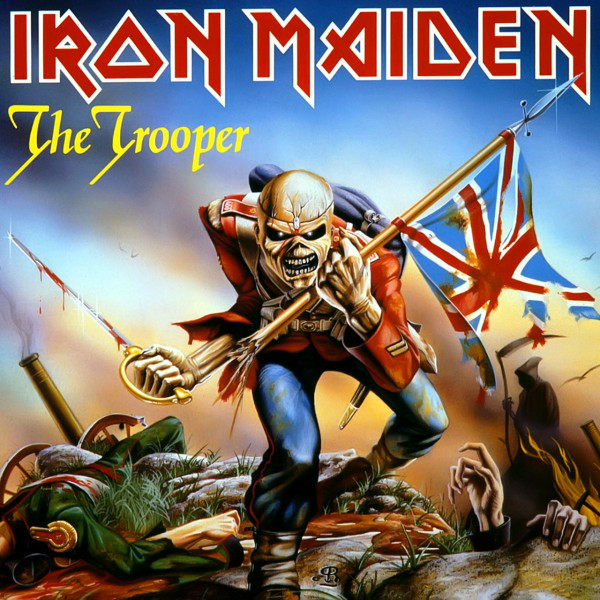
"The Trooper"does not need much introduction. This metal classic has gained the same level of fame as "Run to the Hills," even getting a shoutout in the novel World War Z as the song played by American troops to get them pumped up for zombie-killing action. A stunning riff that synchronizes the guitar and bass kicks things off, followed by a series of trills that is meant to evoke the galloping of horses. The title character is a soldier in the Crimean War, and this was the first of many Maiden songs that discussed the horror and stupidity of war, though it's more subtle here. After the trooper gets shot, the final lines state that he is "forgotten and alone." Some reward for wartime bravery, eh? This song is a true masterpiece that fully deserves its enduring fame.

What most people remember about "Still Life" is the garbled nonsense during the intro. Iron Maiden decided to have some fun at the expense of their Christian Right critics - when they weren't demonizing metal fans over "The Number of the Beast," they were searching for Satanic messages played backwards on records. If they bothered to reverse it, all they would have heard was Nicko's drunken impersonation of African dictator Idi Amin. The song itself is a spooky, macabre story about a man who becomes obsessed with the images he claims to see in a pool of water...obsessed to a dangerous extent. The lyrics do a very impressive job of telling this tale.

"Quest For Fire" is based on the movie of the same name about tribes of cavemen searching for a power they did not yet understand. The first line makes paleontologists cry and the whole thing is massively cheesy. Still, it's a charming kind of cheese and is still fun to listen to.

Next is the samurai tale "Sun and Steel." It's short and simple, with a devilishly catchy chorus. One thing worth noting about this album is all the tracks that seem like filler are more enjoyable than they probably have a right to be. This is probably one of the most solid albums to listen from beginning to end.

This album's concluding epic is "To Tame A Land," based on Frank Herbert's Dune. In fact, the band wanted to name the song after the book but the author made it clear he hated metal and wanted nothing to do with it, so the name was changed. Bruce got some revenge in the subsequent tour - while introducing the song, he referred to Herbert as "a bit of a cunt, actually." This track is no "Hallowed Be Thy Name," but it does a damn good job of evoking the barren scenery of its source material and Steve Harris gives a phenomenal bass performance. The lyrics prove to be a bit of a drawback...they are so full of Dune jargon that it becomes utterly incomprehensible to all but the hardcore fans of the book.

_____________________________________

Overall Strengths: A very solid album with few, if any, weak points.

Overall Weaknesses: Not many, but this album doesn't produce as many all-time classics as some other "golden age" material.

Recommended Tracks
Where Eagles Dare
Flight of Icarus
Die With Your Boots On
The Trooper


Next: The band keeps things going strong (and crafts its longest song ever) with "Powerslave."

Friday, June 17, 2011

Iron Maiden Commentary - Part Three


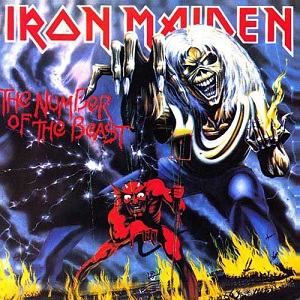
The Number of the Beast (1982)

If you have only limited knowledge of Iron Maiden, this album (and its title song) are what you are likely most familiar with. This album, widely considered one of the greatest, if not the greatest, in Metal history was a phenomenal success worldwide. Fans consider it to be the beginning of the band's "golden age," a series of superb albums that continues throughout the rest of the 1980s. Part of this album's success came from the controversy around its use of Satanic vocabluary, but more on that later.

After the departure of vocalist Paul Di'Anno, the band chose someone with a radically different voice. Dramatic tenor Bruce Dickinson could shriek like few others, earning him the nickname "the Air Raid Siren." Iron Maiden had been putting out exciting metal from day one, but Bruce's voice adds a whole new level of drama. The music began to adjust accordingly - the songs began to get longer and the lyrics began to branch far beyond the tales of street violence that characterized most of the last two albums. You can make a convincing argument that the seeds of the subgenre that became "power metal" were planted with The Number of the Beast.

Drummer Clive Burr, whose work on this album is simply brilliant, would leave the band before the next album emerged. He was later diagnosed with multiple sclerosis, and medical costs left him bankrupt. Iron Maiden's members are still close with Burr and they have staged multiple charity concerts on his behalf. His plight brought attention to MS within the metal community and the "Clive Aid" charity still works to raise funds for various MS-related programs around the world.


Given this album's formidable reputation, I'm still shocked at how much I dislike the first track. "Invaders," about the Viking conquests, is so cheesy that it borders on Spinal Tap territory. The verses go so fast that Dickinson barely has time to enunciate anything, and the chorus is impossible to take seriously. Bruce sings "In-VAY-ders!" and then there's a dinky little riff, followed by a shout of some Viking-relating gerund like "Pillaging!" It's not the worst track Iron Maiden ever made (those will come much later in this series), but it's pretty damn bad.

Things improve in a BIG way with "Children of the Damned." Based on the vintage horror film, this song features absolutely face-melting vocals by Dickinson. All of the instruments are in top-form, but this song is undeniably a vocal showcase, treating the listener to a pro singer at the top of his game. At one point, he holds a note for a good 20 seconds. If you think that doesn't sound like much, try it sometime. One more thing to note about this song - it's the first example of what I'll call the "repetition problem," an ongoing complaint from some people about Maiden songs which use the same phrase or phrases repeatedly to make up the chorus. In this case, it's "Children of the Damned" four times in a row, but it works just fine. This issue will come up many times over the course of this series, however.

Next is "The Prisoner," inspired by a 1960s British TV mini-series that the band were huge fans of. Iron Maiden even secured the permission of co-creator and star Patrick McGoohan to use audio from the series in the song's introduction. According to Maiden lore, the band was star-struck during a fateful phone call and babbled incoherently about their plans to pay tribute to the show. "A heavy metal band, you say?" McGoohan replied, before taking a dramatic pause. "Do it!" The song is an uplifting anthem about individuality and defiance that requires no knowledge of the show to appreciate. The solo is amazing too.

"22 Acacia Avenue" is a song I never really "got." It's the second installment of the "Charlotte the Harlot" saga. It seems like a song that was written for Di'Anno and lyrically, it's just as goofy as its predecessor (the line "it's no life for you, stop all this screwin'" always makes me laugh). This song has some ardent fans, but I guess I'm not seeing what they are.

From the ominous opening narration to Dickinson's legendary shriek, "The Number of the Beast" is one of the most famous songs in metal history. Indeed, all the pieces are in place - the twin-guitar assault, Steve Harris's busy bassline and Burr's dynamic drumming. It's popularity is well deserved, though most serious Iron Maiden fans will tell you that they enjoy the song, but feel that there is much better work to be found on this album and in the band's career as a whole. Kinda like how very few Metallica fans feel "Enter Sandman," while classic, is the band's best song.

This song inspired a wave of protests from the Christian Right following its 1982 debut, with many gathering to burn records and sentence all metal fans to eternal damnation. Let's be clear - anyone who actually thinks this song endorses Satanism is a moron who is only taking the song's name at face value and not bothering to read the lyrics, which make it clear Satan is something to be feared, not worshipped. It was inspired by a nightmare Steve Harris had after watching The Omen. Are we still allowed to talk about our nightmares? Is that okay with you? Well if it's not, too fucking bad. In the end, they shot themselves in the foot with this whole incident. Young listeners everywhere said "Hey, you don't get to tell me what music I can or can't listen to!" and thus a huge amount of new fans were introduced to the band and inspired other groups like Slayer to follow suit, after realizing that pissing off these so-called moral guardians was both easy and profitable.

"Run to the Hills" is another all-time classic, and it's appeal is best summed up by a coundtown of the great hard rock/metal songs aired on VH1. "Everything about that song is impossible," said music critic Steve Huey. "The drums are impossibly fast, the bass playing will give you tendonitis, and the chorus has impossibly high notes." A brutal account of the Native American genocide, the song is a four minute blast of pure metal that retains its ability to stun listeners (and the fact that it was turned into a laughably difficult song on Rock Band on ALL the instruments led to a whole different sort of appreciation). Wisely, Maiden never really tried to out-do this song in terms of speed. A few come close (we'll get to "The Trooper" and "The Evil That Men Do" in future entries), but the band could hardly be called a one-trick pony...many other tricks were up their sleeves.

"Gangland" kicks off with an awesome drum solo from Burr and makes for a very fun listen overall. With its story of gang violence, it was probably written for Di'Anno but Dickinson manages to make it his own. This song seems to have a weak reputation among the band's fandom at large, but I've always enjoyed it.

"Total Eclipse," a dark story of environmental devastation, was originally left off the album but later restored on a 1990s re-release. Listening to it today with a knowledge of Iron Maiden's later work makes it feel way ahead of its time. It may be the first time the band lent their voice to a current issue, and the progressive elements hint at some of the experimentation that would come in later albums. The mournful section that starts about 3 minutes in is a highlight.

As good as most of these songs are, none of them can match the epic grandeur of the album's final track, "Hallowed Be Thy Name." Most Maiden fans consider this song to be not just the crown jewel of the album, but the band's finest work and arguably the greatest metal song ever written. A tale of a man whose religious convictions are put to the test as his faces his own death, the genre had never seen anything with this much sheer power. The long instrumental section likely represents the protagonist's soul leaving his body and facing the great beyond, and what exactly is meant by the song's final invocation of the Lord's Prayer is left to the listener. The whole band is at the top of their game, but special attention needs to be given to Dickinson and especially Burr. With its elaborate drum fills, this song was the perfect way for him to go out. One final thing to note - whenever I make CDs or ITunes playlists featuring Iron Maiden, this song is always last. Why? Because nothing can follow it.

_________________________________________

Overall Strengths: The album is a bona fide milestone and features several of Iron Maiden's best and most beloved songs.

Overall Weaknesses: Some songs make it clear this is still a band in transition. "Invaders" is just bad.

Recommended Tracks
Children of the Damned
The Prisoner
Run to the Hills
Hallowed Be Thy Name


Next: Nicko McBrain takes over on drums and the classic line-up is complete for "Piece of Mind."

Tuesday, June 7, 2011

Iron Maiden Commentary - Part Two


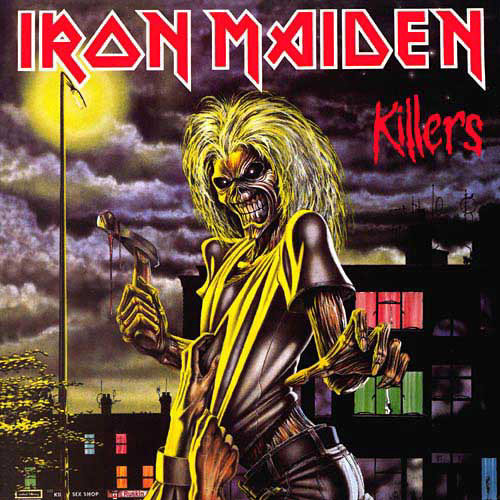
Killers (1981)

Longer and nastier than its predecessor, Iron Maiden's second album is an impressive demonstration of the style of metal the band helped create. They would evolve a great deal over the course of their career, and while the music would get much more complex and sophisticated, I don't think it ever got faster than some of the songs on Killers.

While Iron Maiden was something of a metal potpourri (there's a Jeopardy word for you) with little similarity between the individual songs, Killers is much more unified in both style and subject matter. As the name would suggest, the thematic element tying this album together is murder. Insane serial killers (the title track), punks plotting the demise of their enemies ("Wrathchild"), unfortunate saps who have been wrongly accused ("Murders in the Rue Morgue," "Innocent Exile"), victims communicating from beyond ("Twilight Zone"), scoundrels hoping to atone ("Prodigal Son," "Drifter"), it's all here.

Guitarist Dennis Straton left the band after the first album and was replaced by Adrian Smith. With him on the team, the entire ensemble is even stronger, though more changes would be on the way. Singer Paul Di'Anno, who contributes a lot of great vocals this time around, was kicked out of the band after his rampant cocaine and alcohol use began bringing down the band's live performances. The rest of the band avoided most of the drug-related pitfalls that plague musicians, and Di'Anno already had a reputation for troublemaking. He went on to a semi-successful solo career and is apparently still quite a scoundrel - he just recently completed a jail sentence for welfare fraud.


The album's first track is the instrumental "The Ides of March,", a very brief song that serves mostly as an epic intro to "Wrathchild." Though never released as a single, it remains the most consistently popular track off this album and it isn't hard to see why. Everything just works - Steve Harris's badass bass intro, Smith and Murray's screaming guitars, Di'Anno's growling, and Clive Burr's verstatile drumming. The brief drum solo in the middle is right up there with "In the Air Tonight" in terms of air-drumming potential.

"Murders in the Rue Morgue" has a slow intro that quickly revs up into a series of furious riffs that evoke a high-speed pursuit. Based on a short story by Edgar Allan Poe, the lyrics are unusually detailed as far as this early Maiden stuff goes. Our protagonist is on the run after being accused of two murders he didn't commit (or did he?)

So far so good, though things falter a bit with the next few tracks. I'm forever getting "Another Life" and "Innocent Exile" mixed up - both have scant but repetitive lyrics and long instrumental sections. Sandwiched between them is another instrumental track, "Genghis Khan," which does a decent job evoking the kind of epic battles associated with its namesake. That said, I'm not sure the album needed another track sans lyrics. Upon closer examination, "Another Life" is the weaker of the two songs. It's basically one verse repeated multiple times and there's very little that stands out musically either. "Innocent Exile" fares better, with a nice bass intro and some quality Di'Anno shrieks.

"Killers" is one of the best tracks on the album, which is evident from the stunning introduction. It leads off with another awesome bass intro by Harris (this album as a whole is a perfect demonstration of his skills) and a series of spooky yells from Di'Anno. Then it kicks into high-gear and doesn't stop until the very end. The drum part that starts at about 2:18 is jaw-droppingly fast. Lyrically, it's complex and interesting. The killer seems to be driven by some twisted moral motive and seems to have moments of guilt...but in the end, "his bloodlust defies all his needs."

"Prodigal Son" doesn't really do much for me. Normally, I'm a big fan of Maiden's ballads, but this one lacks the haunting qualities that made "Strange World" so great. It's not bad, but usually when I'm listening to this album in full, I find myself waiting for this one to be over.

Then there's "Purgatory." Holy shit, "Purgatory." Iron Maiden crams more awesome riffs into this three and a half minute song than most bands do in entire albums. It careens forward at top speed, and Di'Anno sounds like he's having an absolute blast singing this one. It never fails to get me psyched up, but for whatever reason it's a consistently underrated song in the band's catalogue.

Next is "Twilight Zone," a trim song with no connection to the television show of the same name. Given its 70s rock vibe, a better comparison might be to Golden Earring, who has a song with this same title. It's enjoyable, though I find it a little too short. You start getting into it and then it just ends.

The lyrics of "Drifter" make references to the idea of moving on and hoping for a better future, and I can't help thinking of Di'Anno's departure when I listen to it, though I don't think that was intentional. It's a pretty complex finale to the album, with a lot of tempo changes and some interesting solos.

____________________________________

Overall Strengths: The skills of all the musicians involved was already impressive on the last album and on this one they have only gotten better, especially Steve Harris's phenomenal bass. A very strong album with a unified theme and feel.

Overall Weaknesses: The songs can be a little too similar at times, particularly in the same-ey middle section.

Recommended Tracks
The Ides of March/Wrathchild
Murders in the Rue Morgue
Killers
Purgatory


Next: Bruce Dickinson arrives and the band changes metal forever with "The Number of the Beast."

Thursday, June 2, 2011

Iron Maiden Commentary - Part One

Part review, part tribute, all metal.

This series, which I intend to finish over the summer but could also wind up reaching well into fall, will go through each of the band's fifteen studio albums in an attempt to articulate the qualities that have made Iron Maiden such a highly-respected and unstoppable force within the realm of metal music.

So why them? Well, there's a lot to say about this music...so much so that a website with the name "The Iron Maiden Commentary" exists and can keep you busy for hours if you like. This series won't go into that exhausting level of detail and will be more personalized. Believe it or not, I'm a late-blooming fan of Iron Maiden. I feel like I should have discovered this stuff as a teenager like most other fans, but I didn't. In fact, for most of my teenage years and even early college years, my musical preferences were limited to The Offspring and video game soundtracks. But metal slowly crept in over the years and before I knew it, it dominated my iPod.

It's been about two years since I became a "serious" Iron Maiden fan, meaning that I sought out songs that weren't "The Number of the Beast" or "Run to the Hills," and I keep waiting for my "Iron Maiden phase" to end. But it doesn't...and I'm not sure it will. Something about this band's work resonates deeply, and there are times when I feel like it was made specifically for me. That is, of course, ridiculous because this is the second-most commercially successful metal band in history we're talking about (Metallica is first). Still, the key to their success is somehwere in there - this band projects a sense of sincerity like few others...and the actual music...well, there will be time for that.

So here's how these entries will work. I'm being more ambitious with my blogging here - there will be a YouTube playlist featuring all the songs on the album that's in the spotlight. First, we'll have an introduction. Then we start talking about each individual track. At the end, we assess the strengths and weaknesses of the album. Finally, I'll pick four "recommended tracks" that I especially like. So let's get this started with their self-titled debut album.


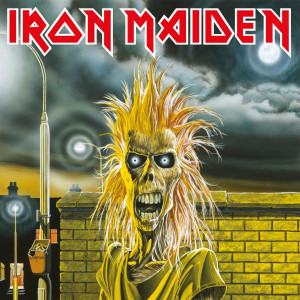
Iron Maiden (1980)

The band had been performing for a few years in their native London by the time this first album came out, but this marked the beginning of what would be a decade of dominance for Iron Maiden. The lineup at the time was Steve Harris on bass, Dennis Straton and Dave Murray on guitar, Clive Burr on drums and Paul Di'Anno on vocals. Only two of these guys are still part of the band today.

Right from the start, you can see the advantage of having two lead guitarists, which was not common at all at the time. The harominzed riffs, plus the indispensable creativity of Harris's bass lines, are the blueprints for that distinctive sound. When describing Clive Burr's lightning-fast drumming, it's worth nothing that even though popular culture tends to associate metal with very fast music, it wasn't always that way by a long shot. Black Sabbath, who more or less created metal, wrote songs that were slow and ominous, a style which is now described as "doom metal." Deep Purple wrote mostly mid-tempo stuff that frequently gave way to psychedelic jam sessions that went on for ages. That was before the "New Wave of British Heavy Metal," typically referred to as NWOBHM by fans. Along with bands like Motorhead and Judas Priest, Iron Maiden sped up the tempo and ditched the jam sessions, creating a leaner and meaner brand of music.

While a lot of the core Maiden elements are present in this first album, there is one element that can be jarring. Today, the voice of singer Bruce Dickinson is synonymous with the band...but the group made two albums before he joined up. It's a safe bet that only the fans who were there at the beginning heard Paul Di'Anno's singing before Dickinson's, and now it can be a bit jarring for newer fans. He didn't have the same range, but his snarling style is pretty illustrative of how a lot of early metal singers sounded...and he'll surprise you with some of his high notes. His is the voice I picture coming out of the mouth of Eddie, the band's longtime undead mascot.

"Prowler" is the first song off the first album, and it's a winner. It shows right off the bat what the band is capable of with its catchy riff and solid solos. If the melody feels a little sleazy, it's nothing compared to the lyrics. The title character is a pervert who likes to flash women...yeah, not quite as sophisticated as "Rime of the Ancient Mariner," but what are you gonna do?

Next up is "Sanctuary," which eventually became a single. Iron Maiden got in a little bit of hot water after the cover of the single depicted Margaret Thatcher freshly murdered by Eddie. Ironically enough, she was sometimes given the nickname "the Iron Maiden." The song itself is a good example of the punk-rock influences that contributed to this early stuff, though I could do without a few of the gimmicks - the siren in particular. Lyrically, it's pretty typical of the Di'Anno albums, which often told stories of young troublemakers on the run.

The next track is the ominous "Remember Tomorrow," one of the best on the album. It's structure, alternating between slow and frenzied sections, was a major inspiration for future classics like Metallica's "Fade to Black" or Pantera's "Cemetery Gates." A great example of Di'Anno's vocals and especially Harris's bass work.

With "Running Free," we have an enduring classic that still shows up at concerts. It's a little ironic, because this particular song sounds nothing like most of the material Iron Maiden has made since...you could almost mistake it for a piece of 1970s classic rock. It's still hard to resist and it makes sense that the band chose it as their very first single.

The band would create its first real epic with the seven-minute "Phantom of the Opera," which is probably the most effective use of the dual guitar sound on the album. Throughout their career, Iron Maiden would frequently center songs on various books, movies and historical events. The song remains a fan favorite, and it isn't hard to see why - The instrumental section in the middle is simply brilliant. If I have any complaints about this song, it's that I feel like Di'Anno isn't given much to do. He mostly winds up singing along to the main riff. Still, it was clearly a milestone song for the band.

"Transylvania" is an instrumental track, one of four Iron Maiden would release in their career. It's probably the best of the four, and it flows nicely into the next track, "Strange World." This song is a striking change of pace, a melancholy ballad that wouldn't be out of place on a Pink Floyd album. The bizarre lyrics are either referring to some dystopian future or a really bad drug trip...I'm not really sure which. I'm a big fan of this one, I think it features Di'Anno's finest vocal performance on the album and the guitar solo in the middle is damn good too.

The riffs in "Charlotte the Harlot" are so catchy, they should be illegal. The title character would make a handful of appearances in Iron Maiden's songs, but I always felt that prostitutes weren't really worthy subject matter for a band this intelligent. These guys eventually would write a song about the siege at Montsegur...singing about whores just seems so...hair metal. Still, the song is quite enjoyable, with a bluesy interlude that comes out of nowhere.

Last is "Iron Maiden," off the album Iron Maiden, by Iron Maiden. See a pattern? The song remains a metal anthem, thanks to its distinctive harmonized riff and drums that are tailor-made for head-banging. Lyrically, it's laughably weak, but that can be forgiven this early in the game. It became a tradition at concerts for someone dressed in the Eddie costume to emerge while this song is played.

___________________________________

Overall Strengths: This first album shows off the versatility of the band right away, introducing a number of songs that are still considered classics.

Overall Weaknesses: The lyrics and subject matter aren't nearly as interesting as some of the material that would come later.

Recommended Tracks
Prowler
Remember Tomorrow
Phantom of the Opera
Strange World


Next: Guitarist Adrian Smith joins the band for the second album with Di'Anno on vocals - the ambitious "Killers."

Monday, May 30, 2011

Clone Saga Revisited, Part Five

Well, here we are again. The last collection of the Clone Saga felt like something of a climax, but there was still a lot left before it actually ended. Back when these issues first came out, it started to feel like we would never be going back to the status quo – Spider-Man adventures that were somewhat standalone without massive crossovers and BIG CHANGES every month. Big-time “events” are fun every so often, but you get sick of them eventually. After all, if there’s always SHOCKING TWISTS, they stop being shocking after a while. Twists are only effective because of how they differ from the status quo. It obviously doesn’t help if the twists are lame, either.

The previous installment of the saga ended with the revelation nobody wanted – the man we had known as Peter Parker so long was actually a clone. The newcomer, Ben Reilly, was in fact the genuine article. Thankfully, Parker’s angst about this was more or less resolved by the end of “Maximum Clonage,” so now the duplicates wrestle with the question of whether New York needs two Spider-Men, and if it doesn’t, which one of them will keep it up? That’s what we deal with in the fifth book of this “Complete Clone Saga Epic,” but I have to say I’m pretty disappointed with just how much filler bogs down this volume. As with the horrid “Planet of the Symbiotes” story that ate up space in Volume 3, Marvel seems determined to give us EVERY story that ran during this period, even if it was just random supplemental stuff that didn’t contribute anything to the Clone Saga at large. Thoroughness is appreciated, but it gets out of hand this time.

Volume 5 starts with an issue of the New Warriors, a superhero team that the Scarlet Spider joined. There are a few NW comics mixed with this collection, which is okay because it resolves a loose end from “Maximum Clonage” – Helix, the genetic aberration that resulted from the Jackal’s experiments. His bizarre powers and violent behavior prove to be quite a handful and the team struggles to figure out what to do with him. After that, we get a totally unrelated five-part story which pits the Scarlet Spider against the Lizard and some team of mercenaries. It’s aggressively uninteresting, goes on for what feels like an eternity, and has nothing to do with the Clone Saga.

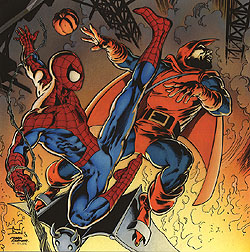
If you make it through that, we get to “Exiled.” This is basically three separate stories, and I think only linked together because Marvel had gotten so used to these multi-part crossovers. The first installment involves The Black Cat, and the fourth involves the Vulture. Sandwiched between the two is a short story arc that depicts how Ben Reilly came to meet his friend, the geneticist Seward Trainer.

Things get much crazier with the two-part “Time Bomb” story. Think Spider-Man meets The Manchurian Candidate. Specifically, a post-hypnotic suggestion planted by the Jackal (and set off by his cryptic last words before his death in “Maximum Clonage”) sends Peter Parker into an uncontrollable rage and Mary Jane has to run for her life. The New Warriors show up once again to halt Spider-Man’s unwilling pursuit, and he basically makes them all look like amateurs. But eventually he manages to resist the programming through pure will. The story was just kind of depressing. It seemed to be yet another indicator that Peter Parker was really, truly a clone…which nobody particularly wanted to be true.

Finally, we have the three-part “The Greatest Responsibility.” In this collection, parts two and three are separated by a completely random team-up between Spider-Man and the X-Men that’s really long and totally irrelevant. Enough with the filler already, sheesh! The story introduced a new Doctor Octopus, a young woman named Carolyn Trainer (Seward’s daughter). She didn’t have the charm of the original, but oh well…the mystical ninjas will be along to resurrect him eventually. Both Spider-Men get involved and the bond between them carries this story along. Meanwhile, Mary Jane is farther along in her pregnancy and the couple’s upcoming parenthood becomes impossible to ignore. By the end, Parker has given up his superhero duties, handing it over to Ben.

A brand new Spider-Man? Did anyone really want this? I know I’ve said that a few times, but I really feel like this whole nonsense was just pushed on the fans because Marvel had this stupid notion that Parker was too old, too married, too boring to appeal to readers. The narration in the third part of “The Greatest Responsibility” is insufferable, transparently forcing the agenda of the writers on to the readers. But that’s the way it was at the time, and some more silly stunts were on the way.

As of this writing, I can’t find a release date for the sixth volume of this Clone Saga collection, meaning that this series is on hold indefinitely. But fear not, I have a new fifteen-part one that’s coming up and should keep this blog at lest semi-busy all through the summer, if not until Oscar season.

Thursday, May 26, 2011

Classic Films that Suck to Actually Watch


When people evaluate movies, they usually have at least one of two things in mind when deciding if they like it or not.

1. The artistic quality: Does it display impressive craftsmanship? Does it show innovation in terms of its writing, editing or art direction? Does the story offer a new or interesting perspective on its subject matter?

2. Entertainment Value: Does it hold your attention? Does viewing it provide a fun time in the theater? Is it emotionally rewarding to watch?

The best movies will satisfy both of these requirements. However, there are times when they come in conflict with each other, and this is a topic I don't think is discussed enough (in a mature fashion, at least) in movie-buff land.

It's pretty common to find films that outright fail Question 1 while passing Question 2 with flying colors. We all have "bad" movies that we have more fun watching than "good" ones. Plan 9 From Outer Space, Commando, Troll 2, The Room, etc. These are movies where the viewing experience is so fun, that it basically transcends the need for genuine artistic merit and becomes a different, and I think equally legitimate, kind of "good."

But what about the reverse scenario? A movie that has undeniable artistic merit but is not so fun to sit through? This comes up every so often and it can be super frustrating. Can a movie really be "good" if it bores you? Tough question. Let's look a few examples. (Disclaimer: Examples of this will obviously vary from person to person. This is all opinion and I'm sure these classic films will continue to be admired long after I hit "publish post" on the blogger page. So chill.)

Nosferatu (1922)

Why Classic? Famous piece of silent cinema. Max Schreck's amazing performance and the impressive makeup involved. Adapted Bram Stoker's Dracula before the American version with Bela Lugosi. A few visual effects sequences that defied the technological limitations of its era and still leave scholars in awe.

The Problem: Large portions of it are just....uninteresting. The editing in the third act is borderline incoherent and it's damn confusing trying to figure out where everyone is...and not that good David Lynch sort of confusing, either. You can't blame it on being a silent film either, I've seen enough to know that some have aged much better than others. Films like The Cabinet of Dr. Caligari, The Love Light, The Lodger, Metropolis, and pretty much anything from Charlie Chaplin or Buster Keaton demonstrate that the best ones are still gripping. This one comes off like it just needed some more work, but I'm definitely in the minority and this is frequently cited as a silent classic and one of the best vampire films ever. Actually, that last part might be true. Vampires have a pretty bad track record throughout film history. Thankfully, Count Orlock doesn't sparkle.


2001: A Space Odyssey (1968)

Why Classic? Influenced a generation of science-fiction storytellers. Phenomenal use of classical music. Brilliant use of symbolism. Stanley Kubrick's mad skills and all-around superb cinematography. HAL the evil computer - "I can't do that, Dave." Stoners like the part where the astronaut goes through the wormhole.

The Problem: I've read so much about why this movie is a classic and perhaps one of the greatest ever made...so why can't I stay awake any time I try to watch it? The part at the beginning with the apes is great. And when HAL turns on the crew, that scene and the rest of the movie afterwards is great. But this is a long film and just about nothing happens between those scenes I mentioned. People float in space, you see the spaceship crusing along, maybe someone will use a computer for a bit, people float in space, etc. And despite my best efforts, eventually my eyelids start getting pushed down. Are great movies supposed to put viewers to sleep? I'm not exactly some ADD-riddled teen who needs explosions every five minutes, either. I have a Bachelor's Degree in Cinema Studies and I've sat through some seriously slow-paced inpenetrable movies that still managed to keep my attention. But the acclaim for this particular movie is so damn omnipresent that it must just be my problem.

Dawn of the Dead (1978)

Why Classic? Solidified zombie tropes that George Romero himself invented in Night of the Living Dead (the real masterpiece, in my view). Placing zombies inside a mall to comment on widespread American superficiality was the kind of inspired satire uncommon to horror films. Tom Savini's excellent makeup and gore effects.

The Problem: The same problem with the other two...most of Dawn of the Dead is friggin boring! I remember enjoying it for the first half-hour or so, but once the main cast gets secured inside the mall with zombies kept safely at bay, things go downhill. They avail themselves of the mall's many material comforts, and obviously this is all part of Romero's social commentary. Unfortunately, neither the dialogue or the performers speaking it are up to the task. We're left with what feels like an eternity of characters just hanging out until the zombies inevitably become a threat again. As the 140 minute film drags on and on, you start to understand why so few horror movies cross the 2-hour mark. Once a psychotic biker gang comes into the mall, the movie roars back to life and it's almost enough to save things. Almost.

I watched it with three other friends and we all were seriously disappointed. We are definitely in the minority. People love this and frequently cite it as one of the best horror movies of all time, if not THE best. What always goes through my head is, "Sure it's hugely influential. But when's the last time you actually tried to watch the damn thing?" Does having a brilliant concept get you a free pass for a lack of entertainment value? Over time, the non-stop praise for this bore turned my disappointment into outright anger and resentment for the original Dawn of the Dead. It drove me to commit a cardinal movie-buff sin - my DVD collection features Romero's Night of the Living Dead as well as Day of the Dead, the third one in the series. Sandwiched between them...is Zack Synder's remake of Dawn of the Dead. Yeah, that's right. The remake can't claim any influence, but at least it was a zombie movie with some actual friggin' suspense.

I could probably come up with more, but you get the idea. If anyone has any thoughts on these situations or has other movies in mind for the "classics that suck to watch" distinction, feel free to share!