Disclaimer
If you read this blog for awards season analysis and other movie commentary (if you read it at all), this post might come as something of a surprise. When I first started writing here eleven years ago, I imagined that there would be a fair amount of political entries. It didn't take me very long to learn how exhausting that really is. Politics on the internet is a constant parade of various outrages and overblown non-news stories and I'm not sure how anyone with any sort of real-life schedule is supposed to "react" to all of them. I put that stuff aside to keep the focus on what I thought I did pretty well, stuff like Oscar predictions and looking back on childhood shows with an adult's point of view. Sometimes, though, I just have to get something out and that's basically what this is. Not a rant exactly, more like a structured essay that gives me a chance to express some feelings I've been stewing about for a few years now. If that's not your thing, I understand. Oh, just one more note - I've been working on this for so long that the bulk of it was actually written before Trump was elected. I'm going to try and keep him out of it, especially since he's a particularly vile symptom rather than the disease. But with him around, basically take everything here and multiply it by ten.
Preface
I've seen quite a few articles about how anxiety and depression is rising in America, particularly with young people. As I read them, I often slowly nod my head in agreement since the observations of the journalist line up with my own observations in my personal and professional life. I honestly feel like the majority of people I know struggle with anxiety (and possibly depression, although that's harder to spot). Medical science says that people are born with a certain level of susceptibility to these feelings and that leads to a sense of inevitability that compresses the conversation into variations on "What can these individuals do to help themselves?" This is all well and good, but if we really are seeing more anxiety and depression than we used to, I think we have to talk about the bigger picture as well.
The "big picture" is usually invoked as a way to cheer someone up, as in "You had a bad day today but in the big picture, your life is going pretty well!" That's fine but I don't hear people talk about how if the picture gets big enough, it might make you feel worse. I don't think you can talk about these prominent mental conditions in America without talking about life in America. Quality of life in America to be more specific, which is often compromised by our country's obsession with productivity and profit. It's true that some people are more prone to depression or anxiety than others. That doesn't mean we always need to be making it so goddamn easy to feel that. Right now, America is facilitating anxiety and depression, keeping it going the same way my phone charger didn't create my phone but keeps it at 100% power. We've got to do better.
Obviously, there are a lot of directions we can go with this - poverty, discrimination, police brutality, war, environmental blight, our longtime tradition of constant mass shootings, border patrols re-enacting scenes from Sophie's Choice with migrant families at the Mexican border, etc. If I was younger, I probably would have tried to hit all of them with an essay like this. These days, I think a "jack of all trades" approach to advocacy leads to inevitable instances of sounding presumptuous and/or uninformed. That said, while all of these issues don't impact everyone directly, they do contribute to an overall portrait of despair that can do more damage to someone's mental state that we usually give credit for. I'm narrowing my focus to a few loosely connected issues that relate to a person's relationship with their career as well as obstacles in the way of getting the necessary help, which are topics I have plenty of personal experience with. Those who have had conversations with me in real life will probably find that much of this is familiar, but I never get the chance to tie it all together like this. Four paragraphs is a long enough introduction, I'd say. Let's start.
The Broken Bargain
Since the economy went south, it's become very common to hear things like "you should be happy to even have a job right now with the economy the way it is." Yet when you consider how so many people in America are treated by their employers, gratitude is hardly the first emotion that comes to mind.
People talk about full-time work as if there is no downside to it. But there is. There always has been. Giving up 40 hours of your life every week for years is a huge sacrifice. That's time that could be spent with your family, out in a park, doing something creative or just quiet reflection. Time is not a renewable resource. When it's gone, we're gone. The whole idea behind it is that you get paid enough to sustain yourself and enjoy the time that you're not at work. The exchange of time for money - this is a bargain that is supposed to sustain contemporary society, but it's broken.
We've lost respect for the time that people give up when they spend countless hours in an office. America's $7.25/hour minimum wage is an insult, not even close to anything resembling proper compensation for giving up that time. To make up for this, many people have taken on additional jobs, giving up even more time in exchange for earning just enough to stave off hunger for another week. I don't have enough negative adjectives to describe this situation - unjust, heinous, despicable, shameful, horrifying, take your pick. Politicians like to say "Nobody who works full-time should live in poverty." I'd prefer to say that nobody at all should live in poverty, but yes it's particularly insulting when you're also working your ass off. But there's more to quality of life than just avoiding poverty. People who are giving up that much time should make enough to pay their bills, feed their families, and have enough left over for something special every so often. A trip to a restaurant, a family vacation, an opportunity to enjoy life. Because if you can't do that, what's the point of working? What's the point of even being alive?
Sometimes you hear people say that the minimum wage should be kept low in order to encourage fast-food workers and other people at "dead-end" jobs to strive for something better. But those jobs will always exist because there's always a need for them, so someone will have to do them. Not everyone has the resume to move on to something more respectable (and fewer will in the future since higher education has gotten so laughably unaffordable), so is it really right to sentence these people to lives full of struggle just for working jobs that are always necessary and yet seen by the public as disreputable? Fast food places are everywhere so there's obviously high demand for them. Why have we collectively decided that the people who serve the food deserve to be paid so poorly?
This issue is at the heart of the "income inequality" concept, which I have to admit is a term I'm not a big fan of. Not because I don't feel it's a problem, it obviously is, but because I think the wording is ripe for distortion. It's too easy for pundits to get overly defensive and sound the alarm about the plot to bring everyone's wages to the same level. We don't actually need a society where everyone gets paid the same exact amount of money. We just need to make sure nobody gets screwed. The bottom of the ladder, so to speak, should still yield enough money to live a decent life. Once again, I'm not saying everyone needs to be able to get sports cars and mansions and luxuries of that nature, but they should be able to live comfortably with opportunities to create those memories that make life worthwhile.
Real Family Values
The fact that the phrase "family values" is almost exclusively used in American politics as a warped justification for various types of bigotry or moral censorship is a sad commentary on our national conversation in general. We shouldn't have to cringe when our leaders use that phrase, because actual family values are important and not given much respect in this country's work culture. The most glaringly obvious example is that new parents are still not guaranteed any paid time off to care for their newborn children. We love to heap praise on mothers and fathers when their respective parent-themed holidays roll around, but when it counts, it's just talk.
In the interest of honesty, I should note that this is personal. When I became a father, I was shocked and deeply discouraged by how my employer behaved. They couldn't legally deny me time off, but they tried everything to make the process as inconvenient and unhelpful as possible. I'm not going to get into all the details here, I've told the story many many times. I don't mind telling it since it has that rare 100% success rate of getting a sympathetic response, which I've never been accustomed to when talking about my problems. The unanimous solidarity people express when hearing that story, regardless of age, background or politics, makes me wonder why our laws are so behind on this issue because clearly a decent chunk of our people are not. But make no mistake, what America offers is abysmal compared to the rest of the world. Even Iran, a country we always paint as full of backwards-ass fundamentalist nutbars, will give you 12 weeks of paid family leave.
The Family and Medical Leave Act (FMLA) was passed about 25 years ago and provides 12 weeks of unpaid leave to new parents and guarantees that you will have a job when you return. I got to become very familiar with this law during my own experiences, particularly its limitations. Various exceptions within the legislation mean that a huge chunk of the workforce (sometimes estimated as high as 50 percent) is not eligible for anything. But beyond that, unpaid leave creates a very different dynamic than paid leave. Sure you can keep your job, but you are being punished for taking the time off by having your income cut off. Have you ever bought baby formula? How about diapers? It's expensive. Not the best time to be short on money. It's supposed to be an incentive to have children, but instead it becomes an incentive to go back to work earlier. That doesn't strike me as an accident.
I've seen a few articles reporting that a significant percentage of people my age and younger don't intend to have kids. If they just don't want to, that's all well and good. Being a parent is a ton of work that shouldn't be forced on anyone who doesn't truly want children. However, the most commonly cited reason is not a lack of desire but financial insecurity. They're afraid that they can't afford it or that it will compromise their careers and they're totally justified in those fears. I've seen a lot of tone deaf articles whining about not enough babies being produced so what's holding us back from doing something significant about it? Well, I read one article that speculated that opposition to paid family leave is rooted in opposition to women working at all. While I'm sure that's the motivation for a decent amount of people in Congress, I think most of it is just cold hard capitalism. Too many employers are worried that paid family leave could cause them to miss out on some potential money. As far as America is concerned, there is no greater good that's good enough to risk such a horrible fate.
So that's the sad state we find ourselves in. Productivity and profit is more important than the continuation of society itself. Bringing the next generation into the world, already challenging on its own, is turned into a major financial risk for thousands of families out there. Speaking from experience, I can tell you this sort of thing is very bad for your mental health. It poisoned my mood for the few months I spent at my job afterwards and even now, it still haunts me. I think of these lyrics from Eminem's "Like Toy Soldiers" - Even though the battle was won/I feel like we lost it/Spent so much energy on it/Honestly, now I'm exhausted/But I'm so caught up in it I almost feel like I'm the one who caused it. But I didn't. I was just trying to be a good father until my job got in the way. We won't shut up about "family values" and yet we don't actually value families. The irony is very cruel indeed.
The One Great Sight
"Wildness is a necessity. I am losing previous days. I am degenerating into a machine for making money. I am learning nothing in this trivial world of men. I must get out into the mountains and hear the news."
-John Muir
Quick note: We don't have paid sick leave either. This one really boggles the mind. Do you want a waiter serving your food at a restaurant to have the flu? Didn't think so. This is a much easier sell than family leave and yet for some ungodly reason, we still don't have it.
Vacation time...now that's a hard sell. Most people agree that taking time off to get healthy or to care for a newborn child are still practical choices. But taking time off to relax? To see a beautiful place? To enjoy uninterrupted time with your family? This isn't seen by employers or politicians as smart use of time that could be spent making other people money. This is a distinctly American eccentricity. We've been called "The No Vacation Nation" by the Center of Economic and Policy Research. There are benevolent employers out there who grant paid vacation time to their employees, but the fact that you're at the mercy of your employer when it comes to this issue is what bothers me.
Our obnoxious cultural disdain for enjoying life in non work-related ways can be summed up by a car commercial from a while back. I'm not gonna give a link to it because they can go fuck themselves. It showed an over-privileged white douchebag walking around his house insulting the French for taking six weeks of vacation each year and praising America for using our limited time on the planet making great cars instead. Yeah, I'm sure the French are sulking around Europe during their long vacations because they don't make cars as cool as ours. However, that wasn't the worst part of this commercial. The most insidious part was at the end, when the pitchman said that "only taking two weeks off in August" was worth it for a nice car. This presents two weeks of vacation as the default in America, but it isn't. The default is nothing. A large portion of people working in this country have no time off whatsoever.
Making the whole situation even stranger is that despite our reluctance to guarantee vacation time to our citizens, we still have the federal government taking care of millions of acres of protected land - our National Parks. They're meant to preserve beautiful places for our enjoyment, but these days they're used more by foreign tourists. You know what I'm talking about if you've been to one - most people there are from Germany or Canada or China or Japan. In fact, I've even seen Chinese-speaking tourists at Walden Pond. You've got to have a lot of time off to make the trip from China to Massachusetts...and be really into Thoreau. The parks are one of the greatest things America ever did. Most of the world has followed suit, but why are we not prouder that we did it first? Why do we take more pride in how efficiently we can destroy other nations rather than the beauty of where we live? I actually feel patriotic when I'm in a national park. Yeah, me. The lack of access to television and the internet probably helps with that.
There was a time when our leaders found them patriotic as well. President Theodore Roosevelt, who did more for this cause than anyone else to hold the position, once described the Grand Canyon as "the one great sight that every American should see." But good luck making good on this if you don't already live near it and don't have any vacation time. Trying to do it in a weekend would be more stressful than your job. I saw a particularly dense article (this is becoming a running theme) theorizing why more minorities in America don't go to the parks. The writer wondered if it was because there was no wi-fi. Someone actually got paid to suggest that but I'll tell you the truth for free. They don't go for the same reason a sizable portion of white people don't go - not enough money, not enough time off.
I understand that parks aren't necessarily where everyone wants to go, but whatever you enjoy doing that isn't strictly profitable...you should have time for that without having to risk your financial security. It's not unreasonable to ask for that, no matter what a brain dead commercial might tell you.
Good Help is Hard to Find
"I tell ya, I get no respect! I get no respect at all!"
-Rodney Dangerfield
If you've read everything up to this point and are on board...thanks! But this is the part you're not going to like. Still, it needs to be said. More often than not, the way people react to depression and the people who have it is the opposite of help.
This is the sad, awful truth about living with depression - being alive is hard. It doesn't even have to be a bad day. The simple state of being alive is hard. When you consider the deaths of beloved, successful people like Robin Williams, Chris Cornell or Anthony Bourdain, people who weren't dealing with any of the stuff I've been going on about, you understand just how ruthless depression is. I've got kids running around, I have to drag myself out of bed every day but it's hard when your energy level is so often depleted. Sometimes a simple thing like bending over to pick something up becomes tiring. Some days I panic if people ask too many questions because of the effort required to answer them all. Tasks that most people would complete without a second thought often require me to spend a while shoring up the energy and willpower. People just don't want to hear this. They hate the idea of someone having an "excuse" not to be overly productive or hardworking. It's simply not acceptable. So they tend to react to people who are mentally ill with passive-aggressive glurge or sometimes outright hostility. Want some examples?
"Stop being so selfish!"
You know what somebody who is struggling is going to think after you say this? Here's a hint, it's not "Wow, he's right!" More like "Well, I won't be opening up about my struggles to that person again." If that's what you wanted (and something tells me it just might be), then mission accomplished. Just don't start going on about how "I had no idea anything was wrong."
One of the worst parts of depression or any mental illness is the shame, that awful guilt about being a burden to everyone around you. Unfortunately, a lot of people feel like the proper thing to do is to pile on even more shame. They think it's about your well-being, but it's not. It's about what you can give them. They'll call you selfish for taking something away from them, never mind the hurt of what they take from you.
"You're not entitled to a living wage/sick time/vacation time/family leave/anything that might give you the impression that you're a worthwhile human being!"
Ah, the E-word. Where would assholes be without it? The thing is...it cuts both ways. You're not entitled to borderline free labor from employees who express nothing but happiness about getting screwed over! See how easy that is?
"Smiling is the best anti-depressant!"
Wait, isn't this a quote from The Stepford Wives? No? This is a thing people actually say? Wow. Well, it's inaccurate in addition to being incredibly stupid.
Otherwise well-meaning people might interpret this stuff as "tough love," but frankly nothing about it feels loving. We're all getting called out constantly by the culture around us and to be treated like this by our loved ones does not help. People who are a little more savvy will advise you to get professional help. They're right but it's not always as simple as it sounds.
It's become routine for journalists to provide the number for the suicide hotline at some point in their coverage. It's a thoughtful idea but it's not a magic bullet. The hotline's go-to move is to send you to the ER, because that's the surest bet that you'll remain alive once they're off the phone. But the suicide hotline doesn't pay that ER bill. Not only that, visits to a therapist add up. Medication adds up.
And so we've gotten to the most literal example of mental health being compromised by the whims of business and commerce. As long as we treat mental health care (or any health care, really) like a big screen TV or some other luxury, this won't stop. You can keep pushing people into darker corners, but you can't make them happy about it. We're all going to become very familiar with that reality. When the next shooting comes around (should be any day now, it's been a few weeks) and people start reprising their empty declarations about "mental health," maybe think about what it would actually take to address that instead of just using it to fill airtime.
Conclusion
This rise in anxiety and depression that baffles so many otherwise intelligent people is inextricably linked to a society that doesn't see its citizens as actual people, but economic units to be plugged at their lowest possible price into a ruthless market that provides the greatest possible returns on investment to the wealthy few...all with no thought to the resulting human resentment and misery.
It may be tempting to think that it's not worth even trying. If depression is so bad, is it even possible to do anything? The answer is yes. Some people are lucky enough to have their illnesses go into remission for a long time, sometimes even years. Many other people will always be dealing with them at least a little bit. Regardless, moments of happiness and joy are still possible. It can be anything from standing on top of Glacier Point to hearing "What is Love" start playing over the intercom while you're grocery shopping (I like that, anyway). More than anything else, hope for more moments like these is what keeps people alive. So maybe don't make it so difficult to experience them?
It's just a thought.
Showing posts with label Me. Show all posts
Saturday, June 9, 2018
Saturday, June 6, 2015
The 24 Hour Setlist: Introduction
For my first ever participation in the Extra Life charity event for children's hospitals, I'll be singing a 24 hour marathon on Rock Band 3 from November 7th to 8th!
Here is my page on Extra Life, which has more information on that initiative. The marathon will be broadcast live on my Twitch channel.
So why Rock Band? I don’t say this lightly, and this is not hypberbole, Rock Band changed my life. We knew right away it was a cooperative game experience like none other as we selected our roles in the band. My brother Alex had a knack for the Guitar Hero series and continued that role on Rock Band. Our lifelong friend Mark took on the drums. As for me, there was nobody on the mic so I basically found myself there my default. We never did find ourselves a permanent bassist, although a few great candidates came and went over the years.
As for the mic, I loved it. My voice was the controller. I used to be nervous about singing in front of people, but I found much more confidence as I went from failing out on “Reptilia” to being able to get 100% on insane Iron Maiden songs on the hardest difficulty even while I had bronchitis. Rock Band vocals were the only video game I had where I was the most skilled person I knew (not the best singer in general, but the best at singing for the game, I don’t want to sound too over the top). At the peak of my powers, which was around the time that Rock Band 3 came out, I had gold-starred (very high scores on expert difficulty) hundreds upon hundreds of songs in RB’s ever-growing library and was one of the top 100 singers in the world as ranked by the online leaderboards.
Eventually, the genre of music games fell on hard times. Activision’s competing Guitar Hero games, which had sloppily adopted the full band format as well, flooded the marketplace with half-baked spin-offs. As for Rock Band, they were a little too eager to silence idiots who would insult the games since “it’s not like playing a real instrument.” You don’t say? All this time I thought guitars only had five notes, who knew? Not sure how that applies to singing, anyhow. Your voice is your voice. Anyway, Rock Band wanted to prove that it could actually teach people real music, so for Rock Band 3 Harmonix invested considerable expense into a “pro guitar” mode that would enable people to play along to the real notes a controller modeled after an actual guitar. There was also the addition of the keyboard that had its own “pro” mode. It was impressive ambition, but in the end Harmonix greatly overestimated the demand among players for “real instruments” and Rock Band 3 sold far less than the concurrent Guitar Hero game that had no such ambitions.
The company added more songs to the game’s huge library for a couple of years afterward, but the genre was fading away. Nobody I knew wanted to play anymore. Finally, they announced that the DLC songs would also be coming to an end. The world may have decided that “the era was over,” but I really wasn’t ready for it to go. It had brought too much joy into my life. The news of Rock Band 4's upcoming release was hugely uplifting and I decided that this year's Extra Life event would be one epic way to say goodbye to Rock Band 3.
We're still months away from the big day, but I'll be practicing on the Twitch Channel hopefully once a week (Friday nights) and later this summer, I'll post the setlist in all it's 335 song glory! Please look forward to it!
Sunday, February 8, 2015
The Birth of A Nation - 100 Years Later
In The Harlem Hellfighters, a graphic novel by Max Brooks, a World War I regiment comprised of black soldiers gets unexpected respect in Europe for their bravery on the battlefield. In the midst of this, one character flashes back to his pre-war life as a janitor in a movie theater. In 1915, just a few years before the war began, he had watched a huge white audience embrace a film that would become notorious for its racist content - D.W. Griffith's The Birth of A Nation. Despite putting their lives on the line on behalf of America, these soldiers knew what was waiting for them when they returned home.
When I started my life as a film buff back in high school, I sought out as many classics as I could. Most of us start with the ones that get name-dropped the most when it comes to the history of film - Citizen Kane, Casablanca, The Godfather, Seven Samurai, etc. Another name I had heard quite often was The Birth of a Nation, although I avoided it because of both its massive length (nearly 3.5 hours) and its reputation as a horribly racist movie. Did I really want to spend that much time on something so pernicious? Not really. During my second year at NYU, the choice was made for me.
The silent film course was one of my favorites. I discovered all sorts of brilliant films from that era. We even had a professional musician come in and play the piano accompaniment to the experimental Russian classic Man With A Movie Camera. It left me with a love of silent cinema that continues to this day...and it's a strong love indeed if it could survive a screening of The Birth of A Nation. Most of the students in the class were also seeing it for the first time - perhaps they had avoided it for the same reasons. Movie classes at NYU typically ran 4 hours in order to accommodate a movie screening and a lengthy discussion afterwards, but Birth took up almost the entire class just to watch. The experience was far more memorable than if I had simply watched it alone.
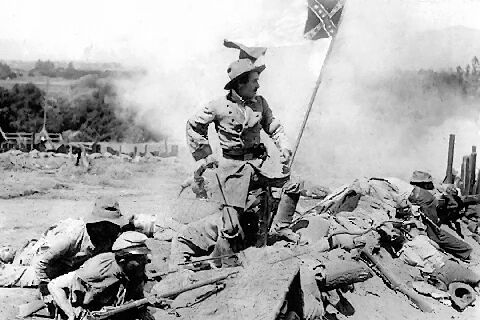
When you go into the movie with knowledge of its reputation, you sit there waiting for the bad stuff to start. It doesn't come right away. At first, it's a Civil War re-enactment played straight with most of the racism relegated to subtext. For example, the movie never acknowledges the Southern attack on Fort Sumter that began the war and treats the conflict as this mysterious force that just came out of nowhere and disrupted everyone's lives. There is also one scene I remember where black onlookers cheered for a Southern victory (Hooray! We're still slaves!). Strangely enough, Abraham Lincoln is treated with a lot of reverence and the scene of his assassination is probably the most impressive moment in the film. Unfortunately, it's also the point at which the movie conjures up this bizarre alternate history of the Reconstruction era where blacks took over the legislature and began to punish the defeated South. A lot of problems here, the biggest being that the movie doesn't believe this history is "alternate."
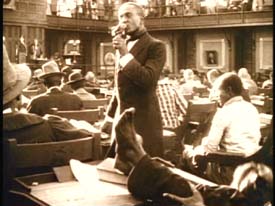
The class had been dead silent through the movie up until this point. I remember when the first gasps came. It was a scene during the election where white people were intimidated into not voting while black officials stuffed the ballot box (A century later, conservatives are still afraid of this). The new black legislators recline in their chairs and put their feet up while guzzling liquor and eating fried chicken. I am not kidding. As viewers, we're meant to be appalled at the lack of respect these men had for a system of government that had endorsed their slavery until just recently. The leader of this radical movement is a half-white/half-black man named Lynch. Not kidding about that either.
On one fateful day, the white hero is depressed about all the black people and sits alone on a tree stump. Suddenly, he sees two children pretending to be ghosts by wearing a white sheet. You can practically see the light bulb appear over his head. Sure enough, the Ku Klux Klan is born and The Birth of a Nation treats them like the goddamn Fellowship of the Ring. They ride across the land in epic scenery shots that were far beyond anything audiences had seen at the time. In the climactic sequence, distressed white people hide inside a shack while hordes of angry black men tear down the walls, a scene that would later become a staple in zombie movies. Contrary to popular belief, D.W. Griffith did not "invent" parallel editing with this sequence, but he did demonstrate how effective it could be in regard to building tension.
Speaking of tension, it hit a fever pitch during my classroom screening during one infamous scene. A young white girl is chased through the woods by a black man and when she gets cornered at the edge of a cliff, jumps to her death rather than risk miscegenation. The obnoxious intertitles tell us not to mourn because she chose death over being defiled. The man is hunted down by the KKK and put on trial. Cut to a horrifying image of a Klan mob restraining him with burning crosses in the background while the screen has a hellish red tint. A brief intertitle pops up. "Guilty." At this point, the class abruptly broke out into laughter. As if there was any doubt how that scene would end. The sheer cognitive dissonance of this sinister image of persecution being presented as an example of righteous justice was too much. The man is killed and the Klan drops his dead body at the front door of the statehouse cause you know, that's just what civilized people do.
Were we assholes for laughing? I don't know. But we had been sitting through this nonsense for two and a half hours and we needed some kind of release. The class continued to laugh at the rest of the film's racist moments because what else can you do at that point? The final scene, of a translucent (and obviously white) Jesus giving an approving smile to everything that has just happened, was the jaw-dropping cherry on top of this shit sundae. We had all expected something pretty bad, but wow. Needless to say, the conversations as we left the classroom were memorable.
The movie was controversial from the start but still a sensation with audiences. President Woodrow Wilson even screened it in the White House. It was used as a recruiting tool for the KKK and is said to have been the inspiration for many spontaneous acts of violence against black citizens. Makes Natural Born Killers look pretty harmless by comparison. D.W. Griffith was bewildered by the accusations of racism (I know, I know) and tried to make amends with another three hour epic, Intolerance, about the struggles of oppressed people through the ages. The Academy Awards wouldn't exist for another 14 years and I'm sure current members are grateful for that, given that an honorary Oscar was given to Al Jolson for his blackface routine in The Jazz Singer during that first round of awards in 1929. Ten years later, the Best Picture Oscar went to Gone With The Wind, a less outwardly offensive film than Birth of a Nation but still infused with that victimized plantation mentality.
Film critics still tie themselves in knots trying to reconcile their feelings about this movie. Never has the difference between a "influential" film and a "good" film been so glaringly apparent. Griffith's innovative techniques and the overall grandiosity of the movie ensured it a permanent place in American film history, a curse on our otherwise impressive contributions to cinema that we brought upon ourselves. As repulsive as it is, I still think anyone seriously interested in film, history and the intersection of the two should watch it. Most of the time, movies about America's sordid racial past depict a conflict between good white people and bad white people in an effort to make us feel better. By showing us the kind of mentality that was mainstream 100 years ago, this movie is actually far more educational.
When I started my life as a film buff back in high school, I sought out as many classics as I could. Most of us start with the ones that get name-dropped the most when it comes to the history of film - Citizen Kane, Casablanca, The Godfather, Seven Samurai, etc. Another name I had heard quite often was The Birth of a Nation, although I avoided it because of both its massive length (nearly 3.5 hours) and its reputation as a horribly racist movie. Did I really want to spend that much time on something so pernicious? Not really. During my second year at NYU, the choice was made for me.
The silent film course was one of my favorites. I discovered all sorts of brilliant films from that era. We even had a professional musician come in and play the piano accompaniment to the experimental Russian classic Man With A Movie Camera. It left me with a love of silent cinema that continues to this day...and it's a strong love indeed if it could survive a screening of The Birth of A Nation. Most of the students in the class were also seeing it for the first time - perhaps they had avoided it for the same reasons. Movie classes at NYU typically ran 4 hours in order to accommodate a movie screening and a lengthy discussion afterwards, but Birth took up almost the entire class just to watch. The experience was far more memorable than if I had simply watched it alone.
When you go into the movie with knowledge of its reputation, you sit there waiting for the bad stuff to start. It doesn't come right away. At first, it's a Civil War re-enactment played straight with most of the racism relegated to subtext. For example, the movie never acknowledges the Southern attack on Fort Sumter that began the war and treats the conflict as this mysterious force that just came out of nowhere and disrupted everyone's lives. There is also one scene I remember where black onlookers cheered for a Southern victory (Hooray! We're still slaves!). Strangely enough, Abraham Lincoln is treated with a lot of reverence and the scene of his assassination is probably the most impressive moment in the film. Unfortunately, it's also the point at which the movie conjures up this bizarre alternate history of the Reconstruction era where blacks took over the legislature and began to punish the defeated South. A lot of problems here, the biggest being that the movie doesn't believe this history is "alternate."
The class had been dead silent through the movie up until this point. I remember when the first gasps came. It was a scene during the election where white people were intimidated into not voting while black officials stuffed the ballot box (A century later, conservatives are still afraid of this). The new black legislators recline in their chairs and put their feet up while guzzling liquor and eating fried chicken. I am not kidding. As viewers, we're meant to be appalled at the lack of respect these men had for a system of government that had endorsed their slavery until just recently. The leader of this radical movement is a half-white/half-black man named Lynch. Not kidding about that either.
On one fateful day, the white hero is depressed about all the black people and sits alone on a tree stump. Suddenly, he sees two children pretending to be ghosts by wearing a white sheet. You can practically see the light bulb appear over his head. Sure enough, the Ku Klux Klan is born and The Birth of a Nation treats them like the goddamn Fellowship of the Ring. They ride across the land in epic scenery shots that were far beyond anything audiences had seen at the time. In the climactic sequence, distressed white people hide inside a shack while hordes of angry black men tear down the walls, a scene that would later become a staple in zombie movies. Contrary to popular belief, D.W. Griffith did not "invent" parallel editing with this sequence, but he did demonstrate how effective it could be in regard to building tension.
Speaking of tension, it hit a fever pitch during my classroom screening during one infamous scene. A young white girl is chased through the woods by a black man and when she gets cornered at the edge of a cliff, jumps to her death rather than risk miscegenation. The obnoxious intertitles tell us not to mourn because she chose death over being defiled. The man is hunted down by the KKK and put on trial. Cut to a horrifying image of a Klan mob restraining him with burning crosses in the background while the screen has a hellish red tint. A brief intertitle pops up. "Guilty." At this point, the class abruptly broke out into laughter. As if there was any doubt how that scene would end. The sheer cognitive dissonance of this sinister image of persecution being presented as an example of righteous justice was too much. The man is killed and the Klan drops his dead body at the front door of the statehouse cause you know, that's just what civilized people do.
Were we assholes for laughing? I don't know. But we had been sitting through this nonsense for two and a half hours and we needed some kind of release. The class continued to laugh at the rest of the film's racist moments because what else can you do at that point? The final scene, of a translucent (and obviously white) Jesus giving an approving smile to everything that has just happened, was the jaw-dropping cherry on top of this shit sundae. We had all expected something pretty bad, but wow. Needless to say, the conversations as we left the classroom were memorable.
The movie was controversial from the start but still a sensation with audiences. President Woodrow Wilson even screened it in the White House. It was used as a recruiting tool for the KKK and is said to have been the inspiration for many spontaneous acts of violence against black citizens. Makes Natural Born Killers look pretty harmless by comparison. D.W. Griffith was bewildered by the accusations of racism (I know, I know) and tried to make amends with another three hour epic, Intolerance, about the struggles of oppressed people through the ages. The Academy Awards wouldn't exist for another 14 years and I'm sure current members are grateful for that, given that an honorary Oscar was given to Al Jolson for his blackface routine in The Jazz Singer during that first round of awards in 1929. Ten years later, the Best Picture Oscar went to Gone With The Wind, a less outwardly offensive film than Birth of a Nation but still infused with that victimized plantation mentality.
Film critics still tie themselves in knots trying to reconcile their feelings about this movie. Never has the difference between a "influential" film and a "good" film been so glaringly apparent. Griffith's innovative techniques and the overall grandiosity of the movie ensured it a permanent place in American film history, a curse on our otherwise impressive contributions to cinema that we brought upon ourselves. As repulsive as it is, I still think anyone seriously interested in film, history and the intersection of the two should watch it. Most of the time, movies about America's sordid racial past depict a conflict between good white people and bad white people in an effort to make us feel better. By showing us the kind of mentality that was mainstream 100 years ago, this movie is actually far more educational.
Tuesday, August 12, 2014
Robin Williams and Depression
Depression is one of those subjects people prefer to keep under the rug. It’s intimidating subject matter, both for those with or without experience with it. But every so often, something happens that makes everyone take notice. By now, you’re surely aware of the death of Robin Williams. For people my age, it’s nigh impossible to imagine our childhood without him. More upsetting still is that the death appears to have been a suicide. If an Oscar-winning actor and comedian who made a fortune off his talent and was beloved all over the world can still be taken down by depression, things don’t look so good for the rest of us.
And yes, I am included in the “us” category. People who know my work probably aren’t surprised to find out I have depression. It tends to show up a lot in my body of work. Eddie Humphrey is the most obvious one, but Beth, Drew Stephenson, Cade Mistral and Stoic all dealt with it. Stoic reaching a breaking point and sealing himself inside a cave for centuries to escape all the hurt from the outside world was quite a personal sequence. Everyone’s experience with it is different – when it’s bad for me, I get in these moods where everything pisses me off and I just want to be left alone…except not really, because then it’s just me and all the thoughts about how I suck, I can’t do anything right and I’ll never have any real kind of success.
I’ve dealt with depression for almost 20 years. For a lot of those years, people pointed me towards anti-depressants as a possible source of relief. I resisted for a long time. I never looked down on other people who used them, that’s not the kind of thing I do and I believe people need to make their own choices based on their own circumstances, but for me it was a no-sell. Why? I had all sorts of reasons.
The corporate culture of anti-depressants bothered me, and still does. Believe it or not, it used to be illegal to have commercials for those drugs on television. Something got passed during the George W. Bush administration that changed that and suddenly they were all over the place. That created a strange association in my mind…I felt like the world was telling me that if I was dismayed about the direction the country was going in, it meant something was wrong with me and I needed to be put on meds. I would think to myself, “Fuck that! Bush is a terrible president and depression is the only natural response to what he’s doing!” There was also the side-effects, which can be nasty if you’re not careful. Anti-depressants have a reputation of halting creativity in people and that frightened me. Writing stories has always brought some solace and I felt if I lost that, it would compromise any other benefits I got from the stuff.
But after a lot of talking and a lot of thinking, I realized there was a much deeper fear driving all of this. I saw anti-depressants as a threat to my very identity. I felt that taking them would fully acknowledge depression as a purely medical problem, and not a cause-and-effect result of experiences like my sister’s death, years of being picked on in school, witnessing 9/11 firsthand in New York City, etc. I needed that cause-and-effect line of thinking to make sense of my life. If I was going to be depressed no matter what, then those experiences were essentially meaningless…and I need them to have meaning or else life just seems totally pointless and cruel.
I think of it differently now. It’s like the difference between alcoholism and addiction. Alcohol is a man-made substance, there’s no gene for alcoholism, how could there be? But there is a gene for addiction and addiction is the disease. A lot of times alcohol is the problem, but it could be any number of things – cocaine, heroin, gambling, coffee, cutting yourself, World of Warcraft. Similarly, the capacity for depression is what I was born with…and life threw more than enough at me to feed it. I might have struggled without those incidents, but it wouldn’t have been the same.
Because here’s the thing, and this is the most important part of all this, my life’s been on an upward curve ever since college. I am a husband and father now. I have a nice little house to call my own. I’ve gotten the chance to finish a number of stories that were sitting in my head for years. I have a movie collection that beautifully reflects my passion for film. I’ve gotten to see amazing sights like the rugged Castle Tintagel in England, the impossibly blue water of Crater Lake, the incomparable landscape of New Zealand, with many years in my life left to see more. Yeah, there are still struggles. My kids interrupt my sleep on a routine basis, America’s in really tough shape, we haven’t yet been able to turn our games into something that can support us financially. But if I am still plagued by moods where I’m incapable of appreciating what I have, the problem is still not solved.
If there’s a lesson to be learned from what happened to Robin Williams, it’s that you can’t beat depression just by living well. The guy accomplished so much but still struggled. Left unchecked, depression is a monster without empathy who absolutely will not stop until you are dead.
So a few months ago, I finally said enough was enough and started taking the pills. It was hard for me, I worried about being a hypocrite. I was afraid of the side-effects, although I am still writing. At first, it didn’t even work. I had to increase my dosage because the depression had simply adjusted to it. I still don’t know if it will be enough. But I can’t do nothing, and neither can you if you have similar struggles. It’s not cowardly or anything like that, it’s simply the will to survive. No matter what happens, you have to try your best to hold onto that. RIP, Robin Williams.
And yes, I am included in the “us” category. People who know my work probably aren’t surprised to find out I have depression. It tends to show up a lot in my body of work. Eddie Humphrey is the most obvious one, but Beth, Drew Stephenson, Cade Mistral and Stoic all dealt with it. Stoic reaching a breaking point and sealing himself inside a cave for centuries to escape all the hurt from the outside world was quite a personal sequence. Everyone’s experience with it is different – when it’s bad for me, I get in these moods where everything pisses me off and I just want to be left alone…except not really, because then it’s just me and all the thoughts about how I suck, I can’t do anything right and I’ll never have any real kind of success.
I’ve dealt with depression for almost 20 years. For a lot of those years, people pointed me towards anti-depressants as a possible source of relief. I resisted for a long time. I never looked down on other people who used them, that’s not the kind of thing I do and I believe people need to make their own choices based on their own circumstances, but for me it was a no-sell. Why? I had all sorts of reasons.
The corporate culture of anti-depressants bothered me, and still does. Believe it or not, it used to be illegal to have commercials for those drugs on television. Something got passed during the George W. Bush administration that changed that and suddenly they were all over the place. That created a strange association in my mind…I felt like the world was telling me that if I was dismayed about the direction the country was going in, it meant something was wrong with me and I needed to be put on meds. I would think to myself, “Fuck that! Bush is a terrible president and depression is the only natural response to what he’s doing!” There was also the side-effects, which can be nasty if you’re not careful. Anti-depressants have a reputation of halting creativity in people and that frightened me. Writing stories has always brought some solace and I felt if I lost that, it would compromise any other benefits I got from the stuff.
But after a lot of talking and a lot of thinking, I realized there was a much deeper fear driving all of this. I saw anti-depressants as a threat to my very identity. I felt that taking them would fully acknowledge depression as a purely medical problem, and not a cause-and-effect result of experiences like my sister’s death, years of being picked on in school, witnessing 9/11 firsthand in New York City, etc. I needed that cause-and-effect line of thinking to make sense of my life. If I was going to be depressed no matter what, then those experiences were essentially meaningless…and I need them to have meaning or else life just seems totally pointless and cruel.
I think of it differently now. It’s like the difference between alcoholism and addiction. Alcohol is a man-made substance, there’s no gene for alcoholism, how could there be? But there is a gene for addiction and addiction is the disease. A lot of times alcohol is the problem, but it could be any number of things – cocaine, heroin, gambling, coffee, cutting yourself, World of Warcraft. Similarly, the capacity for depression is what I was born with…and life threw more than enough at me to feed it. I might have struggled without those incidents, but it wouldn’t have been the same.
Because here’s the thing, and this is the most important part of all this, my life’s been on an upward curve ever since college. I am a husband and father now. I have a nice little house to call my own. I’ve gotten the chance to finish a number of stories that were sitting in my head for years. I have a movie collection that beautifully reflects my passion for film. I’ve gotten to see amazing sights like the rugged Castle Tintagel in England, the impossibly blue water of Crater Lake, the incomparable landscape of New Zealand, with many years in my life left to see more. Yeah, there are still struggles. My kids interrupt my sleep on a routine basis, America’s in really tough shape, we haven’t yet been able to turn our games into something that can support us financially. But if I am still plagued by moods where I’m incapable of appreciating what I have, the problem is still not solved.
If there’s a lesson to be learned from what happened to Robin Williams, it’s that you can’t beat depression just by living well. The guy accomplished so much but still struggled. Left unchecked, depression is a monster without empathy who absolutely will not stop until you are dead.
So a few months ago, I finally said enough was enough and started taking the pills. It was hard for me, I worried about being a hypocrite. I was afraid of the side-effects, although I am still writing. At first, it didn’t even work. I had to increase my dosage because the depression had simply adjusted to it. I still don’t know if it will be enough. But I can’t do nothing, and neither can you if you have similar struggles. It’s not cowardly or anything like that, it’s simply the will to survive. No matter what happens, you have to try your best to hold onto that. RIP, Robin Williams.
Wednesday, July 23, 2014
Four Types of Movie Watchers
I've wanted to do something like this for a while. Ever since I became a serious movie watcher some 15 years ago, I've been pretty fascinated about the different expectations and standards people have for the medium. For anyone who doesn't know my background, I lived and breathed movies for my high school years before majoring in Cinema Studies at New York University. I wanted to be a film critic, but I couldn't afford to keep living in the city after graduation and even in an environment like that, the jobs are slim. I did write movie reviews for my hometown paper for a number of years but eventually moved on to other pursuits. I still watch movies constantly, however, and perhaps one day I'll find a major use for this expertise. So long story short, I've had extensive experience with all of these "types" and I'm not talking out of my bum. With that established, let's get started.
Casual Viewer
For these people, movies just aren't a significant part of life. They've seen plenty, although they would have no clue how many if you asked them. They probably are in a movie theater less than five times a year, for major blockbusters or romantic comedies, depending on taste. Perhaps a book they really liked was adapted into a film, they'll check that out. If they have children, they are actually fairly knowledgeable about the Disney and Pixar canon because it's an easy way to give the rugrats something to do. Learning about the history of movies is not something they have any interest in doing. Chances are they haven't seen most of the more famous classics (i.e. Citizen Kane, Casablanca, The Godfather, etc) unless one was shown to them in a classroom.
It will be very hard to write this paragraph without being condescending, but please know I'm trying my best. A defining trait of the casual viewer is a lack of expectations. They go to movies expecting a two-hour distraction and if they got that, then they're satisfied and it's time to go back to the real world. Every so often, this total lack of critical evaluation can be infuriating to anyone who has thought seriously about film. In particular, Michael Bay's Transformers movies have become notorious for drawing the battle lines between casual moviegoers and everyone else. You'll often hear them defended as "just a dumb action movie" or "a fun popcorn movie," which is a phrase the person saw in an article recently. Perhaps you'll be told to go watch some highbrow French film instead, as if there's no possibility for an intelligent action film. Therein lies the key issue, actually - understanding the difference between "silly" and "brainless." A silly movie can be a lot of fun, but a brainless movie just sucks. I'm not really comfortable calling anything "objectively" terrible, but those Transformers movies really tempt me.
Casual viewers hate the Oscars because... "Who cares about the Oscars? Nobody's ever heard of the movies that get awards!"
Fanboy/Fangirl
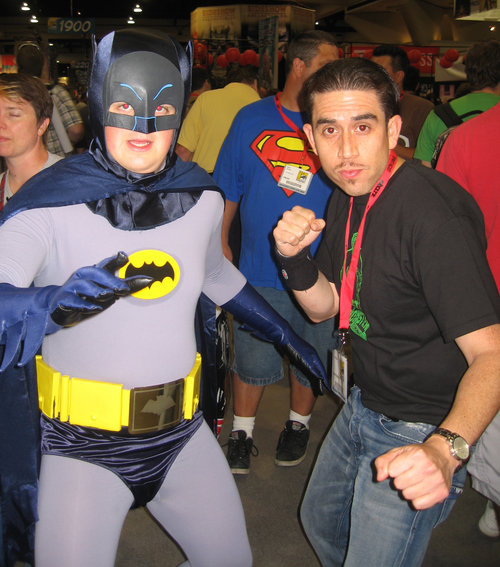
For fanboys (hopefully the inclusion of all genders is understood at this point), it's less about movies and more about geek-friendly genres of fiction like science-fiction, superheroes, fantasy, animation and horror. Most of them don't have much interest in the world of cinema outside these genres, but they are incredibly passionate about the movies within their realm. These are the costumed fans who will stand in line at Comic-Con for six hours to watch a two minute clip of the next Marvel movie. When it comes to the movies they love, they are tireless advocates. In particular, fanboys have been essential to the continued success of the horror genre.
However, there are dark sides to this level of fandom. They don't react kindly to innovation or experimentation when a movie adapts their treasured source material. They expect the movie adaptations to cater totally to them and resent attempts to appeal to a wider audience by altering the original stories. When this happens, they flood the internet with the level of vitriol you would expect from gun control debates on Facebook. Tread carefully before you start a conversation about George Lucas.
Fanboys hate the Oscars because...all their favorite genres routinely go ignored by the Academy. The only horror film to win Best Picture is The Silence of the Lambs, which people try to separate from horror by calling it a "psychological thriller." Please. A guy gets his a chunk of his face bitten off, it's a horror film. There you go, fanboys. Don't said I never did anything for ya.
Film Buff
A film buff will watch just about anything because they love movies. They seek a broad understanding of the medium, watching stuff from all genres and locations, and like to share their passion with others. When they see something great, they will sing its praises to their friends. When they see a fun bad movie (i.e. Plan 9 From Outer Space, Troll 2, The Room), they will make sure their friends get a chance to experience it. When they see a movie that's just plain bad, they will relish the chance to rip it apart. If you want a movie recommendation, find a film buff. If they know you well, they'll be able to cherry-pick their mental library for something you will like.
Passion and knowledge of film can impress other people, but it can also cost them friends if they don't keep their ego in check. Some film buffs take a fanboy attitude towards cinema as a whole, dismissing the opinions of others who haven't seen as many films as they have. A long movie-watching resume does give you a very informed opinion, but it doesn't take away the inherent subjectivity of the medium.
Film buffs hate the Oscars because...actually, they are the ones who are most likely to get at least some enjoyment out of it. Chances are, they like at least one of the movies that gets a statue. But they are also very familiar with all the films in each category, getting pissed off about their favored film losing the Cinematography Oscar while their friends are bewildered. It's a serious love/hate situation.
Cinephile
The cinephile is more interested in movies as art than as entertainment. Unlike the film buff, who seeks familiarity with all genres, the cinephile has no use for movies with overt commercial intentions. They have discerning taste and usually have a formal education in the history and language of film to back it up. I once heard a cinephile define "film buff" as "someone who dominates at Trivial Pursuit but has never seen a Victor Erice film." Directors like Erice, Eric Rohmer, Andrei Tarkovsky and Yasujiro Ozu are their bread and butter. They have a huge tolerance for boredom as long as the film they're watching is technically or thematically appealing to them. As you might have guessed by now, there is a noted correlation between cinephilia and hipsterism.
Like film buffs, a cinephile's worst enemy is his own ego. If they can keep that in check, cinephiles make outstanding professors and can get others to appreciate film in exciting new ways. If not, they run the risk of being utterly insufferable like the infamous commentator Armond White. In fact, most film critics are cinephiles (although the late Roger Ebert was definitely a film buff).
Cinephiles hate the Oscars because...they pretend not to care about the Oscars at all. But they do. However, the movies they love are almost always too obscure to get any nominations. Maybe in the Foreign Language category if they're lucky.
As for me, I'd identify myself as a film buff, but I do have a cinephile's education and a few of those tendencies (I have seen a film by Victor Erice, in fact). Not everyone will neatly fit into these categories, but I think articulating differences like this helps create more of a vocabulary that can be useful for discussing movies in general. I'd love to hear feedback about this one if anyone reads it. Am I on to something here or not even close? Which one are you?
Casual Viewer
For these people, movies just aren't a significant part of life. They've seen plenty, although they would have no clue how many if you asked them. They probably are in a movie theater less than five times a year, for major blockbusters or romantic comedies, depending on taste. Perhaps a book they really liked was adapted into a film, they'll check that out. If they have children, they are actually fairly knowledgeable about the Disney and Pixar canon because it's an easy way to give the rugrats something to do. Learning about the history of movies is not something they have any interest in doing. Chances are they haven't seen most of the more famous classics (i.e. Citizen Kane, Casablanca, The Godfather, etc) unless one was shown to them in a classroom.
It will be very hard to write this paragraph without being condescending, but please know I'm trying my best. A defining trait of the casual viewer is a lack of expectations. They go to movies expecting a two-hour distraction and if they got that, then they're satisfied and it's time to go back to the real world. Every so often, this total lack of critical evaluation can be infuriating to anyone who has thought seriously about film. In particular, Michael Bay's Transformers movies have become notorious for drawing the battle lines between casual moviegoers and everyone else. You'll often hear them defended as "just a dumb action movie" or "a fun popcorn movie," which is a phrase the person saw in an article recently. Perhaps you'll be told to go watch some highbrow French film instead, as if there's no possibility for an intelligent action film. Therein lies the key issue, actually - understanding the difference between "silly" and "brainless." A silly movie can be a lot of fun, but a brainless movie just sucks. I'm not really comfortable calling anything "objectively" terrible, but those Transformers movies really tempt me.
Casual viewers hate the Oscars because... "Who cares about the Oscars? Nobody's ever heard of the movies that get awards!"
Fanboy/Fangirl
For fanboys (hopefully the inclusion of all genders is understood at this point), it's less about movies and more about geek-friendly genres of fiction like science-fiction, superheroes, fantasy, animation and horror. Most of them don't have much interest in the world of cinema outside these genres, but they are incredibly passionate about the movies within their realm. These are the costumed fans who will stand in line at Comic-Con for six hours to watch a two minute clip of the next Marvel movie. When it comes to the movies they love, they are tireless advocates. In particular, fanboys have been essential to the continued success of the horror genre.
However, there are dark sides to this level of fandom. They don't react kindly to innovation or experimentation when a movie adapts their treasured source material. They expect the movie adaptations to cater totally to them and resent attempts to appeal to a wider audience by altering the original stories. When this happens, they flood the internet with the level of vitriol you would expect from gun control debates on Facebook. Tread carefully before you start a conversation about George Lucas.
Fanboys hate the Oscars because...all their favorite genres routinely go ignored by the Academy. The only horror film to win Best Picture is The Silence of the Lambs, which people try to separate from horror by calling it a "psychological thriller." Please. A guy gets his a chunk of his face bitten off, it's a horror film. There you go, fanboys. Don't said I never did anything for ya.
Film Buff
A film buff will watch just about anything because they love movies. They seek a broad understanding of the medium, watching stuff from all genres and locations, and like to share their passion with others. When they see something great, they will sing its praises to their friends. When they see a fun bad movie (i.e. Plan 9 From Outer Space, Troll 2, The Room), they will make sure their friends get a chance to experience it. When they see a movie that's just plain bad, they will relish the chance to rip it apart. If you want a movie recommendation, find a film buff. If they know you well, they'll be able to cherry-pick their mental library for something you will like.
Passion and knowledge of film can impress other people, but it can also cost them friends if they don't keep their ego in check. Some film buffs take a fanboy attitude towards cinema as a whole, dismissing the opinions of others who haven't seen as many films as they have. A long movie-watching resume does give you a very informed opinion, but it doesn't take away the inherent subjectivity of the medium.
Film buffs hate the Oscars because...actually, they are the ones who are most likely to get at least some enjoyment out of it. Chances are, they like at least one of the movies that gets a statue. But they are also very familiar with all the films in each category, getting pissed off about their favored film losing the Cinematography Oscar while their friends are bewildered. It's a serious love/hate situation.
Cinephile
The cinephile is more interested in movies as art than as entertainment. Unlike the film buff, who seeks familiarity with all genres, the cinephile has no use for movies with overt commercial intentions. They have discerning taste and usually have a formal education in the history and language of film to back it up. I once heard a cinephile define "film buff" as "someone who dominates at Trivial Pursuit but has never seen a Victor Erice film." Directors like Erice, Eric Rohmer, Andrei Tarkovsky and Yasujiro Ozu are their bread and butter. They have a huge tolerance for boredom as long as the film they're watching is technically or thematically appealing to them. As you might have guessed by now, there is a noted correlation between cinephilia and hipsterism.
Like film buffs, a cinephile's worst enemy is his own ego. If they can keep that in check, cinephiles make outstanding professors and can get others to appreciate film in exciting new ways. If not, they run the risk of being utterly insufferable like the infamous commentator Armond White. In fact, most film critics are cinephiles (although the late Roger Ebert was definitely a film buff).
Cinephiles hate the Oscars because...they pretend not to care about the Oscars at all. But they do. However, the movies they love are almost always too obscure to get any nominations. Maybe in the Foreign Language category if they're lucky.
As for me, I'd identify myself as a film buff, but I do have a cinephile's education and a few of those tendencies (I have seen a film by Victor Erice, in fact). Not everyone will neatly fit into these categories, but I think articulating differences like this helps create more of a vocabulary that can be useful for discussing movies in general. I'd love to hear feedback about this one if anyone reads it. Am I on to something here or not even close? Which one are you?
Wednesday, January 29, 2014
Top Ten Films of 2013
For a while, I didn't think I was going to have one of these this year. With the twins born in February, the lifestyle around here is obviously a LOT different. These lists were always on the late side just because it's harder to get to see smaller movies in Connecticut (for the record, I am pissed that I still can't see Miyazaki's The Wind Rises for another month...I'm pretty confident that would have landed on here somewhere, for now let's just assume it tied with one of the movies currently on the list). I watched a lot of films on Netflix during late nights up with babies, but actually getting to the theater was tougher. It's a small price to pay, obviously, for having two cute little men crawling around the house. And yet movies are an important part of my identity, and falling far behind made me feel a bit like I was losing part of myself.
Typically, I recover from my geographical disadvantage with Operation Drink From Fire Hose, the annual December-January binge where I'm watching movies constantly. However, this year it was derailed early on by the wave of ear infections, pinkeye and flu that invaded our house around Christmas. As tough as it was, it didn't last forever, and by January things were mostly back to normal. So I decided not to give up on this tradition and had quite a rally when it came to movie watching. The convenience of Netflix, as well as that ever-shortening window between a film's theatrical release and its DVD release, made things easier...although there's still a handful of films I wish I'd made it to. Still, I ended things with a list I was very happy with. It helped that 2013 was a good year.
Family comes first...but the reason the word "first" even appears in that phrase is because there's other things out there to focus on sometimes. So the next time someone tells you that your interests fade away once you have children, tell them to stop watching Judd Apatow movies and grow a pair. With that out of the way, here's ten movies I really liked.
10. The Lords of Salem
It's not a Rob list without horror, right? There were a few horror films I could have thrown up here, but none were more visually striking than the latest movie from former metal singer Rob Zombie. Back in 2005, he stunned genre fans with The Devils Rejects, an alternately hilarious and horrifying allegory of post-9/11 America that, among other things, had a final scene that used all of "Free Bird." Since then, he regrettably got bogged down with unnecessary remakes of the first two Halloween films, but The Lords of Salem is one formidable comeback. A radio DJ (played by Zombie's wife, Sheri Moon) is sent a sample song from a mysterious new doom metal band, a melody which seems to have bizarre effect on her life. Zombie gets to have some fun with that old cliche about metal being "the devil's music" and also shows just how well he understands the visual language of horror. No cats jumping into the frame or ghosts in medicine cabinet mirrors here, just top notch ambience and imagery so intense I'm not sure I would recommend this one to people without some experience with the genre.
9. Elysium
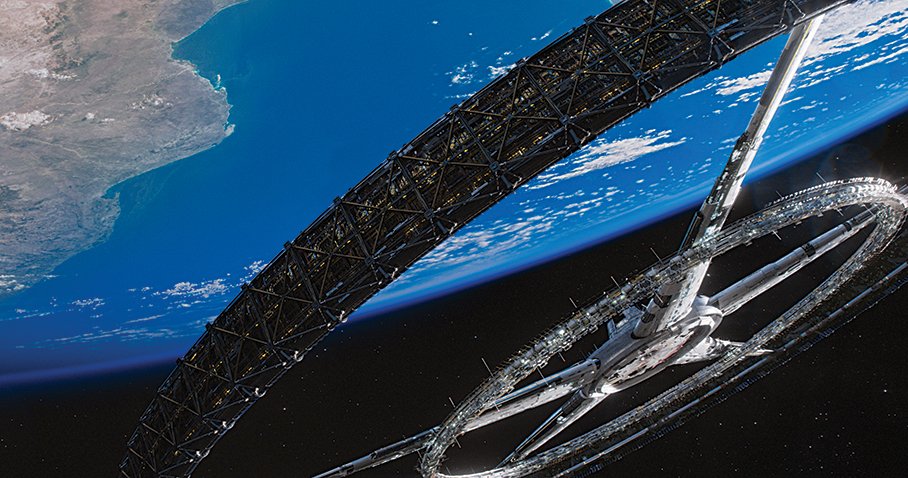
So here's a movie I really liked that nobody else seemed to care about one way or the other. The second feature from Neill Blomkamp (District 9) envisions a future in which all the rich folks live on a pristine satellite in space while everyone else lives on the ruined Earth below. When a factory worker named Max (Matt Damon) gets radiation poisoning, his only hope is to get to Elysium, where they have machines that can cure any ailment in seconds. The subtext of all this isn't very far under the surface, which often gets a movie like this criticism for being too "blunt" or "in your face." Honestly, I prefer movies that don't sugarcoat things and the whole scenario is a great metaphor for how too many powerful people in America view health care - as a luxury that you only get if you can pay for it, like a big-screen TV that also just happens to keep you alive. Of course, the movie's not just one long sermon about compassion for the least of us. Blomkamp is already a master when it comes to judicious use of digital effects and staging action scenes. It may not be the revelation that District 9 was, but it's still miles ahead of most action films that come out these days.
8. Twelve Years A Slave
Here's why you should never read the comments. While perusing an article about Steve McQueen's slavery epic, I saw someone ask why there were "so many movies about slavery" and urging for a reduction in "negative Black movies." A reaction like that only illustrates the cultural importance of this film. Not only that, there really haven't been all that many films that depict slavery in America, even less once you filter out patronizing bullshit like Gone With The Wind, where all the slaves are just delighted to be trapped on the plantation. There's some exploitation stuff like Django Unchained or Mandingo, and I think the bluntness of exploitation can be well-suited to this subject, but this movie is a whole different kind of experience. The great and (until now) unappreciated actor Chiwetel Ejiofor plays Solomon Northrup, a free black man who is abducted and sold into slavery in the South for a dozen years. It's a beautifully made, chilling portrait of dehumanization occasionally punctuated by the brutal violence that was a fact of life during this era. Based on the real-life Northrup's memoirs, Twelve Years a Slave is a film that feels like a journey, one that will prompt a great deal of reflection when it finally ends. It's a film to be reckoned with - hard to like, but easy to appreciate.
7. Drug War
The story of Drug War is familiar stuff - cops, crime lords, undercover operations - but you rarely see it executed this well. Directed by Hong Kong filmmaker Johnnie To, this remarkably taut adventure is devoid of sentimentality or filler. Louis Koo is superb as Timmy Choi, a scheming, self-serving dealer who hopes to avoid the death penalty by teaming up with Zhang Lei (Honglei Sun), the tough cop (and brilliant mimic) who busted him. The entire film is a master class in building tension up until the no-holds-barred finale. This was the first time To was allowed to shoot on mainland China, and he conjures up a memorable atmosphere, alternately sterilized and grimy. I'm not sure the Chinese government will be in a hurry to let him do it again.
6. Blackfish
A devastating documentary about the tragedy that can come from treating nature too recklessly, similar to the stories of Steve Irwin and "Grizzly Man" Timothy Treadwell. But instead of an individual, the subject is Sea World and its cavalier pattern of abducting wild killer whales and training them to do tricks in front of massive crowds. Director Gabriela Cowperthwaite set out to investigate the shocking death of veteran trainer Dawn Brancheau at the hands of an orca named Tilikum. What she found was that given the whale's violent history in captivity, the incident shouldn't have been all that shocking. What is shocking, however, is the appalling behavior by the Sea World executives, whether it's the CEO blaming Brancheau for her own violent death or instructing tour guides to tell flat-out lies to tourists about killer whale life expectancy in order to mask the reality of the creatures dying young while imprisoned. Several former Sea World employees share powerful anecdotes and the cumulative effect of their stories has already left quite a welt on Sea World, judging from their unhinged gloating on Twitter after Blackfish failed to grab an Oscar nomination for Best Documentary. With or without awards, this is a powerful film that goes beyond the ethics of Sea World and makes us question our own human arrogance for thinking we can bend the natural world to our will.
5. Short Term 12
Destin Cretton's first feature takes viewers inside a group foster home, a setting rarely seen in the movies, and it's one of the most convincing and compassionate portraits of troubled young people I've ever seen. In its compact 90 minutes, it gives a glimpse into the lives of teens who have suffered and waiting around while the system decides just what to do with them. Keith Stanfield and Kaitlyn Dever are standouts among the younger actors, but the film's core narrative focuses on the not-much-older supervisors, specifically Brie Larson as Grace, who is forced to examine her own demons after meeting a young girl with a similar life story. It's a tough story to pull off, but the film's blend of hope and melancholy contributes to a genuinely moving experience.
4. John Dies At The End
Two aimless friends discover an alternate dimension that is quietly threatening the human race and have to rely on a mysterious drug called "soy sauce" that can send users across dimensions but also across time. It only gets weirder from there in this sublime horror-comedy from Don Coscarelli, who gifted the world with the one-of-a-kind masterpiece Bubba Ho-Tep ten years ago. Filled with absurd twists, gloriously off-the-wall humor and one very heroic dog, it's an unpredictable joy to watch. The film critic Dana Stevens coined the phrase "artisinal horror," referring to low-budget horror films like this one that refuse to play by any of the genre's rules. I'm not sure if that's the phrase I would use, but she's on to something. Part of the fun of this movie is the gradual realization of just how out there it is, although it doesn't compromise the entertainment value in the slightest.
3. Gravity
How does one define the "movie of the year?" I've thought about this a lot lately and came up with an informal method of evaluating a movie's box office success, critical AND audience response, and impact on day-to-day pop culture. With that in mind, the title would seem to go to Gravity and it's a bandwagon I don't mind jumping on. The movie is a tremendous technical achievement and a vivid story of survival filled with breathtaking suspense. George Clooney shows up for a while to do his smooth-talking-George-Clooney routine, but for the most part it's up to Sandra Bullock as the stranded novice astronaut to carry things along and she makes it look easy. Director Alfonso Cuaron had to invent new technology to make this film possible and the results are so striking that I still have to remind myself that this was not actually shot in outer space. Cuaron's movies are always great demonstrations of what movies as an art form are capable of, with this one's 17-minute opening tracking shot as just one example. It's not perfect, in fact I was surprised by how clumsily the lead character's tragic backstory was handled, but a viscerally thrilling movie experience like Gravity can get away with a lot.
2. Fruitvale Station
The story of Oscar Grant, whose outrageous death at the hands of trigger-happy police officers was captured on video for the whole world to see, has been adapted into a small masterpiece that only needs empathy to drive home just how cruel modern America can be if you're a young black man in the wrong place at the wrong time. With a premise like this, the ending is a foregone conclusion, but the bulk of the movie is simply the last 24 hours of Oscar Grant's life. Grant, played to perfection by the outstanding Michael B. Jordan, is genuinely kind but also troubled, trying to get his act together but prone to fits of pride or anger. In short, he's like a lot of us trying to make sense of the screwed up world we live in. The more time you spend with Grant, the more devastating that foregone conclusion becomes. In a depressing development, the movie was completely shut out by the Oscars, with some commentators looking at the pile of nominations for Twelve Years A Slave and concluding that Hollywood can only focus on one black movie at a time. I suspect that this is part of it, the other part being the notoriously short memories of Academy members. The ceremony is supposed to honor a year's worth of film but nothing released before October hardly ever gets nominated. If they had any brains, you would be seeing about five or six nominations for this July release, including Best Actor for Jordan and Best Supporting Actress for Melonie Diaz, who broke my heart as Grant's girlfriend and mother of his child. The fact that incidents like this keep appearing in the news means that this film's importance will only grow over time. For each of those events, a story like this could be told.
1. The Act of Killing
In the end credits for Joshua Oppenheimer's amazing documentary, dozens of crew members and even a co-director are listed as "Anonymous." These are the Indonesian crew members who didn't feel safe attaching their actual names to The Act of Killing, which deals with mass killings in that country during the 1960s, an atrocity barely known to the outside world. After a failed coup by Communist forces, the country's leaders retaliated by wiping out hundreds of thousands of supposed "Communists," i.e. union leaders, public intellectuals and ethnic Chinese. Fifty years later, many of the perpetrators have gone unpunished and still enjoy protection from the state and are something akin to celebrities. Their cavalier attitudes about the slaughter bring the concept of "cognitive dissonance" to a whole new level and things get even stranger when the director invites them to recreate the genocide as a film that they would have total creative control over. Borrowing tropes from their favorite musicals and crime films, they stage increasingly surreal interpretations of the event. However, revisiting the past brings reflection, and to at least one of the killers, the beginnings of true remorse and shame. It's a bizarre experience to watch, but the human drama becomes positively overwhelming by the unforgettable conclusion. This is a truly dangerous film, but also one that has the potential to change lives and really do good in the world. It has a nomination for Best Documentary, but an Oscar doesn't feel like enough. A movie like this deserves a Nobel Prize.
Happy 2014, everyone. Back to babies!
Typically, I recover from my geographical disadvantage with Operation Drink From Fire Hose, the annual December-January binge where I'm watching movies constantly. However, this year it was derailed early on by the wave of ear infections, pinkeye and flu that invaded our house around Christmas. As tough as it was, it didn't last forever, and by January things were mostly back to normal. So I decided not to give up on this tradition and had quite a rally when it came to movie watching. The convenience of Netflix, as well as that ever-shortening window between a film's theatrical release and its DVD release, made things easier...although there's still a handful of films I wish I'd made it to. Still, I ended things with a list I was very happy with. It helped that 2013 was a good year.
Family comes first...but the reason the word "first" even appears in that phrase is because there's other things out there to focus on sometimes. So the next time someone tells you that your interests fade away once you have children, tell them to stop watching Judd Apatow movies and grow a pair. With that out of the way, here's ten movies I really liked.
10. The Lords of Salem
It's not a Rob list without horror, right? There were a few horror films I could have thrown up here, but none were more visually striking than the latest movie from former metal singer Rob Zombie. Back in 2005, he stunned genre fans with The Devils Rejects, an alternately hilarious and horrifying allegory of post-9/11 America that, among other things, had a final scene that used all of "Free Bird." Since then, he regrettably got bogged down with unnecessary remakes of the first two Halloween films, but The Lords of Salem is one formidable comeback. A radio DJ (played by Zombie's wife, Sheri Moon) is sent a sample song from a mysterious new doom metal band, a melody which seems to have bizarre effect on her life. Zombie gets to have some fun with that old cliche about metal being "the devil's music" and also shows just how well he understands the visual language of horror. No cats jumping into the frame or ghosts in medicine cabinet mirrors here, just top notch ambience and imagery so intense I'm not sure I would recommend this one to people without some experience with the genre.
9. Elysium
So here's a movie I really liked that nobody else seemed to care about one way or the other. The second feature from Neill Blomkamp (District 9) envisions a future in which all the rich folks live on a pristine satellite in space while everyone else lives on the ruined Earth below. When a factory worker named Max (Matt Damon) gets radiation poisoning, his only hope is to get to Elysium, where they have machines that can cure any ailment in seconds. The subtext of all this isn't very far under the surface, which often gets a movie like this criticism for being too "blunt" or "in your face." Honestly, I prefer movies that don't sugarcoat things and the whole scenario is a great metaphor for how too many powerful people in America view health care - as a luxury that you only get if you can pay for it, like a big-screen TV that also just happens to keep you alive. Of course, the movie's not just one long sermon about compassion for the least of us. Blomkamp is already a master when it comes to judicious use of digital effects and staging action scenes. It may not be the revelation that District 9 was, but it's still miles ahead of most action films that come out these days.
8. Twelve Years A Slave
Here's why you should never read the comments. While perusing an article about Steve McQueen's slavery epic, I saw someone ask why there were "so many movies about slavery" and urging for a reduction in "negative Black movies." A reaction like that only illustrates the cultural importance of this film. Not only that, there really haven't been all that many films that depict slavery in America, even less once you filter out patronizing bullshit like Gone With The Wind, where all the slaves are just delighted to be trapped on the plantation. There's some exploitation stuff like Django Unchained or Mandingo, and I think the bluntness of exploitation can be well-suited to this subject, but this movie is a whole different kind of experience. The great and (until now) unappreciated actor Chiwetel Ejiofor plays Solomon Northrup, a free black man who is abducted and sold into slavery in the South for a dozen years. It's a beautifully made, chilling portrait of dehumanization occasionally punctuated by the brutal violence that was a fact of life during this era. Based on the real-life Northrup's memoirs, Twelve Years a Slave is a film that feels like a journey, one that will prompt a great deal of reflection when it finally ends. It's a film to be reckoned with - hard to like, but easy to appreciate.
7. Drug War
The story of Drug War is familiar stuff - cops, crime lords, undercover operations - but you rarely see it executed this well. Directed by Hong Kong filmmaker Johnnie To, this remarkably taut adventure is devoid of sentimentality or filler. Louis Koo is superb as Timmy Choi, a scheming, self-serving dealer who hopes to avoid the death penalty by teaming up with Zhang Lei (Honglei Sun), the tough cop (and brilliant mimic) who busted him. The entire film is a master class in building tension up until the no-holds-barred finale. This was the first time To was allowed to shoot on mainland China, and he conjures up a memorable atmosphere, alternately sterilized and grimy. I'm not sure the Chinese government will be in a hurry to let him do it again.
6. Blackfish
A devastating documentary about the tragedy that can come from treating nature too recklessly, similar to the stories of Steve Irwin and "Grizzly Man" Timothy Treadwell. But instead of an individual, the subject is Sea World and its cavalier pattern of abducting wild killer whales and training them to do tricks in front of massive crowds. Director Gabriela Cowperthwaite set out to investigate the shocking death of veteran trainer Dawn Brancheau at the hands of an orca named Tilikum. What she found was that given the whale's violent history in captivity, the incident shouldn't have been all that shocking. What is shocking, however, is the appalling behavior by the Sea World executives, whether it's the CEO blaming Brancheau for her own violent death or instructing tour guides to tell flat-out lies to tourists about killer whale life expectancy in order to mask the reality of the creatures dying young while imprisoned. Several former Sea World employees share powerful anecdotes and the cumulative effect of their stories has already left quite a welt on Sea World, judging from their unhinged gloating on Twitter after Blackfish failed to grab an Oscar nomination for Best Documentary. With or without awards, this is a powerful film that goes beyond the ethics of Sea World and makes us question our own human arrogance for thinking we can bend the natural world to our will.
5. Short Term 12
Destin Cretton's first feature takes viewers inside a group foster home, a setting rarely seen in the movies, and it's one of the most convincing and compassionate portraits of troubled young people I've ever seen. In its compact 90 minutes, it gives a glimpse into the lives of teens who have suffered and waiting around while the system decides just what to do with them. Keith Stanfield and Kaitlyn Dever are standouts among the younger actors, but the film's core narrative focuses on the not-much-older supervisors, specifically Brie Larson as Grace, who is forced to examine her own demons after meeting a young girl with a similar life story. It's a tough story to pull off, but the film's blend of hope and melancholy contributes to a genuinely moving experience.
4. John Dies At The End
Two aimless friends discover an alternate dimension that is quietly threatening the human race and have to rely on a mysterious drug called "soy sauce" that can send users across dimensions but also across time. It only gets weirder from there in this sublime horror-comedy from Don Coscarelli, who gifted the world with the one-of-a-kind masterpiece Bubba Ho-Tep ten years ago. Filled with absurd twists, gloriously off-the-wall humor and one very heroic dog, it's an unpredictable joy to watch. The film critic Dana Stevens coined the phrase "artisinal horror," referring to low-budget horror films like this one that refuse to play by any of the genre's rules. I'm not sure if that's the phrase I would use, but she's on to something. Part of the fun of this movie is the gradual realization of just how out there it is, although it doesn't compromise the entertainment value in the slightest.
3. Gravity
How does one define the "movie of the year?" I've thought about this a lot lately and came up with an informal method of evaluating a movie's box office success, critical AND audience response, and impact on day-to-day pop culture. With that in mind, the title would seem to go to Gravity and it's a bandwagon I don't mind jumping on. The movie is a tremendous technical achievement and a vivid story of survival filled with breathtaking suspense. George Clooney shows up for a while to do his smooth-talking-George-Clooney routine, but for the most part it's up to Sandra Bullock as the stranded novice astronaut to carry things along and she makes it look easy. Director Alfonso Cuaron had to invent new technology to make this film possible and the results are so striking that I still have to remind myself that this was not actually shot in outer space. Cuaron's movies are always great demonstrations of what movies as an art form are capable of, with this one's 17-minute opening tracking shot as just one example. It's not perfect, in fact I was surprised by how clumsily the lead character's tragic backstory was handled, but a viscerally thrilling movie experience like Gravity can get away with a lot.
2. Fruitvale Station
The story of Oscar Grant, whose outrageous death at the hands of trigger-happy police officers was captured on video for the whole world to see, has been adapted into a small masterpiece that only needs empathy to drive home just how cruel modern America can be if you're a young black man in the wrong place at the wrong time. With a premise like this, the ending is a foregone conclusion, but the bulk of the movie is simply the last 24 hours of Oscar Grant's life. Grant, played to perfection by the outstanding Michael B. Jordan, is genuinely kind but also troubled, trying to get his act together but prone to fits of pride or anger. In short, he's like a lot of us trying to make sense of the screwed up world we live in. The more time you spend with Grant, the more devastating that foregone conclusion becomes. In a depressing development, the movie was completely shut out by the Oscars, with some commentators looking at the pile of nominations for Twelve Years A Slave and concluding that Hollywood can only focus on one black movie at a time. I suspect that this is part of it, the other part being the notoriously short memories of Academy members. The ceremony is supposed to honor a year's worth of film but nothing released before October hardly ever gets nominated. If they had any brains, you would be seeing about five or six nominations for this July release, including Best Actor for Jordan and Best Supporting Actress for Melonie Diaz, who broke my heart as Grant's girlfriend and mother of his child. The fact that incidents like this keep appearing in the news means that this film's importance will only grow over time. For each of those events, a story like this could be told.
1. The Act of Killing
In the end credits for Joshua Oppenheimer's amazing documentary, dozens of crew members and even a co-director are listed as "Anonymous." These are the Indonesian crew members who didn't feel safe attaching their actual names to The Act of Killing, which deals with mass killings in that country during the 1960s, an atrocity barely known to the outside world. After a failed coup by Communist forces, the country's leaders retaliated by wiping out hundreds of thousands of supposed "Communists," i.e. union leaders, public intellectuals and ethnic Chinese. Fifty years later, many of the perpetrators have gone unpunished and still enjoy protection from the state and are something akin to celebrities. Their cavalier attitudes about the slaughter bring the concept of "cognitive dissonance" to a whole new level and things get even stranger when the director invites them to recreate the genocide as a film that they would have total creative control over. Borrowing tropes from their favorite musicals and crime films, they stage increasingly surreal interpretations of the event. However, revisiting the past brings reflection, and to at least one of the killers, the beginnings of true remorse and shame. It's a bizarre experience to watch, but the human drama becomes positively overwhelming by the unforgettable conclusion. This is a truly dangerous film, but also one that has the potential to change lives and really do good in the world. It has a nomination for Best Documentary, but an Oscar doesn't feel like enough. A movie like this deserves a Nobel Prize.
Happy 2014, everyone. Back to babies!
Saturday, November 16, 2013
"Dear Mr. Watterson" doesn't go deep enough
It's not hyperbole to say that "Calvin and Hobbes" is the closest thing I have to a religion. For all the writing I do on here about important entertainment from my past, none of those TV shows or movies, or even Spider-Man, played as big a role in my life as Bill Watterson's legendary comic strip. Everyone who knows me has probably heard me react to a situation by saying "This is like that Calvin and Hobbes strip where..." As a kid, I enjoyed it at face value for Calvin's mischief and the frequent appearance of dinosaurs. Reading it when I was older revealed the deep meaning behind those panels. I realized I had taken powerful lessons from those comics and it didn't feel like an accident when I came across this illustration of a speech given by Bill Watterson shortly after I left my job. It was a scarily perfect summation of the last year of my life...but maybe I'm getting ahead of myself.
The "Calvin and Hobbes" phenomenon is explored in the documentary Dear Mr. Watterson, which just opened in a handful of theaters but is also available for purchase and download via Itunes. It's an entertaining watch and I would happily recommend it to any fan of the comic, but I couldn't help but feel like it missed a few major opportunities. But I'll quickly sum up the best parts of the film - the section detailing the visual resemblance between the world of "Calvin and Hobbes" and Watterson's hometown of Chagrin Falls, Ohio, other comic strip artists giving their perspective on why the strip is so memorable, and a moving conclusion that analyzes the famous final Sunday strip ("It's a magical world, Hobbes old buddy, let's go exploring.")
Anyone who has knows the strip's history won't be surprised that the elusive Watterson never appears on camera. He tends to give one print interview per decade and it appears no picture of him has been taken since the 1980s, to the point where his elusive nature has given "Calvin and Hobbes" a whole new layer of intrigue. The director, Joel Allen Schroeder, respects Watterson far too much to mount some guerrilla attempt to ambush him for an interview and spends a lot of time on screen himself. It doesn't surprise me given this particular subject matter. "Calvin and Hobbes" is one of those special treasures that feels deeply personal to each fan even though it's been enjoyed by millions of people all over the world. Actually, I said something similar about Iron Maiden's music and I believe that's the measure of a truly great work of art. However, my main disappointment with the documentary is that it never gets at why it feels so intensely personal to those who read it. The movie leaves you with the impression that it was simply because of great illustrations and a sharp wit, and while those things are certainly integral to its success, it goes far deeper.
Seth Green, co-creator of "Robot Chicken," describes the strip as "so subversive," but the movie never follows up on exactly why that is. Naturally, it covers Watterson's relentless battle to prevent "Calvin and Hobbes" from being merchandised, a rejection of what would have surely added up to hundreds of millions of dollars. However, it isn't mentioned that his decision was completely in line with the overriding themes of the strip. The reason "Calvin and Hobbes" is subversive is that it completely rejects the rat race and the idea that success is defined only by acquisition of wealth. Calvin's adventures drive home that real fulfillment comes from play and leisure, rather than work, and is there anything more taboo in modern America than that? This country is obsessed with productivity and profit and has no concern with the mental and emotional well-being of its people. Then we wonder why so many people here snap and go on murderous rampages. Those who make unprofitable activities like leisure or vacation a priority get called lazy or indulgent or, my favorite, "entitled."
The wave of dogshit articles using "entitled" as a pejorative against anyone who would like a life that doesn't suck demonstrates how hard it actually is to actually live the philosophy of "Calvin and Hobbes." If you're not working at some terrible job, you're expected to be looking for some terrible job full-time, rather than taking time for things like walking in the woods, sledding down a hill, playing with a cardboard box, or anything else Calvin enjoys doing. The irony is that the word isn't even being used correctly. If you really think you're "entitled" to something, you won't make any effort to get it since you think the world owes it to you. But I think that anyone who was a kid in the heyday of "Calvin and Hobbes" knows by now that society isn't going to give anything to you, ever. If you want a meaningful life, you have to fight against conventional wisdom and very powerful interests to take it for yourself, and that's the opposite of "entitled." In the end, I think Watterson's decision to avoid licensing altogether was not just to protect the artistic integrity of his work, but also to maintain the life he wanted. If "Calvin and Hobbes" became a multimedia empire like "Garfield," he's not just a cartoonist but a manager. It just wasn't how he wanted to spend his days.
"There's never enough time to do all the nothing you want," Calvin once said. Time for rest and reflection is treated as a luxury but Watterson knew it was essential. This is the reason I believe the strip connects with people the way it does, because deep down most of us know what's really important, we just ignore it in the name of sensibility. Perhaps it's a bit foolish to expect a documentary to delve that deep into the strip's meaning, but then again, there was one particularly interesting scene where the director analyzed a strip towards the end of the comic's run. Calvin imagines sledding off the top of a huge mountain but the end reveals it was just a tiny hill and he looks back, disappointed by the brief sled ride. Schroeder reads this as a metaphor for Watterson realizing that the thrill of creating "Calvin and Hobbes" was fading and now we know it didn't last much longer after that. In the end, I think I wanted more analysis like that...less discussion of the strip's popularity and more about its actual content. Maybe next time.
The "Calvin and Hobbes" phenomenon is explored in the documentary Dear Mr. Watterson, which just opened in a handful of theaters but is also available for purchase and download via Itunes. It's an entertaining watch and I would happily recommend it to any fan of the comic, but I couldn't help but feel like it missed a few major opportunities. But I'll quickly sum up the best parts of the film - the section detailing the visual resemblance between the world of "Calvin and Hobbes" and Watterson's hometown of Chagrin Falls, Ohio, other comic strip artists giving their perspective on why the strip is so memorable, and a moving conclusion that analyzes the famous final Sunday strip ("It's a magical world, Hobbes old buddy, let's go exploring.")
Anyone who has knows the strip's history won't be surprised that the elusive Watterson never appears on camera. He tends to give one print interview per decade and it appears no picture of him has been taken since the 1980s, to the point where his elusive nature has given "Calvin and Hobbes" a whole new layer of intrigue. The director, Joel Allen Schroeder, respects Watterson far too much to mount some guerrilla attempt to ambush him for an interview and spends a lot of time on screen himself. It doesn't surprise me given this particular subject matter. "Calvin and Hobbes" is one of those special treasures that feels deeply personal to each fan even though it's been enjoyed by millions of people all over the world. Actually, I said something similar about Iron Maiden's music and I believe that's the measure of a truly great work of art. However, my main disappointment with the documentary is that it never gets at why it feels so intensely personal to those who read it. The movie leaves you with the impression that it was simply because of great illustrations and a sharp wit, and while those things are certainly integral to its success, it goes far deeper.
Seth Green, co-creator of "Robot Chicken," describes the strip as "so subversive," but the movie never follows up on exactly why that is. Naturally, it covers Watterson's relentless battle to prevent "Calvin and Hobbes" from being merchandised, a rejection of what would have surely added up to hundreds of millions of dollars. However, it isn't mentioned that his decision was completely in line with the overriding themes of the strip. The reason "Calvin and Hobbes" is subversive is that it completely rejects the rat race and the idea that success is defined only by acquisition of wealth. Calvin's adventures drive home that real fulfillment comes from play and leisure, rather than work, and is there anything more taboo in modern America than that? This country is obsessed with productivity and profit and has no concern with the mental and emotional well-being of its people. Then we wonder why so many people here snap and go on murderous rampages. Those who make unprofitable activities like leisure or vacation a priority get called lazy or indulgent or, my favorite, "entitled."
The wave of dogshit articles using "entitled" as a pejorative against anyone who would like a life that doesn't suck demonstrates how hard it actually is to actually live the philosophy of "Calvin and Hobbes." If you're not working at some terrible job, you're expected to be looking for some terrible job full-time, rather than taking time for things like walking in the woods, sledding down a hill, playing with a cardboard box, or anything else Calvin enjoys doing. The irony is that the word isn't even being used correctly. If you really think you're "entitled" to something, you won't make any effort to get it since you think the world owes it to you. But I think that anyone who was a kid in the heyday of "Calvin and Hobbes" knows by now that society isn't going to give anything to you, ever. If you want a meaningful life, you have to fight against conventional wisdom and very powerful interests to take it for yourself, and that's the opposite of "entitled." In the end, I think Watterson's decision to avoid licensing altogether was not just to protect the artistic integrity of his work, but also to maintain the life he wanted. If "Calvin and Hobbes" became a multimedia empire like "Garfield," he's not just a cartoonist but a manager. It just wasn't how he wanted to spend his days.
"There's never enough time to do all the nothing you want," Calvin once said. Time for rest and reflection is treated as a luxury but Watterson knew it was essential. This is the reason I believe the strip connects with people the way it does, because deep down most of us know what's really important, we just ignore it in the name of sensibility. Perhaps it's a bit foolish to expect a documentary to delve that deep into the strip's meaning, but then again, there was one particularly interesting scene where the director analyzed a strip towards the end of the comic's run. Calvin imagines sledding off the top of a huge mountain but the end reveals it was just a tiny hill and he looks back, disappointed by the brief sled ride. Schroeder reads this as a metaphor for Watterson realizing that the thrill of creating "Calvin and Hobbes" was fading and now we know it didn't last much longer after that. In the end, I think I wanted more analysis like that...less discussion of the strip's popularity and more about its actual content. Maybe next time.
Saturday, July 27, 2013
The Labyrinthine Dreams Kickstarter is on!
If you click this link and help us out with a donation, you'll have my eternal gratitude!
Nerve-wracking stuff, this crowdfunding business. We've put a dream of ours in the hands of the masses. But if it works out, Mark (ArtBane) and I will be able to work towards a major milestone in our personal and professional lives. The short version of this is that we're seeking $6,000 to enhance our puzzle game Labyrinthine Dreams. Most of the funds would go towards hiring a couple of professional artists, with other portions meant for expected business and marketing costs. If we're able to secure the money and get this work done, we'd have a real commercial game that had a chance in the competitive independent game market.
Regular readers of this blog know that I've got a long history with RPG Maker. Our six-year collaboration on Master of the Wind was how Mark and I made a name for ourselves in the RPG Maker Community, who bestowed a highly generous amount of acclaim and awards on us that remains humbling. Since then, we haven't been quite as focused. I took some time to write my novel The World Beyond and later, we began to work on our detective game X-Noir. We had some thoughts of a commercial future for X-Noir, but now that we're about two-thirds done with it, it seems that will not be its destiny. It's a little too odd, too tough to refine into something with a feasible commercial future. We needed something that would be ambitious and unique without being too sprawling and difficult to polish. Enter Labyrinthine Dreams.
We had seen a few of our friends successfully put together games that were fairly short, but highly focused in their story, gameplay and art style. Meanwhile, we had spent 2005 to 2011 on one of the longest completed RPG Maker games ever released. X-Noir was meant to be on a smaller scale, but the highly detailed nature of the game's story has turned into a fairly big undertaking itself. This time, the game would be designed so that players could complete it in about an hour and there would be one consistent gameplay mechanic throughout - mazes. With this project, Mark had a chance to tackle an idea he'd been holding on to for a while - a game set inside a dream. He had briefly worked on a previous game with this concept called Vacant before we determined that I'd be back in the writer's seat.
It was interesting timing to be sure - I had just returned from the hospital after the birth of my sons. Vacant had been dark and sinister, but I wasn't necessarily feeling dark and sinister. My mood was something like exhausted triumph. The year that led up to the birth was packed with drama, adversity and confrontations, but my wife and I had gotten past them all and now we had two cute little guys. I could go into more detail, but one of the Kickstarter rewards is an audio commentary so I should probably save it until then. But in general, I wanted to distill my experience into a story that was vague enough so others could relate to it. I'd say there's two main themes of Labyrinthine Dreams - one is an old-fashioned arc of perseverance and redemption, the other is a critical look at the toll that our cultural obsession with productivity and profit takes on quality of life.
We've got a full playable version of the game now that gives a good sense of the story and gameplay, but as with all our projects, it's art that we need some help on. There's a four-minute video on the Kickstarter page that gives a few more details. I hope you'll decide to help out, either by donating or by spreading the word. Thanks!
Sunday, April 29, 2012
Casshan and Me
If the eight Spider-Man entries weren't a clue (and the next one of those is imminent), I've been on a bit of a nostalgia kick for the last couple of years. Some psychologist could probably come up with a theory about a need to try and make sense of my childhood, which wasn't typical, by revisiting the most significant entertainment for me at that time. I'm not really sure, but I do find it interesting to look back at these movies, TV shows or comics and see what impact they might have had on me as a writer.
The character Casshan (or Casshern) was first introduced to Japanese audiences in a 1970s anime series, but that wasn't the version I saw. In 1993, the story was reimagined as a four-part limited series called Casshan: Robot Hunter. The Sci-Fi Channel edited this series into a two-hour film and showed it on their "Saturday Anime" feature, a weekly treat that introduced a whole generation of American kids to the very different kind of cartoons that got made on the other side of the Pacific Ocean. I tuned into Saturday Anime often, but it was always mixed in with the more traditional cartoons I was into at the time. I'd usually flip back and forth when one went to commerical, but Casshan was the first one that really held my attention. I was about 11 or 12 and had never seen an animated story with this level of intense action and drama. It absolutely blew me away. It starred an android in a dorky/awesome outfit whose preferred combat move was a karate chop that could split a robot in half. He also had a robot dog that could breathe fire. What more could a kid ask for? My mother happened to walk in during a scene where Casshan shouted "Damn you!" to his nemesis, the Black King (Android BK-1). She expressed her surprise and I indignantly replied, "Mom, this isn't for kids."
Rewatching it so many years later was an emotional experience. That distinctive style of late 80s/early 90s anime feels iconic at this point and I even kept the cheesy English dubbing on because that was what I remembered. I was able to recall how magical this was for me as a child, but as an adult it's clear it's not quite a masterpiece. The storyline lifts shamlessly from Terminator, Star Wars and a little bit of Mega Man. Characterization is barely given any thought. The boobilicious outfit worn by Casshan's love interest is ridiculously impractical for a war zone. The environmentalist elements of the story make less sense the more you think about them - why would the Black King resort to using nuclear weapons if he's so concerned about preserving the planet?
However, those are the comments of a movie buff with thousands of films under his belt. Sometimes I feel like my younger self's reaction is the one that deserves more attention. Indeed there are moments of real drama within this two hours and the ending is grandiose and moving in a fashion that only anime can pull off. My firsthand knowledge of how powerful this film can be for a child gives it a special kind of value that can't be compromised by any standard cinematic/storytelling flaws.
The character has been revisited a few times now, first in 2004 with a bonkers live-action adaptation simply called Casshern. Then in 2008, a depressing and SUPER angsty reboot called Casshern: Sins discarded most of the canon. Seriously, I'm talking dangerous, potentially toxic Kingdom Hearts levels of emo. It didn't speak to me the way the original did, but it might for some kid out there who could stumble upon it...
Right around this time, I also got my first look at other anime shows out there, including Teknoman (which will probably gets its own entry after I rewatch that). A couple of years later came the one-two punch of Dragon Ball Z and Satoshi Kon's Perfect Blue. After that, there was no going back. But my fondness for anime, and perhaps for animation in general, can be traced right back to Casshan. Who says cartoons rot your brain?
The character Casshan (or Casshern) was first introduced to Japanese audiences in a 1970s anime series, but that wasn't the version I saw. In 1993, the story was reimagined as a four-part limited series called Casshan: Robot Hunter. The Sci-Fi Channel edited this series into a two-hour film and showed it on their "Saturday Anime" feature, a weekly treat that introduced a whole generation of American kids to the very different kind of cartoons that got made on the other side of the Pacific Ocean. I tuned into Saturday Anime often, but it was always mixed in with the more traditional cartoons I was into at the time. I'd usually flip back and forth when one went to commerical, but Casshan was the first one that really held my attention. I was about 11 or 12 and had never seen an animated story with this level of intense action and drama. It absolutely blew me away. It starred an android in a dorky/awesome outfit whose preferred combat move was a karate chop that could split a robot in half. He also had a robot dog that could breathe fire. What more could a kid ask for? My mother happened to walk in during a scene where Casshan shouted "Damn you!" to his nemesis, the Black King (Android BK-1). She expressed her surprise and I indignantly replied, "Mom, this isn't for kids."
Rewatching it so many years later was an emotional experience. That distinctive style of late 80s/early 90s anime feels iconic at this point and I even kept the cheesy English dubbing on because that was what I remembered. I was able to recall how magical this was for me as a child, but as an adult it's clear it's not quite a masterpiece. The storyline lifts shamlessly from Terminator, Star Wars and a little bit of Mega Man. Characterization is barely given any thought. The boobilicious outfit worn by Casshan's love interest is ridiculously impractical for a war zone. The environmentalist elements of the story make less sense the more you think about them - why would the Black King resort to using nuclear weapons if he's so concerned about preserving the planet?
However, those are the comments of a movie buff with thousands of films under his belt. Sometimes I feel like my younger self's reaction is the one that deserves more attention. Indeed there are moments of real drama within this two hours and the ending is grandiose and moving in a fashion that only anime can pull off. My firsthand knowledge of how powerful this film can be for a child gives it a special kind of value that can't be compromised by any standard cinematic/storytelling flaws.
The character has been revisited a few times now, first in 2004 with a bonkers live-action adaptation simply called Casshern. Then in 2008, a depressing and SUPER angsty reboot called Casshern: Sins discarded most of the canon. Seriously, I'm talking dangerous, potentially toxic Kingdom Hearts levels of emo. It didn't speak to me the way the original did, but it might for some kid out there who could stumble upon it...
Right around this time, I also got my first look at other anime shows out there, including Teknoman (which will probably gets its own entry after I rewatch that). A couple of years later came the one-two punch of Dragon Ball Z and Satoshi Kon's Perfect Blue. After that, there was no going back. But my fondness for anime, and perhaps for animation in general, can be traced right back to Casshan. Who says cartoons rot your brain?
Friday, April 13, 2012
Some Press for The World Beyond
So I found myself on the other side of the journalism process when I sat down with my hometown paper (and former employer) to talk about the book. It was a lengthy and sometimes rambling chat, but the final product did a nice job introducing people to the concept and themes. It's not the easiest book to sum up for me, let alone someone who's not the author! I grew up in one town covered by the Town Times and worked there for several years during and shortly after college. I moved on when I got full-time work elsewhere, but it was nice that it was there for me when I needed a venue to try and make people aware this book exists.
If you want to see it as it appeared in the paper, here is Part 1 and Part 2. I've also transcribed it below to give this blog entry more of a reason to exist.
_______________
Local author combines media, reality television and music influences in new book
by Stephanie Wilcox
Rob Glidden has a background in journalism and a fascination with the reality television craze. These two things propelled him to write a futuristic novel about how a print journalist with nothing to lose finds the truth behind The World Beyond, a reality television show owned by a huge media conglomerate. Town Times recently sat down with Glidden, who was raised in Durham and currently resides in Cromwell, to talk about his new book.
How would you describe your book, The World Beyond, and who would be interested in reading it?
It's The Truman Show meets All the President's Men. If you're interested in issues with media, journalism and manipulation of the truth, you'd find this interesting.
How long did it take you to write The World Beyond?
Only two months for the first draft. The second draft was four or five months worth of editing...a lot changed there. I added stuff and beefed up some characters. The third draft was mostly fixing mistakes. I have an annoying habit of leaving out words so I read the whole book out loud.
What is your writing routine?
Afternoons when I had a few hours to work. As a journalist, I don't have a 9 to 5 job; my schedule is different week to week and I have little pockets of time. I [also] worked (on the book) on the weekends, trying to get about 1,500 words a day.
In the book, you mention the influence that music had on the development of this book. Tell me about that.
I think the book is metal. Metal inspired it. I listened to it while writing. I had a soundtrack that corresponded to characters, and certain bands are certain characters and their voices. (Metal) has always been a disreputable genre...it is angry sounding, anti-war, but it's very genuine music. It encourages you to say so if something's wrong.
In the book, you say that some of the ideas were stewing in your head for a while. How long were you mentally working on this book?
The story came in parts. The reality show fantasy adventure had been in my head for like 10 years. Reality shows got big when I as in high school - put people on an island and see how they argue. I remember being skeeved out even then. The way peoples' past anguish is packaged for television unnerves me. These are real tragedies and (reality television) is only worse now. I wanted to tell a story about that and take it further. Imagine your life as if it was television or entertainment. I thought, what if I had some adventure and it was televised and they gave me enhanced behaviors. That would be cool (to write); I can do that. I always wanted to (write a book) and I'm not getting any younger.
You use different mediums of communication to unveil the plot. That was very clever and effective storytelling. How did you know that would work for this novel?
The most fun part of the writing process was working with the different mediums of communication. The style is called epistolary; it means told through documents such as reviews, news articles, transcripts from interviews and blogs. There is an emphasis on plot-driven shows [now]. I think The Sopranos brought this along, and now Lost and others have followed. So I was trying to come up with real people and use multiple voices. I am a member of a lot of internet forums for various interests, like music or video games, so I know the way these people talk. I wanted to convey how the outside world was reacting to the show. (In the book) we only see the show from the viewer's perspective.
The main character, a veteran journalist, agrees that "good news doesn't sell." How much of this book is about the common perception of journalism?
As a journalist, I don't care if I get it first, I just want to get it right. Drew (the main character) discovers how [important] journalism really is. In the beginning he's ready to give up. He's laid off and doesn't think he's relevant or has any power. But the big media company controls everything except little newspapers...and he realizes he is the only one in a position to do what reporters are supposed to do. He rediscovers why journalism matters.
Do you have any other pieces in the works?
I thought about a sequel. I know what it would be about. And I picked out the music for it. But I don't want the same thing again, so I'm not sure.
Where can people find the book?
The paperback and e-book are both available on Amazon (For the e-book, search inside the Kindle store on Amazon). You can also find the paperback on CreateSpace, the self-publishing site I used to publish The World Beyond.
________________
That's that. If I'm fortunate enough to get more press in the future, I'll share it here.
If you want to see it as it appeared in the paper, here is Part 1 and Part 2. I've also transcribed it below to give this blog entry more of a reason to exist.
_______________
Local author combines media, reality television and music influences in new book
by Stephanie Wilcox
Rob Glidden has a background in journalism and a fascination with the reality television craze. These two things propelled him to write a futuristic novel about how a print journalist with nothing to lose finds the truth behind The World Beyond, a reality television show owned by a huge media conglomerate. Town Times recently sat down with Glidden, who was raised in Durham and currently resides in Cromwell, to talk about his new book.
How would you describe your book, The World Beyond, and who would be interested in reading it?
It's The Truman Show meets All the President's Men. If you're interested in issues with media, journalism and manipulation of the truth, you'd find this interesting.
How long did it take you to write The World Beyond?
Only two months for the first draft. The second draft was four or five months worth of editing...a lot changed there. I added stuff and beefed up some characters. The third draft was mostly fixing mistakes. I have an annoying habit of leaving out words so I read the whole book out loud.
What is your writing routine?
Afternoons when I had a few hours to work. As a journalist, I don't have a 9 to 5 job; my schedule is different week to week and I have little pockets of time. I [also] worked (on the book) on the weekends, trying to get about 1,500 words a day.
In the book, you mention the influence that music had on the development of this book. Tell me about that.
I think the book is metal. Metal inspired it. I listened to it while writing. I had a soundtrack that corresponded to characters, and certain bands are certain characters and their voices. (Metal) has always been a disreputable genre...it is angry sounding, anti-war, but it's very genuine music. It encourages you to say so if something's wrong.
In the book, you say that some of the ideas were stewing in your head for a while. How long were you mentally working on this book?
The story came in parts. The reality show fantasy adventure had been in my head for like 10 years. Reality shows got big when I as in high school - put people on an island and see how they argue. I remember being skeeved out even then. The way peoples' past anguish is packaged for television unnerves me. These are real tragedies and (reality television) is only worse now. I wanted to tell a story about that and take it further. Imagine your life as if it was television or entertainment. I thought, what if I had some adventure and it was televised and they gave me enhanced behaviors. That would be cool (to write); I can do that. I always wanted to (write a book) and I'm not getting any younger.
You use different mediums of communication to unveil the plot. That was very clever and effective storytelling. How did you know that would work for this novel?
The most fun part of the writing process was working with the different mediums of communication. The style is called epistolary; it means told through documents such as reviews, news articles, transcripts from interviews and blogs. There is an emphasis on plot-driven shows [now]. I think The Sopranos brought this along, and now Lost and others have followed. So I was trying to come up with real people and use multiple voices. I am a member of a lot of internet forums for various interests, like music or video games, so I know the way these people talk. I wanted to convey how the outside world was reacting to the show. (In the book) we only see the show from the viewer's perspective.
The main character, a veteran journalist, agrees that "good news doesn't sell." How much of this book is about the common perception of journalism?
As a journalist, I don't care if I get it first, I just want to get it right. Drew (the main character) discovers how [important] journalism really is. In the beginning he's ready to give up. He's laid off and doesn't think he's relevant or has any power. But the big media company controls everything except little newspapers...and he realizes he is the only one in a position to do what reporters are supposed to do. He rediscovers why journalism matters.
Do you have any other pieces in the works?
I thought about a sequel. I know what it would be about. And I picked out the music for it. But I don't want the same thing again, so I'm not sure.
Where can people find the book?
The paperback and e-book are both available on Amazon (For the e-book, search inside the Kindle store on Amazon). You can also find the paperback on CreateSpace, the self-publishing site I used to publish The World Beyond.
________________
That's that. If I'm fortunate enough to get more press in the future, I'll share it here.
Tuesday, April 3, 2012
The World Beyond
I'm not very comfortable with self-promotion. Most of the world is just fine and dandy with it, but I always feel like it's opening me up to some sort of trouble. However, when I spend a year on a book and another six months converting it to an E-reader format, the ideal outcome is that people read it.
First, some links. The paperback version can be found here. The newly-completed Kindle version can be found here.
During an interview for a local newspaper (which may also wind up here if there's any interest), I was asked "So why should people read The World Beyond?" I don't do so well with that question. My gut response is "Well, you don't have to if you don't want." That's not going to sell that many books, is it? But I can't help it, I'm not going to just sit here and be like "Read it cause I am brilliant, wa ha ha." If I were to offer up one of those crappy "X meets Y" marketing calculations, I suppose I could say it's The Truman Show meets All The President's Men. If you are interested in dystopian stories, journalism, issues of corporate power, epistolary storytelling and ample sarcasm, I think you might find it enjoyable.
I'm not going to rehash the entire storyline here, though I will reproduce the plot summary from the back of the book:
In the year 2044, nearly all news and entertainment is "under the umbrella" of the huge conglomerate World Media. A highly anticipated new reality show introduces three contestants who grew up in the same small town and tosses them into a huge virtual landscape. As the world reacts to this revolutionary show, Claire Lin does not believe her daughter signed on willingly. She teams up with Drew Stephenson, an embittered print journalist whose vanishing profession gives him nothing to lose. Together, they will slowly uncover the sinister truth behind "The World Beyond."
Some of the concepts in the book have been percolating in my head for a long time. The idea of people who are unwittingly starring in a reality show has been in my brain since I first became familiar with the genre around the turn of the century. Youngins might compare that element to The Hunger Games (though the stakes aren't quite as high) but my inspirations were older films like Series 7 or the aforementioned Truman Show. For a while, I wasn't sure what format to pursue. Should it be a game, like Master of the Wind? It would have been a game with an awful lot of non-playable content. Should it be a screenplay? Maybe, but then I basically have to depend on other people for it to be seen by the public. In the end, a simple book seemed like the most logical choice.
The journalism side of it is a more recent addition. I won't sugarcoat things - this job can be very disillusioning. You often hear that you have a great responsibility to the public who reads your work, but you wouldn't know it by how the industry treats you. You get paid like crap, the benefits are middling at best, and your readers typically ignore you unless you make an error. The ever-shrinking amount of media companies is also cause for great concern...perhaps "World Media" sounds fantastical at first glance, but in the time I wrote this book, two high-profile media consolidations occurred. First Comcast merged with NBC. I recall reading numerous blogs on The Huffington Post that were immensely critical of this merger and of media consolidation in general. Later that same week, AOL bought The Huffington Post. For some reason, media consolidation stopped being popular as a blogging topic on the site. It doesn't strike me as far-fetched that one day in the future, tiny local newspaper reporters like Drew Stephenson might be the only people who can investigate the potential crimes of a media congolmerate without having to worry about a conflict of interest.
Most of the famous dystopian stories deal with the idea of the government having too much power, and history has shown time and again that is indeed something to worry about. However, these days I worry more about the inverse - government having no power. I worry about corporations becoming so deregulated that they essentially exist outside the law. Does that sound ridiculous? I hope so, but if you don't think that's the endgame goal of companies like Goldman Sachs, Bank of America or Comcast, I have a bridge to sell you in Solest.
If that makes the book sound like a bleak and cynical experience, I should note that I also tried to treat all of this with a hint of black comedy. I tend to deal with upsetting elements of life by making sarcastic comments at their expense and some of that sensibility has found its way into the text. I attempted to tell parts of the story though various "documents" - Facebook conversations, message boards, interview transcripts, etc. These sections were extremely fun to write and it was great fun to try and imitate the overall tenor of the internet. It's probably still not harsh enough - I opted not to include any racial/homophobic slurs which cost those sections a bit of authenticity - but for anyone who knows me well, there is probably at least one in-joke in there for you.
So after writing the book and revising it extensively for another few months, it was time to see if I could bring it over to Kindle and other e-readers. How hard could it have been? Really damn hard, as it turned out. What a steep learning curve. I spent another six months nearly banging my head against the wall wondering why the page breaks weren't working, why certain paragraphs weren't indenting properly, and various other shenanigans. I suspect that if I do this again, it will go smoother, but it was way more of an undertaking than I expected. I hope it will be worth the effort - books seem to be going through something very similar to what the music industry experienced ten years ago.
The whole industry is changing. This also means that self-publishing has become a more viable option. I've heard enough horror stories about publishing companies (and I have one of my own, thanks to my ill-fated attempt at a nonfiction book a few years back) that I knew this would be the path I took. I'll have to overcome the stigma of self-published novels being poorly-spelled piles of incoherence, but that also gives a potential advantage of being a pleasant surprise. If anyone reads this and decides to check out the book afterwards, I hope that's what it is for you as well.
First, some links. The paperback version can be found here. The newly-completed Kindle version can be found here.
During an interview for a local newspaper (which may also wind up here if there's any interest), I was asked "So why should people read The World Beyond?" I don't do so well with that question. My gut response is "Well, you don't have to if you don't want." That's not going to sell that many books, is it? But I can't help it, I'm not going to just sit here and be like "Read it cause I am brilliant, wa ha ha." If I were to offer up one of those crappy "X meets Y" marketing calculations, I suppose I could say it's The Truman Show meets All The President's Men. If you are interested in dystopian stories, journalism, issues of corporate power, epistolary storytelling and ample sarcasm, I think you might find it enjoyable.
I'm not going to rehash the entire storyline here, though I will reproduce the plot summary from the back of the book:
In the year 2044, nearly all news and entertainment is "under the umbrella" of the huge conglomerate World Media. A highly anticipated new reality show introduces three contestants who grew up in the same small town and tosses them into a huge virtual landscape. As the world reacts to this revolutionary show, Claire Lin does not believe her daughter signed on willingly. She teams up with Drew Stephenson, an embittered print journalist whose vanishing profession gives him nothing to lose. Together, they will slowly uncover the sinister truth behind "The World Beyond."
Some of the concepts in the book have been percolating in my head for a long time. The idea of people who are unwittingly starring in a reality show has been in my brain since I first became familiar with the genre around the turn of the century. Youngins might compare that element to The Hunger Games (though the stakes aren't quite as high) but my inspirations were older films like Series 7 or the aforementioned Truman Show. For a while, I wasn't sure what format to pursue. Should it be a game, like Master of the Wind? It would have been a game with an awful lot of non-playable content. Should it be a screenplay? Maybe, but then I basically have to depend on other people for it to be seen by the public. In the end, a simple book seemed like the most logical choice.
The journalism side of it is a more recent addition. I won't sugarcoat things - this job can be very disillusioning. You often hear that you have a great responsibility to the public who reads your work, but you wouldn't know it by how the industry treats you. You get paid like crap, the benefits are middling at best, and your readers typically ignore you unless you make an error. The ever-shrinking amount of media companies is also cause for great concern...perhaps "World Media" sounds fantastical at first glance, but in the time I wrote this book, two high-profile media consolidations occurred. First Comcast merged with NBC. I recall reading numerous blogs on The Huffington Post that were immensely critical of this merger and of media consolidation in general. Later that same week, AOL bought The Huffington Post. For some reason, media consolidation stopped being popular as a blogging topic on the site. It doesn't strike me as far-fetched that one day in the future, tiny local newspaper reporters like Drew Stephenson might be the only people who can investigate the potential crimes of a media congolmerate without having to worry about a conflict of interest.
Most of the famous dystopian stories deal with the idea of the government having too much power, and history has shown time and again that is indeed something to worry about. However, these days I worry more about the inverse - government having no power. I worry about corporations becoming so deregulated that they essentially exist outside the law. Does that sound ridiculous? I hope so, but if you don't think that's the endgame goal of companies like Goldman Sachs, Bank of America or Comcast, I have a bridge to sell you in Solest.
If that makes the book sound like a bleak and cynical experience, I should note that I also tried to treat all of this with a hint of black comedy. I tend to deal with upsetting elements of life by making sarcastic comments at their expense and some of that sensibility has found its way into the text. I attempted to tell parts of the story though various "documents" - Facebook conversations, message boards, interview transcripts, etc. These sections were extremely fun to write and it was great fun to try and imitate the overall tenor of the internet. It's probably still not harsh enough - I opted not to include any racial/homophobic slurs which cost those sections a bit of authenticity - but for anyone who knows me well, there is probably at least one in-joke in there for you.
So after writing the book and revising it extensively for another few months, it was time to see if I could bring it over to Kindle and other e-readers. How hard could it have been? Really damn hard, as it turned out. What a steep learning curve. I spent another six months nearly banging my head against the wall wondering why the page breaks weren't working, why certain paragraphs weren't indenting properly, and various other shenanigans. I suspect that if I do this again, it will go smoother, but it was way more of an undertaking than I expected. I hope it will be worth the effort - books seem to be going through something very similar to what the music industry experienced ten years ago.
The whole industry is changing. This also means that self-publishing has become a more viable option. I've heard enough horror stories about publishing companies (and I have one of my own, thanks to my ill-fated attempt at a nonfiction book a few years back) that I knew this would be the path I took. I'll have to overcome the stigma of self-published novels being poorly-spelled piles of incoherence, but that also gives a potential advantage of being a pleasant surprise. If anyone reads this and decides to check out the book afterwards, I hope that's what it is for you as well.
Subscribe to:
Posts (Atom)


.jpg)