Well, I think an apology is in order. If anyone read my post in September about how a Disney rep had indicated to me that the long-delayed Gargoyles Season 2, Volume 2 DVD would finally get released, they may have gotten excited. And then watched that excitement turn into familiar disappointment as 2012 ended with no additional news, not even a release date.
I reached out to Disney again, referencing our past correspondence and pointing out that it was now 2013. This time, I was told "Although we do not have an official release date set, we would be happy to share with the rest of our team that you would like to have this available for purchase."
Oh, bullshit. If desire among fans for the release played any role in this, we would have had this DVD years ago. Gargoyles fans are a dedicated bunch, sometimes disturbingly so. There's one guy in particular whose screen name I've started to recognize because he shows up anywhere this DVD issue is mentioned, including this blog. Disney has to be constantly hearing from superfans like that and yet so far, they've only toyed with the idea.
Despite that, they still must not think there are enough fans out there to make the release profitable. That's hard to imagine, but it must be the reason. Sometimes fans say that Disney hates the show, but that's ridiculous. Money drives these decisions and nothing more. But still, I see on the Disney DVD release site that The Hunchback of Notre Dame, a very interesting but not necessarily beloved animated feature of theirs, and The Hunchback of Notre Dame II, one of those cash grab straight-to-home-video sequels that the company binged on in the 90s, are getting released soon. I can't imagine people are gonna be banging down the doors to get those. The original Hunchback has been released on DVD in the past and the people who really like it probably already have it.
The original response I got indicates that Disney at least considered the Gargoyles release. So in the highly unlikely chance that someone connected to the company sees this...just release the frickin' thing already. We will reward you with money. Not like Wreck-It Ralph money or anything, but a nice amount.
If anyone wants to pester them, the email is disneyinfo@disneyhelp.com.
Thursday, February 7, 2013
Sunday, January 13, 2013
Top Ten Films of 2012
As the long list of honorable mentions makes clear, 2012 was an outstanding year for movies. It was such a strong 12 months that I entertained the idea of expanding this annual column into a full-on Top 20, although in the end I opted to stick with tradition. It was the polar opposite of 2011, where this already-tardy list was delayed by another two weeks as I frantically sought out various films in the hope that I would finally find ten that I felt good enough about.
It's a good thing we saw such an improvement this year, because film culture is in very real danger of being completely supplanted by television. I can't think of any movies that generated as much interest as acclaimed shows like "Mad Men," "Game of Thrones" or "Breaking Bad." We're in the midst of an amazing period of television and we're going to need several movie years like this one in order to keep up. Someone more qualified can rank this year's television (I find it borderline impossible to be well-informed on both, so I choose movies). Here are my ten favorites.
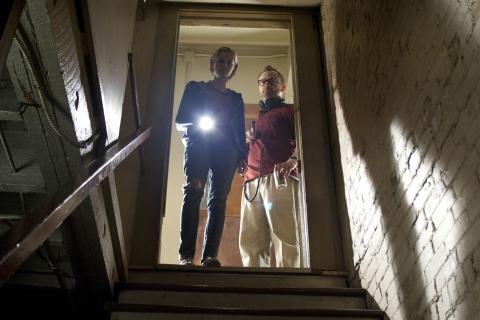
10. The Innkeepers
Horror had a very good year. A new group of young directors is moving away from the excesses of the "torture" era and with the "found footage" trend mostly burnt out, they are relying on good old-fashioned suspense. Ti West's The Innkeepers was the most impressive of this year's offerings, filmed at the real life (and supposedly haunted) Yankee Pedlar Inn in Torrington, CT. A masterful slow burn, it builds character and backstory for quite a while before the major scares start coming. When they do, they are delivered with a lot of ingenuity and creative restraint. One terrifying scene in the hotel's basement relies on the viewer's knowledge that a malevolent ghost is lurking just outside the frame without showing anything at all. If Alfred Hitchcock and Takashi Shimizu worked together, the result might look something like this.
9. Bernie
Richard Linklater's dark comedy is based on a true incident in suburban Texas, starring Jack Black as an affable, popular funeral director who becomes the prime suspect in a murder case. His neighbors just can't believe that such a pillar of the community would be involved in something so heinous and even when they are presented with ample evidence, make excuses for him. Many of these real-life folks are interviewed on camera, delivering dozens of eccentric homespun one-liners that add a distinctive tone to the movie. The actual storyline would be dull by comparison, were it not for Jack Black's career-best performance as Bernie.
8. The Raid: Redemption
The most thrilling action film I've seen in years. With too many modern blockbusters relying entirely on computer-generated replicas of actors when it comes to stunts, Gareth Evans's amazing Indonesian hybrid of kung-fu epic and police drama makes an unbeatable case for the power of old-fashioned fight choreography. When a raid on a notorious drug lord's hotel base turns bad early on, it's up to a few remaining cops (led by the very talented Iko Uwais) to fight their way past his vicious underlings. It's not the most original or intelligent story, but it's tough to get too worked up about that when your jaw's hanging wide open.
7. ParaNorman
The studio behind the awesome Coraline turned in another fantastic piece of stop-motion animation this year. A young outcast who can see the spirits of the dead becomes the only one who can avert a supernatural apocalypse, but the truth behind the spectral threats is much more complex than what viewers typically expect from a "kid's film." The movie has great fun at the expense of society's tendency to torment those who are unique, but also explores the real damage that stifling comformity can do. All that's just a bonus to the absolutely peerless stop-motion wizardry on display.
6. Cloud Atlas
I saw an unusual amount of three-hour movies this year and none of them flew by quicker than this staggeringly ambitious epic from the Wachowski siblings. Jumping back and forth through several different time periods, the movie creates one beautiful story of perseverance and the importance of the greater good. I'll be the first to admit that this is not a perfect movie - some of the casting choices are odd and a handful of scenes are so ridiculous they are downright laughable. But regardless, this was the most emotionally powerful experience I had in a movie theater this year. That has to count for something.
5. Lincoln
Daniel Day-Lewis, arguably the world's greatest actor, plays America's greatest president. How can anyone resist? The master's embodiment of Honest Abe goes against most popular depictions of him, particularly that reedy voice, but he makes you believe. The movie explores Lincoln's uphill battle to get the Thirteenth Amendment through Congress so that the freedom he promised in the Emancipation Proclamation could actually come to pass. The parallels between then and now are too numerous to count and the movie knows the viewers don't need any overt hints to make the connection. Director Steven Spielberg is as competent as you would expect, but it's the script by Tony Kushner that really makes this work. His period dialogue is highly satisfying, especially the withering oratory of Tommy Lee Jones as Congressman Thaddeus Stevens.
4. Wreck-It Ralph
This was the year Disney out-Pixared Pixar. The consensus on Pixar's Brave was that it was good but not great, an opinion I generally agree with. Then the studio's in-house Wreck-It Ralph made it clear that the witty, emotional brand of storytelling that made previous Pixar films so fun and powerful had not gone unnoticed. The movie takes its ingenious premise of a society inside the local arcade to amazing heights, creating a world so detailed and well-developed that it could support a whole season of television rather than just one film. Yet for all the superb world-building going on, the movie never forgets the small crew of characters at the center of the action. John C. Reilly's vocal work as the title character is a master class in this kind of acting and the script wisely balances out the requisite slapstick with a big heart.
3. The Invisible War
Kirby Dick may be the most skilled and versatile director producing documentaries these days. He made viewers laugh hysterically as he stuck it to the MPAA in the superb This Film is Not Yet Rated, but strikes a far more serious and appropriate tone for this painfully moving examination of the prevalence of rape in the United States military. The film gathers a group of very brave soldiers (and they're not all women) who open up about the abuse they suffered while serving their home country. If the incidents themselves weren't bad enough, they were met with indifference and hostility at the hands of the military's leadership. Americans like to brag about how much we "support the troops," but none of us have any business using that phrase until something is done about this.
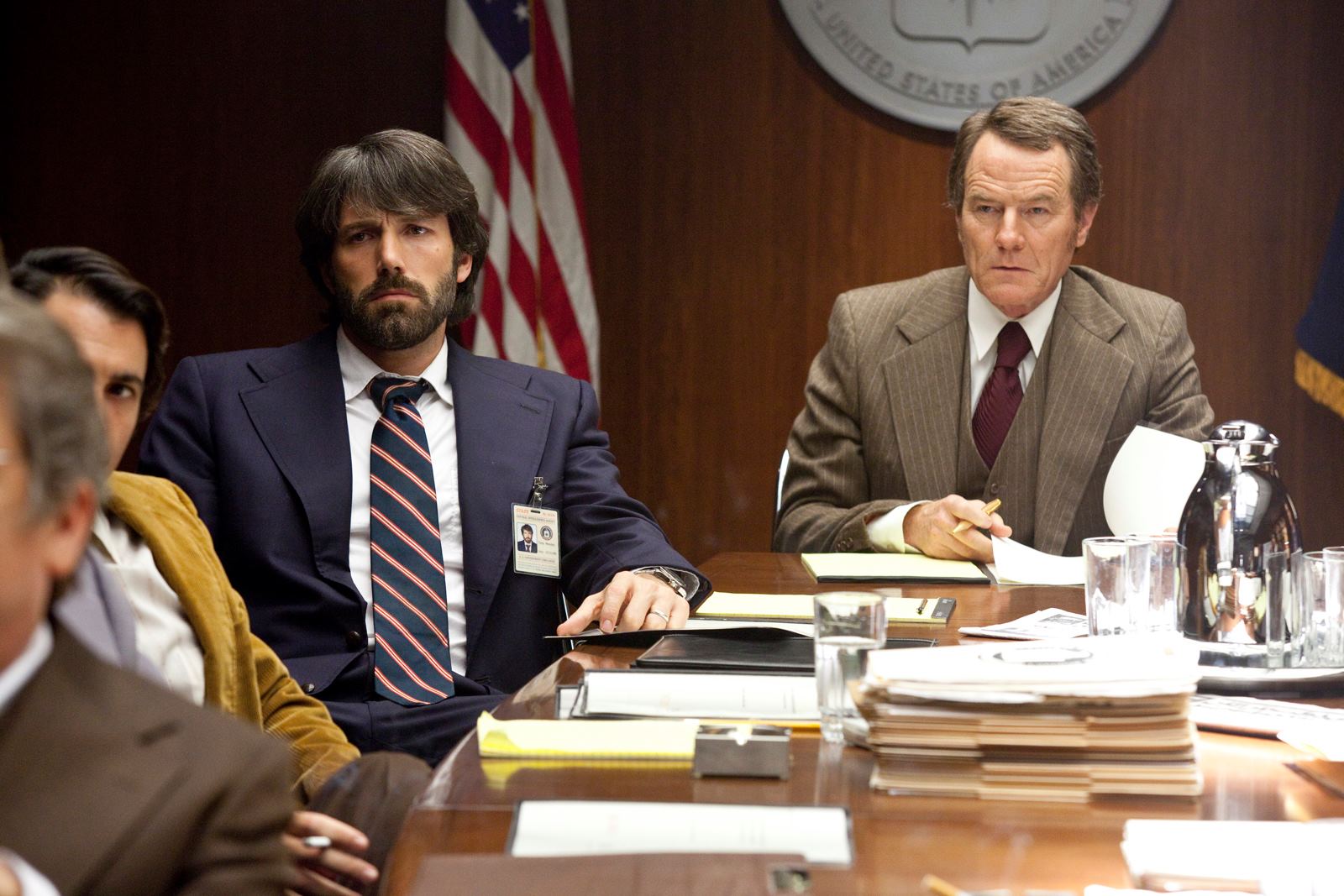
2. Argo
Ben Affleck continues his impressive directing career with a tremendous dramatization of a recently uneveiled rescue mission that unfolded in the background of the 1979 Iran Hostage Crisis. The ending is a foregone conclusion for those who know their recent history and yet the movie is packed full of white-knuckle suspense. The drama is skillfully balanced with more comedic portions as CIA operatives work with Hollywood moguls to concoct a fake movie called "Argo" that provides the cover story for the mission. It turns out that both show business and international relations rely on a great deal of self-aggrandizing BS. There's a lot to like about this movie and yet the most valuable part might be the intro, which gracefully gives a brief history of the toxic relationship between Iran and the United States and provides invaluable insight as to why that country is so hostile to us. Spoiler alert - it's not because they "hate our freedoms." This complex reality is something America will have to wrestle with if we don't want to be stuck in a permanent state of conflict in that region.
1. Django Unchained
It's not very often that a piece of mainstream American entertainment forces us to confront the national disgrace of slavery head-on. Only a filmmaker with a reptuation like Quentin Tarantino's can expect studio support and a wide audience for a topic so inflammatory. And yet Tarantino never forgets he's making a movie, resulting in a wildly entertaining epic that's also an important reminder of our troubled history. Tarantino's a diehard fan of classic exploitation cinema and brings that sensibility to the film - it's definitely more than a lot of people will want to stomach. Still, when you hear the self-anointed moral guradians whine about the violence in this movie, it's important to remember that the reality was far worse. What people forget about exploitation films is that the best of them could use their intensity to make a powerful moral statement. I prefer violence that comes with a clear message, unlike movies that clinically present violence with no comment and then let other people argue about what the point of it is (i.e. Zero Dark Thirty). Django Unchained is a highly satisfying middle finger to the bigotry that still continues to have a strong influence on our national dialogue. It's also masterfully shot and full of great acting - Jamie Foxx, Christoph Waltz, Samuel L. Jackson and Leonardo DiCaprio are all excellent. This is my favorite Tarantino film since Pulp Fiction.
Honorable Mentions: Chronicle, Looper, The Cabin in the Woods, The Secret World of Arrietty, Silver Linings Playbook, Moonrise Kingdom, Sound of My Voice, Excision, The Avengers, The Tall Man
It's a good thing we saw such an improvement this year, because film culture is in very real danger of being completely supplanted by television. I can't think of any movies that generated as much interest as acclaimed shows like "Mad Men," "Game of Thrones" or "Breaking Bad." We're in the midst of an amazing period of television and we're going to need several movie years like this one in order to keep up. Someone more qualified can rank this year's television (I find it borderline impossible to be well-informed on both, so I choose movies). Here are my ten favorites.
10. The Innkeepers
Horror had a very good year. A new group of young directors is moving away from the excesses of the "torture" era and with the "found footage" trend mostly burnt out, they are relying on good old-fashioned suspense. Ti West's The Innkeepers was the most impressive of this year's offerings, filmed at the real life (and supposedly haunted) Yankee Pedlar Inn in Torrington, CT. A masterful slow burn, it builds character and backstory for quite a while before the major scares start coming. When they do, they are delivered with a lot of ingenuity and creative restraint. One terrifying scene in the hotel's basement relies on the viewer's knowledge that a malevolent ghost is lurking just outside the frame without showing anything at all. If Alfred Hitchcock and Takashi Shimizu worked together, the result might look something like this.
9. Bernie
Richard Linklater's dark comedy is based on a true incident in suburban Texas, starring Jack Black as an affable, popular funeral director who becomes the prime suspect in a murder case. His neighbors just can't believe that such a pillar of the community would be involved in something so heinous and even when they are presented with ample evidence, make excuses for him. Many of these real-life folks are interviewed on camera, delivering dozens of eccentric homespun one-liners that add a distinctive tone to the movie. The actual storyline would be dull by comparison, were it not for Jack Black's career-best performance as Bernie.
8. The Raid: Redemption
The most thrilling action film I've seen in years. With too many modern blockbusters relying entirely on computer-generated replicas of actors when it comes to stunts, Gareth Evans's amazing Indonesian hybrid of kung-fu epic and police drama makes an unbeatable case for the power of old-fashioned fight choreography. When a raid on a notorious drug lord's hotel base turns bad early on, it's up to a few remaining cops (led by the very talented Iko Uwais) to fight their way past his vicious underlings. It's not the most original or intelligent story, but it's tough to get too worked up about that when your jaw's hanging wide open.
7. ParaNorman
The studio behind the awesome Coraline turned in another fantastic piece of stop-motion animation this year. A young outcast who can see the spirits of the dead becomes the only one who can avert a supernatural apocalypse, but the truth behind the spectral threats is much more complex than what viewers typically expect from a "kid's film." The movie has great fun at the expense of society's tendency to torment those who are unique, but also explores the real damage that stifling comformity can do. All that's just a bonus to the absolutely peerless stop-motion wizardry on display.
6. Cloud Atlas
I saw an unusual amount of three-hour movies this year and none of them flew by quicker than this staggeringly ambitious epic from the Wachowski siblings. Jumping back and forth through several different time periods, the movie creates one beautiful story of perseverance and the importance of the greater good. I'll be the first to admit that this is not a perfect movie - some of the casting choices are odd and a handful of scenes are so ridiculous they are downright laughable. But regardless, this was the most emotionally powerful experience I had in a movie theater this year. That has to count for something.
5. Lincoln
Daniel Day-Lewis, arguably the world's greatest actor, plays America's greatest president. How can anyone resist? The master's embodiment of Honest Abe goes against most popular depictions of him, particularly that reedy voice, but he makes you believe. The movie explores Lincoln's uphill battle to get the Thirteenth Amendment through Congress so that the freedom he promised in the Emancipation Proclamation could actually come to pass. The parallels between then and now are too numerous to count and the movie knows the viewers don't need any overt hints to make the connection. Director Steven Spielberg is as competent as you would expect, but it's the script by Tony Kushner that really makes this work. His period dialogue is highly satisfying, especially the withering oratory of Tommy Lee Jones as Congressman Thaddeus Stevens.
4. Wreck-It Ralph
This was the year Disney out-Pixared Pixar. The consensus on Pixar's Brave was that it was good but not great, an opinion I generally agree with. Then the studio's in-house Wreck-It Ralph made it clear that the witty, emotional brand of storytelling that made previous Pixar films so fun and powerful had not gone unnoticed. The movie takes its ingenious premise of a society inside the local arcade to amazing heights, creating a world so detailed and well-developed that it could support a whole season of television rather than just one film. Yet for all the superb world-building going on, the movie never forgets the small crew of characters at the center of the action. John C. Reilly's vocal work as the title character is a master class in this kind of acting and the script wisely balances out the requisite slapstick with a big heart.
3. The Invisible War
Kirby Dick may be the most skilled and versatile director producing documentaries these days. He made viewers laugh hysterically as he stuck it to the MPAA in the superb This Film is Not Yet Rated, but strikes a far more serious and appropriate tone for this painfully moving examination of the prevalence of rape in the United States military. The film gathers a group of very brave soldiers (and they're not all women) who open up about the abuse they suffered while serving their home country. If the incidents themselves weren't bad enough, they were met with indifference and hostility at the hands of the military's leadership. Americans like to brag about how much we "support the troops," but none of us have any business using that phrase until something is done about this.
2. Argo
Ben Affleck continues his impressive directing career with a tremendous dramatization of a recently uneveiled rescue mission that unfolded in the background of the 1979 Iran Hostage Crisis. The ending is a foregone conclusion for those who know their recent history and yet the movie is packed full of white-knuckle suspense. The drama is skillfully balanced with more comedic portions as CIA operatives work with Hollywood moguls to concoct a fake movie called "Argo" that provides the cover story for the mission. It turns out that both show business and international relations rely on a great deal of self-aggrandizing BS. There's a lot to like about this movie and yet the most valuable part might be the intro, which gracefully gives a brief history of the toxic relationship between Iran and the United States and provides invaluable insight as to why that country is so hostile to us. Spoiler alert - it's not because they "hate our freedoms." This complex reality is something America will have to wrestle with if we don't want to be stuck in a permanent state of conflict in that region.
1. Django Unchained
It's not very often that a piece of mainstream American entertainment forces us to confront the national disgrace of slavery head-on. Only a filmmaker with a reptuation like Quentin Tarantino's can expect studio support and a wide audience for a topic so inflammatory. And yet Tarantino never forgets he's making a movie, resulting in a wildly entertaining epic that's also an important reminder of our troubled history. Tarantino's a diehard fan of classic exploitation cinema and brings that sensibility to the film - it's definitely more than a lot of people will want to stomach. Still, when you hear the self-anointed moral guradians whine about the violence in this movie, it's important to remember that the reality was far worse. What people forget about exploitation films is that the best of them could use their intensity to make a powerful moral statement. I prefer violence that comes with a clear message, unlike movies that clinically present violence with no comment and then let other people argue about what the point of it is (i.e. Zero Dark Thirty). Django Unchained is a highly satisfying middle finger to the bigotry that still continues to have a strong influence on our national dialogue. It's also masterfully shot and full of great acting - Jamie Foxx, Christoph Waltz, Samuel L. Jackson and Leonardo DiCaprio are all excellent. This is my favorite Tarantino film since Pulp Fiction.
Honorable Mentions: Chronicle, Looper, The Cabin in the Woods, The Secret World of Arrietty, Silver Linings Playbook, Moonrise Kingdom, Sound of My Voice, Excision, The Avengers, The Tall Man
Saturday, December 22, 2012
Clone Saga Revisited - Conclusion
This is the last entry for this series, so I'm going to add a few links in case you stumble upon it first. Here are Part 1, Part 2, Part 3, Part 4, Part 5, Part 6, Part 7, Part 8, Part 9, Part 10 and Part 11.
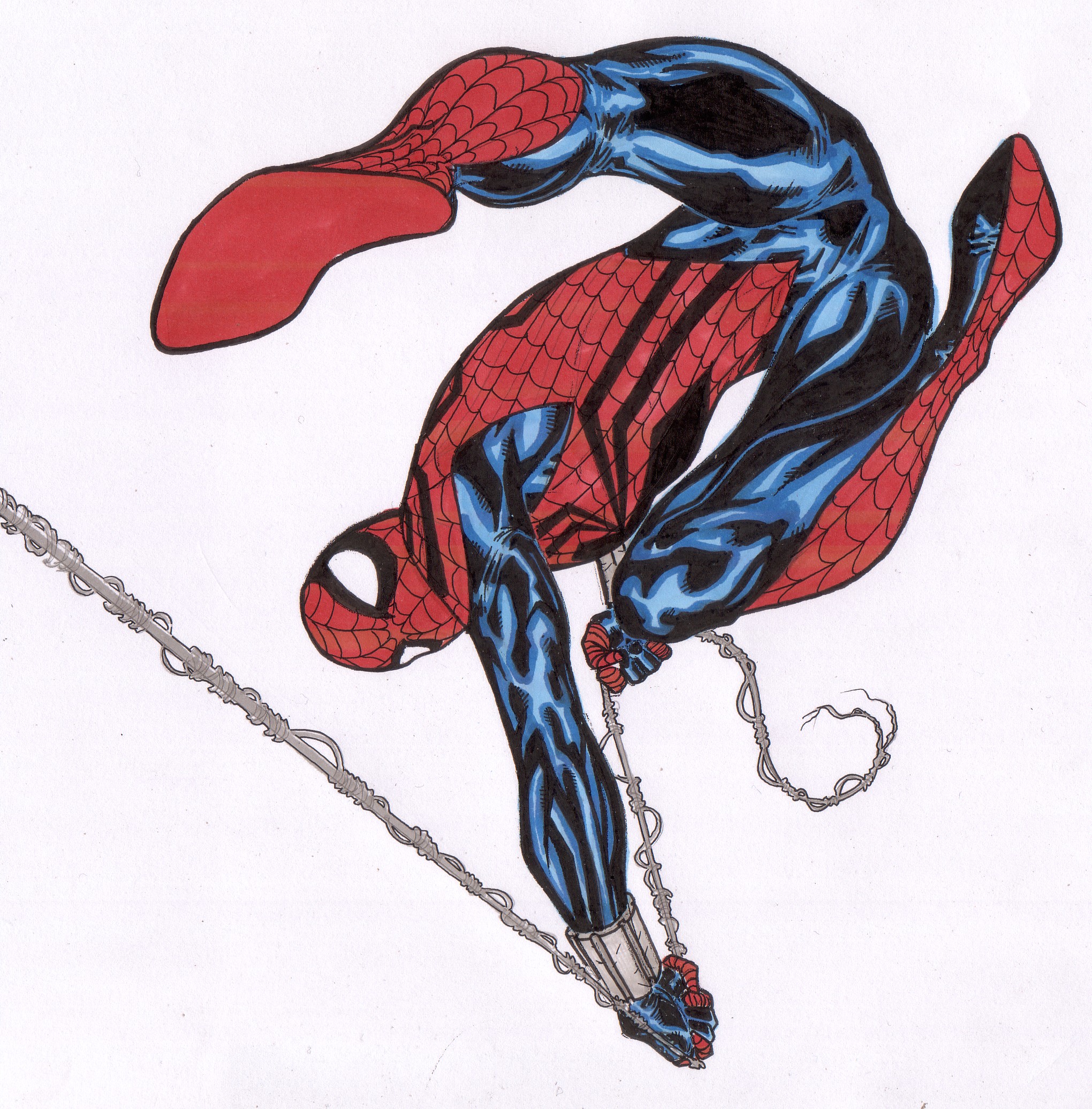
We're done going through the Clone Saga itself, but its impact was felt for a number of years afterward. The "Revelations" storyline ended with Peter and Mary Jane believing that Baby May was dead, when she had actually been taken to Europe by Norman Osborn's agent Allison Mongraine. As I said last time, this is a premise that could have led to some truly epic storylines. Imagine Peter and Mary Jane getting word from some mysterious source that the baby was still alive and Spider-Man adventuring through Europe searching for her. If they ever keep a series of Spidey movies going long enough without restarting it, that idea sounds like a winner. For a while, it seemed like Tom DeFalco was patiently building up to that.
In the "Identity Crisis" storyline, one of the last truly great Spider-Man tales before that rancid "One More Day" crap ruined the continuity, there was a subplot about all of this. Allison Mongraine met with members of the Cult of Scrier, who told her to hand May over and unsuccessfully tried to assassinate her. The Scrier cultists were ambushed by Kaine, who presumably rescued the baby. After all, as another clone of Peter, he's basically an uncle. Later, in the "Gathering of Five" storyline, Mongraine was killed and told Peter before she died that "May is alive." It all sounds pretty good so far, right?
Well, the brass at Marvel didn't think so. They intervened and tried to convince the readers that Mongraine was actually referring to Aunt May - you know, the ancient character who had passed away peacefully in a beautiful story during the Clone Saga? The writers were forced to bring her back, using the absolutely heinous rationale that the old lady who died was actually an actress who underwent plastic surgery to resemble Peter's aunt. Yes, I'm serious. This was one of the first salvos in a noxious campaign to undo Peter Parker's character development to try and appeal to the Johnny-come-lately fans who would have been more likely to make fun of comic readers on the playground until the first Sam Raimi Spider-Man film made $400 million at the box office. This culiminated in the "One More Day" storyline (have I mentioned yet how much that one sucks?) but I was gone long before then. As an older fan, I could tell I wasn't wanted.
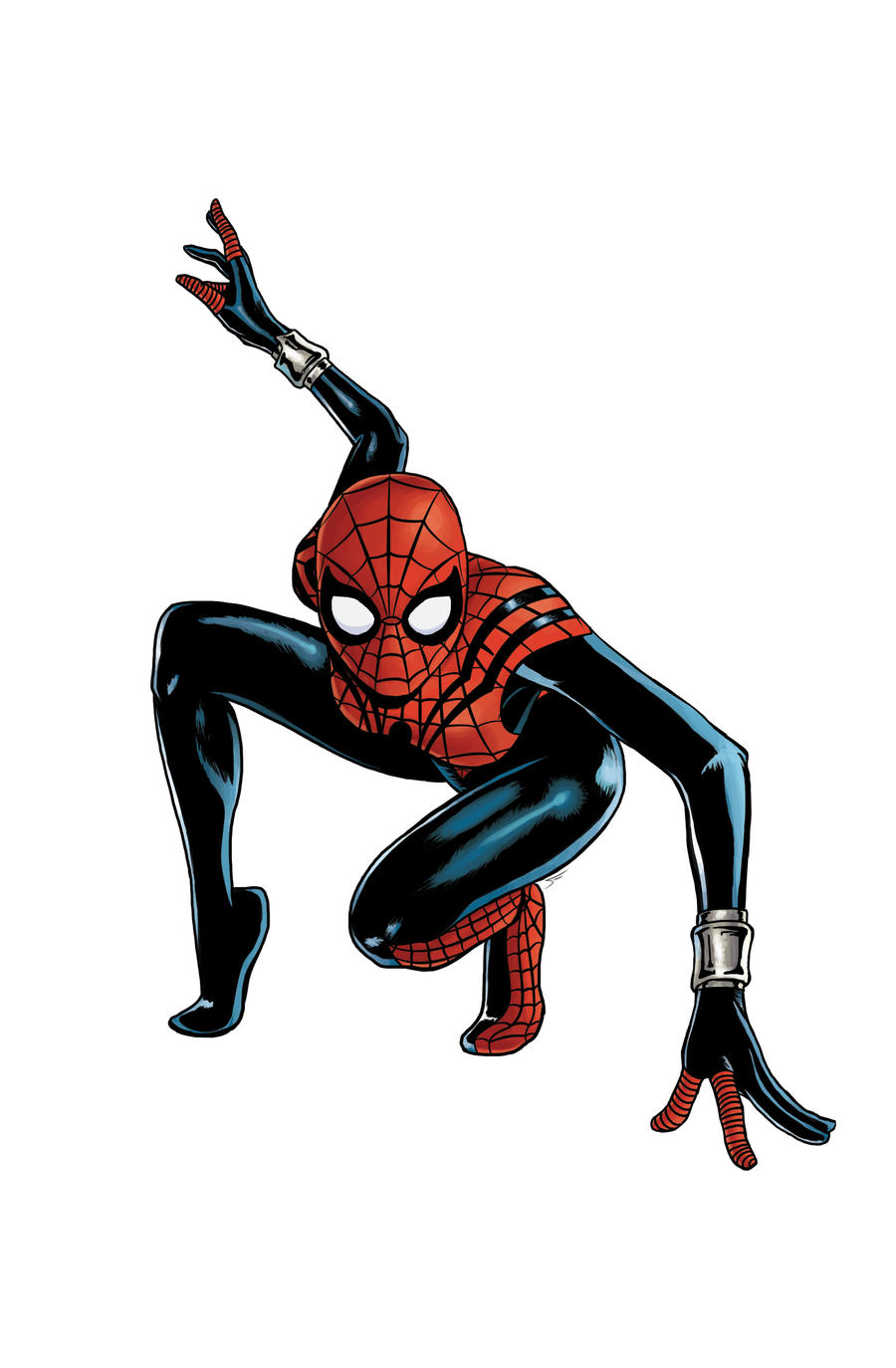
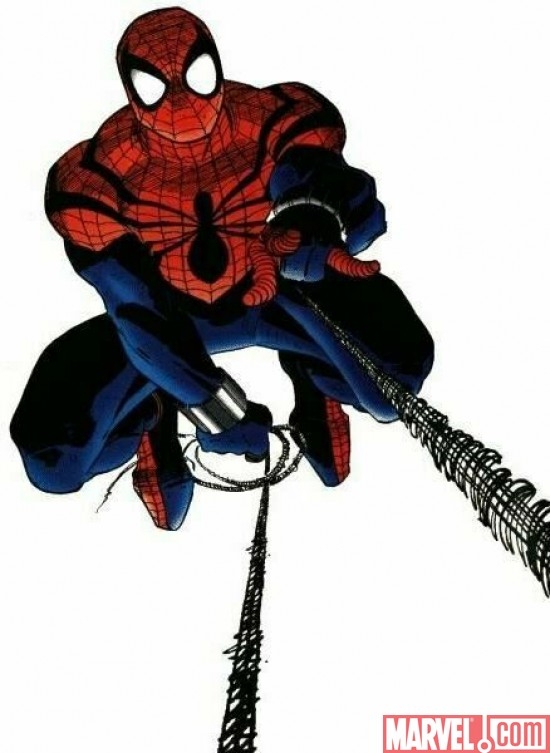
Years later, something caught my eye at a local pharmacy - an issue of "Spider-Girl." The cover featured a woman in the classic Spidey suit but also a visibly aged Peter Parker. I wondered to myself, "is this a series about Baby May?" There was only one way to find out, so I took a chance and bought it.
I loved it. Every panel of every page. With DeFalco at the writer's desk, this series was a lifeline to those fans who were left out in the cold and a chance for him to pursue storyline which had been wrested from him years earlier. It turns out Kaine really was the one who rescued the baby and returned her to the Parkers. He had a role too, as a mercenary working for the United States government who was often a mentor figure for May, now protecting New York City as Spider-Girl. Many readers latched onto this series as the "true" continuity. We were older and we were ready for Peter to be older as well.
I read the Spider-Girl comics faithfully for a number of years, but unfortunately a female heroine doesn't always inspire confidence in comics executives. The series was constantly canceled, un-canceled, and restarted until it finally vanished. Once again, I'm an aging Spidey fan without any Spidey comics that capture the stories I grew up with. So I wind up going back into the comics of the past, which is what I've done for the last 2+ years as part of this blog retrospective.
Since the Clone Saga ended, many of the creators have come forward with their views on why an otherwise promising storyline eventually imploded. "At its heart, the Clone Saga was a very simple story," DeFalco said. "[It] was a storyline designed to last a few months, but, for various reasons, kept getting extended and extended and extended."
J.M. Dematteis said that "it would have been a classic if the creators had been allowed to follow their original vision through to the end." Another writer, Todd Dezago, recalled when "we realized the train was being driven by indecision and sales figures." For an amazingly detailed look at what was going on behind the scenes during the entire Clone Saga, I'd suggest reading the Life of Reilly blog. It was a superb resource while I worked on this series.
In late 2009, DeFalco and fellow Spidey-writer Howard Mackie wrote a six-issue mini-series called, (what else?) Spider-Man: Clone Saga. This was an interesting attempt to do-over the Clone Saga and was likely very cathartic for the creators who watched that original storyline spin out of control. It's a fascinating, highly entertaining take on the storyline that basically fixes every wrong turn the first version made. Here's the list.
-In general, Peter Parker is much more reasonable. He does scuffle with Ben Reilly during their first meeting but is in a more sensible place by the end of the first issue. When it's "revealed" that Reilly may the original, Peter simply says "I honestly don't care if I'm the clone. The way I live is more important than the way I was born." Uh...yeah! Very refreshing indeed.
-Judas Traveller, Gaunt, Seward Trainer, and the Cult of Scrier are completely excised. The Jackal's role is also mercifully less grandiose. I'm sure Marvel got a lot of angry letters about this...maybe even one.
-Kaine defeats Doctor Octopus but doesn't kill him. This obviously means that Lady Octopus and all her "cyberwar" nonsense doesn't come up.
-The mastermind turns out not to be Norman Osborn, but Harry Osborn, who had been dead for far less time. As for Norman, he does show up as a clone. Interestingly, he winds up as one of the good guys. Perhaps because the clone was unburdened with the insanity that eventually twisted the original Norman Osborn?
-Aunt May survives her stroke and Baby May is returned to the family by Kaine shortly after her kidnapping. Ben Reilly also survives the final battle and eventually heads off to seek new adventures.
As you can see, there were many improvements but I don't think this mini-series is perfect either. If over two years worth of comics was way too much, six issues isn't quite enough. It feels a bit too breezy and there are pretty big time skips between the issues that you couldn't get away with in a main continuity. Twelve issues would have been just right...but I don't want to sound ungrateful, this was a very valuable effort!
I suppose that brings us to the end. It's been very satifying to get some additional insight by revisiting this saga and I hope these write-ups provided some of that same insight. But Oscar season is in full-swing once again, so this blog should remain busy!
We're done going through the Clone Saga itself, but its impact was felt for a number of years afterward. The "Revelations" storyline ended with Peter and Mary Jane believing that Baby May was dead, when she had actually been taken to Europe by Norman Osborn's agent Allison Mongraine. As I said last time, this is a premise that could have led to some truly epic storylines. Imagine Peter and Mary Jane getting word from some mysterious source that the baby was still alive and Spider-Man adventuring through Europe searching for her. If they ever keep a series of Spidey movies going long enough without restarting it, that idea sounds like a winner. For a while, it seemed like Tom DeFalco was patiently building up to that.
In the "Identity Crisis" storyline, one of the last truly great Spider-Man tales before that rancid "One More Day" crap ruined the continuity, there was a subplot about all of this. Allison Mongraine met with members of the Cult of Scrier, who told her to hand May over and unsuccessfully tried to assassinate her. The Scrier cultists were ambushed by Kaine, who presumably rescued the baby. After all, as another clone of Peter, he's basically an uncle. Later, in the "Gathering of Five" storyline, Mongraine was killed and told Peter before she died that "May is alive." It all sounds pretty good so far, right?
Well, the brass at Marvel didn't think so. They intervened and tried to convince the readers that Mongraine was actually referring to Aunt May - you know, the ancient character who had passed away peacefully in a beautiful story during the Clone Saga? The writers were forced to bring her back, using the absolutely heinous rationale that the old lady who died was actually an actress who underwent plastic surgery to resemble Peter's aunt. Yes, I'm serious. This was one of the first salvos in a noxious campaign to undo Peter Parker's character development to try and appeal to the Johnny-come-lately fans who would have been more likely to make fun of comic readers on the playground until the first Sam Raimi Spider-Man film made $400 million at the box office. This culiminated in the "One More Day" storyline (have I mentioned yet how much that one sucks?) but I was gone long before then. As an older fan, I could tell I wasn't wanted.
Years later, something caught my eye at a local pharmacy - an issue of "Spider-Girl." The cover featured a woman in the classic Spidey suit but also a visibly aged Peter Parker. I wondered to myself, "is this a series about Baby May?" There was only one way to find out, so I took a chance and bought it.
I loved it. Every panel of every page. With DeFalco at the writer's desk, this series was a lifeline to those fans who were left out in the cold and a chance for him to pursue storyline which had been wrested from him years earlier. It turns out Kaine really was the one who rescued the baby and returned her to the Parkers. He had a role too, as a mercenary working for the United States government who was often a mentor figure for May, now protecting New York City as Spider-Girl. Many readers latched onto this series as the "true" continuity. We were older and we were ready for Peter to be older as well.
I read the Spider-Girl comics faithfully for a number of years, but unfortunately a female heroine doesn't always inspire confidence in comics executives. The series was constantly canceled, un-canceled, and restarted until it finally vanished. Once again, I'm an aging Spidey fan without any Spidey comics that capture the stories I grew up with. So I wind up going back into the comics of the past, which is what I've done for the last 2+ years as part of this blog retrospective.
Since the Clone Saga ended, many of the creators have come forward with their views on why an otherwise promising storyline eventually imploded. "At its heart, the Clone Saga was a very simple story," DeFalco said. "[It] was a storyline designed to last a few months, but, for various reasons, kept getting extended and extended and extended."
J.M. Dematteis said that "it would have been a classic if the creators had been allowed to follow their original vision through to the end." Another writer, Todd Dezago, recalled when "we realized the train was being driven by indecision and sales figures." For an amazingly detailed look at what was going on behind the scenes during the entire Clone Saga, I'd suggest reading the Life of Reilly blog. It was a superb resource while I worked on this series.
In late 2009, DeFalco and fellow Spidey-writer Howard Mackie wrote a six-issue mini-series called, (what else?) Spider-Man: Clone Saga. This was an interesting attempt to do-over the Clone Saga and was likely very cathartic for the creators who watched that original storyline spin out of control. It's a fascinating, highly entertaining take on the storyline that basically fixes every wrong turn the first version made. Here's the list.
-In general, Peter Parker is much more reasonable. He does scuffle with Ben Reilly during their first meeting but is in a more sensible place by the end of the first issue. When it's "revealed" that Reilly may the original, Peter simply says "I honestly don't care if I'm the clone. The way I live is more important than the way I was born." Uh...yeah! Very refreshing indeed.
-Judas Traveller, Gaunt, Seward Trainer, and the Cult of Scrier are completely excised. The Jackal's role is also mercifully less grandiose. I'm sure Marvel got a lot of angry letters about this...maybe even one.
-Kaine defeats Doctor Octopus but doesn't kill him. This obviously means that Lady Octopus and all her "cyberwar" nonsense doesn't come up.
-The mastermind turns out not to be Norman Osborn, but Harry Osborn, who had been dead for far less time. As for Norman, he does show up as a clone. Interestingly, he winds up as one of the good guys. Perhaps because the clone was unburdened with the insanity that eventually twisted the original Norman Osborn?
-Aunt May survives her stroke and Baby May is returned to the family by Kaine shortly after her kidnapping. Ben Reilly also survives the final battle and eventually heads off to seek new adventures.
As you can see, there were many improvements but I don't think this mini-series is perfect either. If over two years worth of comics was way too much, six issues isn't quite enough. It feels a bit too breezy and there are pretty big time skips between the issues that you couldn't get away with in a main continuity. Twelve issues would have been just right...but I don't want to sound ungrateful, this was a very valuable effort!
I suppose that brings us to the end. It's been very satifying to get some additional insight by revisiting this saga and I hope these write-ups provided some of that same insight. But Oscar season is in full-swing once again, so this blog should remain busy!
Sunday, December 9, 2012
Clone Saga Revisited - Part Eleven
The sixth and final "Ben Reilly Epic" collection, the eleventh in total with the five other "Clone Saga" collections, finally offers the conclusion to this storyline. Given how far this plotline had spun wildly out of control, actually ending it in a way that would satisfy frustrated readers (the ones who hadn't already left) would be challenging indeed. Did they pull it off? Well, kind of. We'll get to that soon enough, but first there are a lot of loose ends to manage.
This final collection opens with a two-part story that brings the subplot about Fortunato, a new crime boss and Jimmy Six, the thug who has been hiding out with Ben Reilly, to a climax. Turns out Jimmy is Fortunato's son, but he still can't condone his father's methods, so he works with Spider-Man (not knowing the Reilly connection) to foil his dad's plot. Daredevil helps out too. The next story's task is to get a handle on one of the saga's lamest characters, the demigod Judas Traveler. This is a much tougher problem although only one issue is devoted to it.
This story tries to convince us that Traveler isn't really all-powerful, he's actually just an X-Men-style mutant with illusionist powers. It sounds reasonable at first...unless you go back and check out the older Traveler stories - that heinous "Crossfire" story in particular. If you recall, that was the story where our buddy Judas supposedly took Peter Parker into a future where New York was destroyed but then had to be saved by Parker when he was too reckless with the space-time continuum (you really have to be careful about that!). So if we're now being told that all these incidents were illusions, why did Traveler want to fool Spider-Man into thinking he was an incompetent idiot? Oh well, the two Spider-Man save him from The Rose and in the process, they discover that his mysterious assistant, "Scrier," is actually just one member of a huge cult where they all dress like the Grim Reaper. This is kind of important later.
Next, we have to resolve the "Great Game" storyline where various super-powered folks fight each other and wealthy jerks bet on the results. Reilly's been drawn into this silliness a number of times and it's pretty satisfying to see him finally teach these guys a lesson. In a surprising twist, this story features the death of Nightwatch, Marvel's ill-fated Spawn rip-off. After this is some filler - team-up stories featuring Gambit and Howard The Duck. Yes, I'm serious. The Gambit story is actually pretty good, the Howard the Duck story is as terrible as you would expect.
However, after that is "Relevations," the four-part story that finally ended the Clone Saga. Right from the start, you know that things are dead serious. Seward Trainer, the genecticist who determined that Ben Reilly was the real deal and that the man we knew as Peter Parker was the clone, is on the run. We had found out that Trainer was in league with the mysterious Gaunt and the even more mysterious figure who they both answer to. After a lengthy chase, Trainer is killed by Gaunt, who is revealed to be Dr. Mendel Stromm, the "Robot Master" and an old foe of Spider-Man. It's up to Ben and Peter to defeat Stromm once and for all, but in the meantime the pregnant Mary Jane is in trouble. A con-artist named Allison Mongraine slips a drug into one of her meals that induces labor. Baby May was already almost full-term, so that in itself might not be a huge deal, but there's more trouble ahead.
Peter leaves to try and be with Mary Jane, while Ben is confronted by Stromm's boss. It's none other than Norman Osborn, the original Green Goblin, who had been presumed dead for 20 years worth of Spidey comics. Osborn kills Stromm and defeats Reilly without much trouble. In the meantime, newborn baby May is taken from the hospital by Allison Mongraine. It turns out Osborn engineered this whole situation and tells her to hide the baby in Europe. For whatever else he's capable of, Osborn isn't willing to kill a newborn. He's perfectly content just to let Peter and Mary Jane believe she was stillborn. It's brutal- any Spidey fan's heart will break for the two of them when reading these scenes.
"Relevations" concludes with "Night of the Goblin," which is a pretty great comic on its own. The art is superb and full of atmosphere, and however you might feel about Norman coming back, seeing his return is epic. He confronts Peter and explains everything - how he survived being impaled by his own glider years ago and has been plotting his revenge for years while hiding overseas. With Trainer's help, he made Peter believe he was a clone in a scheme designed to destroy his very identity. If that wasn't enough, he's also manipulated a group of Peter's friends and family into the Daily Bugle building, which he plans to destroy. Ben recovers from the beating Osborn gave him and the two Spider-Men are able to save the others and subdue him. However, the Goblin once again sends his razor-sharp glider at Peter while his back is turned. This time, it's Ben who intervenes and takes a fatal hit. He still believed he was the real Peter but was still willing to sacrifice himself for his "brother."
Peter hits the Goblin with a bag full of pumpkin bombs and he vanishes in a fiery explosion...but he just got back, so we know he'll be sticking around for a while now. Peter tends to the dying Ben, whose body suddenly undergoes the "degeneration" process, revealing beyond all doubt that he had always been the clone. One loss leads to another - the battered Peter finally arrives at the hospital only to hear that baby May is apparently dead. There's another issue after this where Peter and Mary Jane try to cope with the horrible loss of both Ben and the baby. The writers try to get some uplift in there, but it doesn't work. It's brutally sad. There's also a little subplot about the Chameleon, but that doesn't really matter because the Clone Saga is officially over!
Let's take a detailed look at the ending - what was done right and what didn't work?
The Good
-Obviously, the most important accomplishment of the finale was that it reinstated Peter Parker as the true Spider-Man. The Revelation that Nobody Wanted was finally undone.
-Bringing Norman Osborn back was actually pretty awesome. The Clone Saga had gotten so convoluted that there were precious few characters devious enough to pull off a scheme like that. In fact, Spider-Man himself had been lacking a real arch-enemy for a while. It's not like Venom has the intellect to manage something like this.
-The presumed death of Baby May would have been a truly epic story premise...
The Bad
...if Marvel hadn't completely botched it in the coming years. Despite the best efforts of the great Spidey-writer Tom DeFalco, the editorial staff squelched this subplot and then the absolutely terrible "One More Day" thing made it irrelevant. But more on that next time. Yeah, there's gonna be one more entry, we gotta talk about the legacy of this saga and how it has been perceived over the years.
-Actually killing Ben Reilly was a step too far. The fans didn't want him dead, we just didn't want him to replace Peter. We still liked the guy, he'd been in the comics for over two years at this point! One of the main problems with 90s Spider-Man was that the writers kept killing off longtime supporting characters to create "events" and sell more comics. The problem was that Spidey's world was a lot less interesting without all these folks. Ben could have helped turn that around, but now he was gone too. I suppose the rationale was that the writers wanted to assure the readers that under no circumstances would Ben be declared the original Parker again, but there were other ways to do that. Just another genetic test by someone of unimpeachable moral character - Reed Richards, maybe?
This collection has a few more goodies before it ends. The "Osborn Journal" attempts, with mostly success, to explain just how Norman Osborn planned the entire scheme. After that is "101 Ways to End the Clone Saga," an in-house parody of the difficulty Marvel writers had with the storyline. The final story is "Dead Man's Hand," a convoluted tale of the villain Carrion, whose continuity was in conflict with the events of the Clone Saga. This story was an effort to set things straight, but I think very few fans even thought about it with everything else going on during the saga.
It would be nice to say that the Spider-Man comics got back on track once the Clone Saga was finally over. Unfortunately, things eventually got much worse...but that's a story for another day. In the final entry of this series, I'll go into the saga's legacy and some of the important storylines that came in its aftermath.
This final collection opens with a two-part story that brings the subplot about Fortunato, a new crime boss and Jimmy Six, the thug who has been hiding out with Ben Reilly, to a climax. Turns out Jimmy is Fortunato's son, but he still can't condone his father's methods, so he works with Spider-Man (not knowing the Reilly connection) to foil his dad's plot. Daredevil helps out too. The next story's task is to get a handle on one of the saga's lamest characters, the demigod Judas Traveler. This is a much tougher problem although only one issue is devoted to it.
This story tries to convince us that Traveler isn't really all-powerful, he's actually just an X-Men-style mutant with illusionist powers. It sounds reasonable at first...unless you go back and check out the older Traveler stories - that heinous "Crossfire" story in particular. If you recall, that was the story where our buddy Judas supposedly took Peter Parker into a future where New York was destroyed but then had to be saved by Parker when he was too reckless with the space-time continuum (you really have to be careful about that!). So if we're now being told that all these incidents were illusions, why did Traveler want to fool Spider-Man into thinking he was an incompetent idiot? Oh well, the two Spider-Man save him from The Rose and in the process, they discover that his mysterious assistant, "Scrier," is actually just one member of a huge cult where they all dress like the Grim Reaper. This is kind of important later.
Next, we have to resolve the "Great Game" storyline where various super-powered folks fight each other and wealthy jerks bet on the results. Reilly's been drawn into this silliness a number of times and it's pretty satisfying to see him finally teach these guys a lesson. In a surprising twist, this story features the death of Nightwatch, Marvel's ill-fated Spawn rip-off. After this is some filler - team-up stories featuring Gambit and Howard The Duck. Yes, I'm serious. The Gambit story is actually pretty good, the Howard the Duck story is as terrible as you would expect.
However, after that is "Relevations," the four-part story that finally ended the Clone Saga. Right from the start, you know that things are dead serious. Seward Trainer, the genecticist who determined that Ben Reilly was the real deal and that the man we knew as Peter Parker was the clone, is on the run. We had found out that Trainer was in league with the mysterious Gaunt and the even more mysterious figure who they both answer to. After a lengthy chase, Trainer is killed by Gaunt, who is revealed to be Dr. Mendel Stromm, the "Robot Master" and an old foe of Spider-Man. It's up to Ben and Peter to defeat Stromm once and for all, but in the meantime the pregnant Mary Jane is in trouble. A con-artist named Allison Mongraine slips a drug into one of her meals that induces labor. Baby May was already almost full-term, so that in itself might not be a huge deal, but there's more trouble ahead.
Peter leaves to try and be with Mary Jane, while Ben is confronted by Stromm's boss. It's none other than Norman Osborn, the original Green Goblin, who had been presumed dead for 20 years worth of Spidey comics. Osborn kills Stromm and defeats Reilly without much trouble. In the meantime, newborn baby May is taken from the hospital by Allison Mongraine. It turns out Osborn engineered this whole situation and tells her to hide the baby in Europe. For whatever else he's capable of, Osborn isn't willing to kill a newborn. He's perfectly content just to let Peter and Mary Jane believe she was stillborn. It's brutal- any Spidey fan's heart will break for the two of them when reading these scenes.
"Relevations" concludes with "Night of the Goblin," which is a pretty great comic on its own. The art is superb and full of atmosphere, and however you might feel about Norman coming back, seeing his return is epic. He confronts Peter and explains everything - how he survived being impaled by his own glider years ago and has been plotting his revenge for years while hiding overseas. With Trainer's help, he made Peter believe he was a clone in a scheme designed to destroy his very identity. If that wasn't enough, he's also manipulated a group of Peter's friends and family into the Daily Bugle building, which he plans to destroy. Ben recovers from the beating Osborn gave him and the two Spider-Men are able to save the others and subdue him. However, the Goblin once again sends his razor-sharp glider at Peter while his back is turned. This time, it's Ben who intervenes and takes a fatal hit. He still believed he was the real Peter but was still willing to sacrifice himself for his "brother."
Peter hits the Goblin with a bag full of pumpkin bombs and he vanishes in a fiery explosion...but he just got back, so we know he'll be sticking around for a while now. Peter tends to the dying Ben, whose body suddenly undergoes the "degeneration" process, revealing beyond all doubt that he had always been the clone. One loss leads to another - the battered Peter finally arrives at the hospital only to hear that baby May is apparently dead. There's another issue after this where Peter and Mary Jane try to cope with the horrible loss of both Ben and the baby. The writers try to get some uplift in there, but it doesn't work. It's brutally sad. There's also a little subplot about the Chameleon, but that doesn't really matter because the Clone Saga is officially over!
Let's take a detailed look at the ending - what was done right and what didn't work?
The Good
-Obviously, the most important accomplishment of the finale was that it reinstated Peter Parker as the true Spider-Man. The Revelation that Nobody Wanted was finally undone.
-Bringing Norman Osborn back was actually pretty awesome. The Clone Saga had gotten so convoluted that there were precious few characters devious enough to pull off a scheme like that. In fact, Spider-Man himself had been lacking a real arch-enemy for a while. It's not like Venom has the intellect to manage something like this.
-The presumed death of Baby May would have been a truly epic story premise...
The Bad
...if Marvel hadn't completely botched it in the coming years. Despite the best efforts of the great Spidey-writer Tom DeFalco, the editorial staff squelched this subplot and then the absolutely terrible "One More Day" thing made it irrelevant. But more on that next time. Yeah, there's gonna be one more entry, we gotta talk about the legacy of this saga and how it has been perceived over the years.
-Actually killing Ben Reilly was a step too far. The fans didn't want him dead, we just didn't want him to replace Peter. We still liked the guy, he'd been in the comics for over two years at this point! One of the main problems with 90s Spider-Man was that the writers kept killing off longtime supporting characters to create "events" and sell more comics. The problem was that Spidey's world was a lot less interesting without all these folks. Ben could have helped turn that around, but now he was gone too. I suppose the rationale was that the writers wanted to assure the readers that under no circumstances would Ben be declared the original Parker again, but there were other ways to do that. Just another genetic test by someone of unimpeachable moral character - Reed Richards, maybe?
This collection has a few more goodies before it ends. The "Osborn Journal" attempts, with mostly success, to explain just how Norman Osborn planned the entire scheme. After that is "101 Ways to End the Clone Saga," an in-house parody of the difficulty Marvel writers had with the storyline. The final story is "Dead Man's Hand," a convoluted tale of the villain Carrion, whose continuity was in conflict with the events of the Clone Saga. This story was an effort to set things straight, but I think very few fans even thought about it with everything else going on during the saga.
It would be nice to say that the Spider-Man comics got back on track once the Clone Saga was finally over. Unfortunately, things eventually got much worse...but that's a story for another day. In the final entry of this series, I'll go into the saga's legacy and some of the important storylines that came in its aftermath.
Tuesday, September 18, 2012
Gargoyles on DVD - Disney confirms "tentative" release
After years of waiting, it looks like fans of the outstanding 1990s cartoon Gargoyles may finally get the rest of the series on DVD.
A little background about these releases - Disney put out the entire first season on DVD in 2004. In 2005, we got Season Two - Volume One. It made sense to break it up because the second season was over 50 episodes while the first had been only about a dozen. I bought both and was delighted at the chance to experience this show once again. Fans waited with excitement for the second half of that season...and waited...and waited. Years went by. Creator Greg Wiseman told fans at a convention that Disney had abruptly scrapped plans for the release (Season 3 is also unreleased, but Wiseman wasn't involved with that one and it is typically considered as outside of the canon by most of the fans).
Last year, rumors began to circulate that Disney might finally release the rest of Season 2. I wasn't aware of these rumblings until recently and decided to contact Disney on my own. Here was the response.
Dear Robert,
Thank you for taking the time to contact us! We truly appreciate your interest in Gargoyles.
At this time, we have a 2012 tentative release set. Although there is no additional information currently available, we would be more than happy to share this great suggestion with the rest of our team for future consideration! We truly appreciate the feedback from all of our guests!
You may also be interested in visiting our website at www.disneydvd.com for updates and new title announcements.
There's no official listing for it on that DisneyDVD site and the use of the word "tentative" suggests that this is not a done deal yet. So if anyone reading this would like to see this on DVD, I'd suggest sending an email regarding your interest to disneyinfo@disneyhelp.com. In my email, I wrote about my fond memories of the show, how I would be sure to buy it when it came out and how it still has a lot of loyal fans who would do the same. If they get enough emails like that, we might finally get this in a few months!
On a more personal note for this blog, this series would immediately become the next subject of the "Nostalgia Series" if this works out.
A little background about these releases - Disney put out the entire first season on DVD in 2004. In 2005, we got Season Two - Volume One. It made sense to break it up because the second season was over 50 episodes while the first had been only about a dozen. I bought both and was delighted at the chance to experience this show once again. Fans waited with excitement for the second half of that season...and waited...and waited. Years went by. Creator Greg Wiseman told fans at a convention that Disney had abruptly scrapped plans for the release (Season 3 is also unreleased, but Wiseman wasn't involved with that one and it is typically considered as outside of the canon by most of the fans).
Last year, rumors began to circulate that Disney might finally release the rest of Season 2. I wasn't aware of these rumblings until recently and decided to contact Disney on my own. Here was the response.
Dear Robert,
Thank you for taking the time to contact us! We truly appreciate your interest in Gargoyles.
At this time, we have a 2012 tentative release set. Although there is no additional information currently available, we would be more than happy to share this great suggestion with the rest of our team for future consideration! We truly appreciate the feedback from all of our guests!
You may also be interested in visiting our website at www.disneydvd.com for updates and new title announcements.
There's no official listing for it on that DisneyDVD site and the use of the word "tentative" suggests that this is not a done deal yet. So if anyone reading this would like to see this on DVD, I'd suggest sending an email regarding your interest to disneyinfo@disneyhelp.com. In my email, I wrote about my fond memories of the show, how I would be sure to buy it when it came out and how it still has a lot of loyal fans who would do the same. If they get enough emails like that, we might finally get this in a few months!
On a more personal note for this blog, this series would immediately become the next subject of the "Nostalgia Series" if this works out.
Thursday, August 16, 2012
Teknoman
"War isn't about numbers. It's about people. Never forget that."
-Sgt. Miles O'Rourke (voiced by Bryan Cranston!)
Teknoman (originally called Tekkaman Blade in Japan) was a show I caught just at the right time. It's life on American TV was brief and only about half of the show's roughly 50 episodes were even aired. It was shown on UPN at 7:30 am on Saturday mornings. If I hadn't been up early one of these mornings, bored and looking for a distraction, I might never have seen it at all. I followed it faithfully until suddenly it wasn't on anymore. That was always a tough adjustment for a kid in the 90s - we didn't have the internet to keep us all so informed about show cancellations and schedule changes and all that. So when I heard almost twenty years later that the whole show was on DVD, I jumped at the chance. It was an obvious candidate for the next installment of this "Nostalgia Series," although I'm not sure what to write about next. Maybe The Pirates of Dark Water? I'll entertain suggestions.
I don't think I could have articulated why the series grabbed me so instantly when I first saw it. After watching the whole show recently, I have a better idea. I already said in the Casshan entry that anime tends to lay the drama on thicker than American cartoons, especially during the era we've been talking about. This show has an overriding feeling of futility, desperation and true struggle...feelings that were all very familiar. Despite all the robots and aliens, this show was much closer than other cartoons to the world that I knew. There was also the music, this awesome techno theme that introduced and concluded each episode. I loved that theme. I remember putting a microphone up to the television speakers to record it so that I could have it on tape and listen to a grainy recording of it whenever I wanted. Thankfully, now we have YouTube.
I chose to watch it again with the English dub because that was what I remembered. It's the exact same one from the 90s and it commits most of the sins that drive hardcore anime buffs up the wall. Character names were Americanized. A feminine-looking male character was passed off as a woman (though with anime, the lack of massive cleavage on this "woman" is a dead giveaway). A bunch of James Bond-esque one-liners are delivered during battle scenes and I'm almost positive they were just grunts in the Japanese version...if I ever hear the phrase "sticky situation" again, it will be too soon. There was also a bit of censorship, but that's been undone for this DVD version. Still, after the first couple of episodes, I was nervous this was just going to come off as a hunk of cheese and not be the experience I remembered. However, the show's underlying power could not be diminished.
In the far future, Earth is at war with an alien race called the Radam ("Venomoids" in the English version). The show focuses on a group of elite pilots and mechanics called the Space Knights. This team has an uneasy relationship with the Allied Military Command, which is led by an authoritarian asshole named General Galt. One fateful evening, the Space Knights encounter a man who goes by the name "Blade" and has a crystal that allows him to become an armored warrior. Blade is more than the typical sullen anime hero, he has a serious case of post-traumatic stress from the experience that turned him into a Teknoman.
It is eventually revealed that Blade's real name is Nick Carter, and his entire family encountered the Radam during a benign space exploration. The Radam are highly-intelligent small parasites that seek out hosts to carry out their conquests. Before traveling to Earth, the Radam had enslaved a race of huge arachnid creatures (called "Spider-Crabs" by Earthlings) to serve as their infantry. Humans that encounter them are turned into Teknomen, brainwashed into servitude and assigned to lead the armies. Blade escaped before his transformation was complete, gaining the powers but retaining his free will. The others weren't as lucky, meaning that the evil Teknomen that Blade finds himself up against are all his loved ones - siblings and friends of the family. He may be able to save the Earth, but he'll have to destroy everyone he cares about to do it.
One of the best elements of the show's writing is that it always feels like the odds are totally against the heroes. The enemy Teknomen are much stronger than Blade, and on the rare occasions they are defeated, they learn from the mistakes and come back even tougher. The fact that Blade's original metamorphosis was interrupted comes with dire consequences. Any longer than 20 minutes in the suit and the brainwashing process starts again, threatening to turn him against his allies. Eventually, the Space Knights also discover the transformation is slowly causing his body and mind to deterioriate.
It's all a powerful metaphor for the horrors that come with war - most shows that pit the heroes against an extraterrestrial enemy aren't this honest about it. The human costs of war are hammered home over and over again, sometimes at unexpected moments. A sequence where Blade and his love interest Starr are exploring gets dark quickly when she finds a dusty, bloody doll underneath a pile of rubble. It says a lot without saying much at all. During the 1990s, it was likely intended as a commentary on the past rather than a dire warning for the future...but it certainly feels prescient today. I suppose the era doesn't matter in the end. That core message will always be releveant - the eventual winner of any war is Death.
-Sgt. Miles O'Rourke (voiced by Bryan Cranston!)
Teknoman (originally called Tekkaman Blade in Japan) was a show I caught just at the right time. It's life on American TV was brief and only about half of the show's roughly 50 episodes were even aired. It was shown on UPN at 7:30 am on Saturday mornings. If I hadn't been up early one of these mornings, bored and looking for a distraction, I might never have seen it at all. I followed it faithfully until suddenly it wasn't on anymore. That was always a tough adjustment for a kid in the 90s - we didn't have the internet to keep us all so informed about show cancellations and schedule changes and all that. So when I heard almost twenty years later that the whole show was on DVD, I jumped at the chance. It was an obvious candidate for the next installment of this "Nostalgia Series," although I'm not sure what to write about next. Maybe The Pirates of Dark Water? I'll entertain suggestions.
I don't think I could have articulated why the series grabbed me so instantly when I first saw it. After watching the whole show recently, I have a better idea. I already said in the Casshan entry that anime tends to lay the drama on thicker than American cartoons, especially during the era we've been talking about. This show has an overriding feeling of futility, desperation and true struggle...feelings that were all very familiar. Despite all the robots and aliens, this show was much closer than other cartoons to the world that I knew. There was also the music, this awesome techno theme that introduced and concluded each episode. I loved that theme. I remember putting a microphone up to the television speakers to record it so that I could have it on tape and listen to a grainy recording of it whenever I wanted. Thankfully, now we have YouTube.
I chose to watch it again with the English dub because that was what I remembered. It's the exact same one from the 90s and it commits most of the sins that drive hardcore anime buffs up the wall. Character names were Americanized. A feminine-looking male character was passed off as a woman (though with anime, the lack of massive cleavage on this "woman" is a dead giveaway). A bunch of James Bond-esque one-liners are delivered during battle scenes and I'm almost positive they were just grunts in the Japanese version...if I ever hear the phrase "sticky situation" again, it will be too soon. There was also a bit of censorship, but that's been undone for this DVD version. Still, after the first couple of episodes, I was nervous this was just going to come off as a hunk of cheese and not be the experience I remembered. However, the show's underlying power could not be diminished.
In the far future, Earth is at war with an alien race called the Radam ("Venomoids" in the English version). The show focuses on a group of elite pilots and mechanics called the Space Knights. This team has an uneasy relationship with the Allied Military Command, which is led by an authoritarian asshole named General Galt. One fateful evening, the Space Knights encounter a man who goes by the name "Blade" and has a crystal that allows him to become an armored warrior. Blade is more than the typical sullen anime hero, he has a serious case of post-traumatic stress from the experience that turned him into a Teknoman.
It is eventually revealed that Blade's real name is Nick Carter, and his entire family encountered the Radam during a benign space exploration. The Radam are highly-intelligent small parasites that seek out hosts to carry out their conquests. Before traveling to Earth, the Radam had enslaved a race of huge arachnid creatures (called "Spider-Crabs" by Earthlings) to serve as their infantry. Humans that encounter them are turned into Teknomen, brainwashed into servitude and assigned to lead the armies. Blade escaped before his transformation was complete, gaining the powers but retaining his free will. The others weren't as lucky, meaning that the evil Teknomen that Blade finds himself up against are all his loved ones - siblings and friends of the family. He may be able to save the Earth, but he'll have to destroy everyone he cares about to do it.
One of the best elements of the show's writing is that it always feels like the odds are totally against the heroes. The enemy Teknomen are much stronger than Blade, and on the rare occasions they are defeated, they learn from the mistakes and come back even tougher. The fact that Blade's original metamorphosis was interrupted comes with dire consequences. Any longer than 20 minutes in the suit and the brainwashing process starts again, threatening to turn him against his allies. Eventually, the Space Knights also discover the transformation is slowly causing his body and mind to deterioriate.
It's all a powerful metaphor for the horrors that come with war - most shows that pit the heroes against an extraterrestrial enemy aren't this honest about it. The human costs of war are hammered home over and over again, sometimes at unexpected moments. A sequence where Blade and his love interest Starr are exploring gets dark quickly when she finds a dusty, bloody doll underneath a pile of rubble. It says a lot without saying much at all. During the 1990s, it was likely intended as a commentary on the past rather than a dire warning for the future...but it certainly feels prescient today. I suppose the era doesn't matter in the end. That core message will always be releveant - the eventual winner of any war is Death.
Friday, July 27, 2012
Clone Saga Revisited, Part Ten
I was just about certain this tenth volume of the Clone Saga would be the last, but I've finished it and the storyline remains unresolved. The pieces seem to be in place, but the storyline keeps spinning its wheels. Like many of the past volumnes, there's a lot of filler here but that's not the chief reason. I suspect that Marvel made the decision to end the Clone Saga in No Adjective Spider-Man #75, which is still a few months off from the comics in this installment.
The stories are less tightly connected than they have been, with only subplots tying the various comics together. In the early issues of this collection, Ben as Spider-Man fights a handful of old-timey villains like Dragon Man, the Will O'The Wisp and Dr. Jonas Harrow. He's also in the middle of an ongoing gang war between Hammerhead, the mysterious Fortunato, The Rose and the wacky Delilah, an assassin who speaks in large, multi-colored letters. It's weird. But what of Peter Parker, who collapsed at the end of the last volume and suffers from a mysterious ailment? He's rushed to the hospital and the doctors aren't sure what to do about his deteriorating physical state. Even Dr. Curt Connors flies in from Florida to lend a hand, but he's just as stumped.
One of these issues actually ends with Peter Parker flat-lining and apparently dead. This was brutal. Fans at the time thought, "it finally happened. Peter Parker is dead. Now Ben is Spider-Man and that's the end of it." A comic released one week later revealed that wasn't the case at all. Parker springs back to life almost immediately, and he has his Spidey powers back. So they weren't trying to get rid of Peter...they were undoing the revelation at the end of Spider-Man: The Final Adventure (mere months afterwards, by the way). Not long after that, The Lizard is sighted on a nearby rooftop. No surprise, right? After all, Dr. Connors was in town. But wait, Peter is talking with Dr. Connors at the same time Ben is battling with The Lizard outside! How is that possible?
It's a genuinely gripping cliffhanger, but it will be some time before it's resolved in this collection. There's a massive filler story where Spider-Man fights The Scorption with the help of Nick Cage and Iron Fist. Then there's a god-awful team-up with Spider-Man and the Avengers that involves a lot of time travel chicanery. It's very confusing and very dull. After that is a fun story pitting Spider-Man against The Looter, an egomaniac who has stolen equipment from various B-list villains like The Shocker, The Ringer and The Trapster, and made his own armor suit that uses all of them.
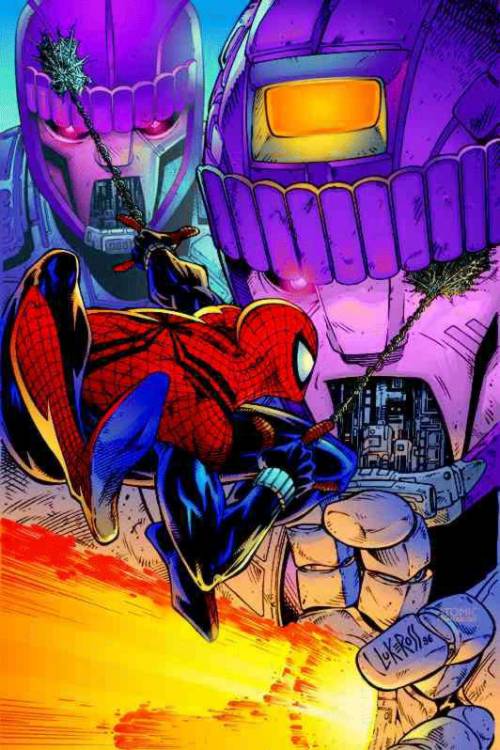
After that, the entire Clone Saga is derailed by the massive "Onslaught" event that was going on in all the Marvel comics at that time. Spidey was only on the periphery of this gimmick, but there are still a few issues featuring him battling Sentinels, the giant robots that usually menace the X-Men. It makes very little sense out of the context of the entire storyline, but seeing Ben in an underdog battle against such fearsome enemies is pretty damn epic.
At the end of Onslaught, The Avengers and The Fantasic Four were all presumed dead. There's an issue devoted mostly to Spider-Man coming to terms with their deaths, but given that they were all resurrected not long after this, the whole thing rings a little hollow. The event also woke up a mass of evil bees named Swarm that Ben has to deal with for a couple of issues. Yeah, I don't know. Don't ask. Honestly, the Peter Parker subplots are far more interesting at this point. The Daily Bugle has a round of layoffs, meaning that Peter is demoted from his full-time position back to freelance. Not good when a baby's on the way. What follows is a beautiful scene where Mary Jane reveals she wants to name the baby May, after Peter's aunt. She also has a nice zinger - "This is the 90s. Job security is as dead as disco." You haven't seen ANYTHING yet, Parkers. What if I were to tell them that these days the 90s are regarded as a time of prosperity? Yeah, our standards have come down a bit.
So, remember that plotline about The Lizard? Next, we finally get back to it. The story shifts to the point of view of Dr. Connors, and we learn that this new Lizard was created during a botched attempt to cure the good doctor of this tendency to become evil and scaly every so often. The creature follows him all the way back to his home in Florida. To save his family, Connors willingly allows his lizard personality to regain control. Spidey arrives just in time to see the original Lizard curb stomb the new one. After an intense battle, Connors regains control. This story is flat-out excellent and a highlight of this particular volume.
In the midst of these somewhat standalone tales, we've seen glimpses of some of the most important players of the Clone Saga, such as Scrier, Judas Traveler (oy vey) and the mysterious Gaunt. Should be wrapping up soon, but this volume ends with an odd distraction - a tale set in Spider-Man's past featuring a lot of characters who are now dead - George and Gwen Stacy, Norman and Harry Osborn, Aunt May and Kraven the Hunter. The high point is the art, which was done in part by John Romita, Sr, who may be the definitive Spider-Man artist. Still, in a collection full of odd detours, this is the most random. Perhaps we'll get our resolution next time?
The stories are less tightly connected than they have been, with only subplots tying the various comics together. In the early issues of this collection, Ben as Spider-Man fights a handful of old-timey villains like Dragon Man, the Will O'The Wisp and Dr. Jonas Harrow. He's also in the middle of an ongoing gang war between Hammerhead, the mysterious Fortunato, The Rose and the wacky Delilah, an assassin who speaks in large, multi-colored letters. It's weird. But what of Peter Parker, who collapsed at the end of the last volume and suffers from a mysterious ailment? He's rushed to the hospital and the doctors aren't sure what to do about his deteriorating physical state. Even Dr. Curt Connors flies in from Florida to lend a hand, but he's just as stumped.
One of these issues actually ends with Peter Parker flat-lining and apparently dead. This was brutal. Fans at the time thought, "it finally happened. Peter Parker is dead. Now Ben is Spider-Man and that's the end of it." A comic released one week later revealed that wasn't the case at all. Parker springs back to life almost immediately, and he has his Spidey powers back. So they weren't trying to get rid of Peter...they were undoing the revelation at the end of Spider-Man: The Final Adventure (mere months afterwards, by the way). Not long after that, The Lizard is sighted on a nearby rooftop. No surprise, right? After all, Dr. Connors was in town. But wait, Peter is talking with Dr. Connors at the same time Ben is battling with The Lizard outside! How is that possible?
It's a genuinely gripping cliffhanger, but it will be some time before it's resolved in this collection. There's a massive filler story where Spider-Man fights The Scorption with the help of Nick Cage and Iron Fist. Then there's a god-awful team-up with Spider-Man and the Avengers that involves a lot of time travel chicanery. It's very confusing and very dull. After that is a fun story pitting Spider-Man against The Looter, an egomaniac who has stolen equipment from various B-list villains like The Shocker, The Ringer and The Trapster, and made his own armor suit that uses all of them.
After that, the entire Clone Saga is derailed by the massive "Onslaught" event that was going on in all the Marvel comics at that time. Spidey was only on the periphery of this gimmick, but there are still a few issues featuring him battling Sentinels, the giant robots that usually menace the X-Men. It makes very little sense out of the context of the entire storyline, but seeing Ben in an underdog battle against such fearsome enemies is pretty damn epic.
At the end of Onslaught, The Avengers and The Fantasic Four were all presumed dead. There's an issue devoted mostly to Spider-Man coming to terms with their deaths, but given that they were all resurrected not long after this, the whole thing rings a little hollow. The event also woke up a mass of evil bees named Swarm that Ben has to deal with for a couple of issues. Yeah, I don't know. Don't ask. Honestly, the Peter Parker subplots are far more interesting at this point. The Daily Bugle has a round of layoffs, meaning that Peter is demoted from his full-time position back to freelance. Not good when a baby's on the way. What follows is a beautiful scene where Mary Jane reveals she wants to name the baby May, after Peter's aunt. She also has a nice zinger - "This is the 90s. Job security is as dead as disco." You haven't seen ANYTHING yet, Parkers. What if I were to tell them that these days the 90s are regarded as a time of prosperity? Yeah, our standards have come down a bit.
So, remember that plotline about The Lizard? Next, we finally get back to it. The story shifts to the point of view of Dr. Connors, and we learn that this new Lizard was created during a botched attempt to cure the good doctor of this tendency to become evil and scaly every so often. The creature follows him all the way back to his home in Florida. To save his family, Connors willingly allows his lizard personality to regain control. Spidey arrives just in time to see the original Lizard curb stomb the new one. After an intense battle, Connors regains control. This story is flat-out excellent and a highlight of this particular volume.
In the midst of these somewhat standalone tales, we've seen glimpses of some of the most important players of the Clone Saga, such as Scrier, Judas Traveler (oy vey) and the mysterious Gaunt. Should be wrapping up soon, but this volume ends with an odd distraction - a tale set in Spider-Man's past featuring a lot of characters who are now dead - George and Gwen Stacy, Norman and Harry Osborn, Aunt May and Kraven the Hunter. The high point is the art, which was done in part by John Romita, Sr, who may be the definitive Spider-Man artist. Still, in a collection full of odd detours, this is the most random. Perhaps we'll get our resolution next time?
Thursday, July 12, 2012
To The Moon
For anyone who was involved in the RPG Maker community in the mid to late 2000s, there was a strong sense of "hometown boy done good" (a unique online version at least) when Kan Gao (aka Reives) moved up to the commerical game scene with To The Moon. It was a very exciting demonstration of what this longtime hobby could lead to with enough dedication and hard work. The whole "indie" game world barely existed in 2005 when Mark (ArtBane) and I started Master of the Wind, but by the time we were done in 2011...wow. Similar to what's happening in the books industry, an entire infrastructure is rising up to meet the needs of people who have artistic ambitions with their games and want an avenue to get into the game world that doesn't include toiling away on some money-grubbing Facebook app. I had planned to play the game as soon as I could after its debut, but it got a little lost in the constant flood of movies, games and books I spend my time with (first world problems, yo) and I didn't get to it until recently.
Years ago, I got introduced to Reives's work with Quintessence: The Blighted Venom, an episodic project that was even more brazen than MotW in terms of heavy story content. However, it was the highly impressive mood and atmosphere of Quintessence that made it stand out. His command of lighting, great music (which he composed himself) and various cinematic effects were miles ahead of most of the other projects on that forum. He also had a knack for maintaining interest in the game by doling out little production tidbits and fanart regularly. This was something I never really mastered during MotW's long periods of inactivity...or perhaps I just didn't want to, since self-promotion has always made me a little nervous. I was highly impressed by how visually polished the game was, although the story's heavy reliance on well-worn anime tropes was evident and my response to the narrative wasn't hugely positive. However, that was probably just growing pains because the next Reives project was a tiny 15-minute piece of surreal genius called The Mirror Lied.
So now we've got To The Moon, which has enhanced the strong elements of the creator's previous work and noticeably beefed up the elements which may have been weaker. I played all four hours of this in one sitting. A synopsis - In the not so distant future, two doctors from a memory-altering agency are called in to tweak the life story of a dying old man named Johnny. Before slipping into a coma, he told his caretakers he wished he had gone to the moon...although he can't quite remember why. While playing it, I thought of Eternal Sunshine of the Spotless Mind, Inception, Millennium Actress and Pixar's Up. In terms of looking for potential inspiration, it's hard to beat that top-notch list of movies.
The two doctors, Eva Rosalene and Neil Watts, spend an awful lot of time bickering and insulting one another. Sometimes this is amusing, other times it gets old and it's especially unwelcome in some of the more intense scenes from Johnny's life story. The constant sardonic commentary sometimes risks taking an otherwise beautiful scene and reducing it to an episode of Mystery Science Theater 3000. However, the fact that this bothered me reflects well on the rest of the story. To go into too much detail could compromise the sense of discovery, but suffice it to say that the story of Johnny and his wife River is full of surprising turns and has a moving, down-to-Earth sensibility while at the same time creates some beautifully poetic moments. The resonant ending left me with conflicting feelings about how the characters ultimately resolved their work and will likely leave many players pondering the weighty matters of life.
Clearly story plays an important role, but what of the gameplay? Well, there isn't all that much. You wander around scenes in Johnny's past looking for items that will unlock the next memory. These sequences typically end with a sleek little tile puzzle that's good fun. It gets toned down even further as the game goes on and sometimes you can partially unlock memories just by walking around. It didn't bother me at all, in fact it was what I expected! I wasn't sure how other gamers unfamiliar with Reives's past work would take it, but the overall positive reception of To The Moon suggests that most players were appreciative of the tight focus on narrative. And why not? It's not like there's a shortage of games where you can shoot things, battle monsters to get your levels up, or stalk conspirators in Renaissance-era Italy with a concealed knife at the ready. This is a unique, highly personal vision and this sort of thing is what the video game world needs if there are any hopes of the medium being considered art.
It almost goes without saying that the game's aesthetic elements are beautifully presented. It's also impossible to overstate the importance of the music, composed by Reives with an assist from Plants vs. Zombies composer Laura Shigihara, another longtime RPG Maker friend. The score goes a long way towards sustaining the melancholy mood that made this so memorable. From my point of view, the work coming out of Freebird Games has improved so steadily with each release that it is a huge inspiration. I'll be looking forward to whatever comes next.
The game is here and I highly suggest The Mirror Lied as a warm-up.
Years ago, I got introduced to Reives's work with Quintessence: The Blighted Venom, an episodic project that was even more brazen than MotW in terms of heavy story content. However, it was the highly impressive mood and atmosphere of Quintessence that made it stand out. His command of lighting, great music (which he composed himself) and various cinematic effects were miles ahead of most of the other projects on that forum. He also had a knack for maintaining interest in the game by doling out little production tidbits and fanart regularly. This was something I never really mastered during MotW's long periods of inactivity...or perhaps I just didn't want to, since self-promotion has always made me a little nervous. I was highly impressed by how visually polished the game was, although the story's heavy reliance on well-worn anime tropes was evident and my response to the narrative wasn't hugely positive. However, that was probably just growing pains because the next Reives project was a tiny 15-minute piece of surreal genius called The Mirror Lied.
So now we've got To The Moon, which has enhanced the strong elements of the creator's previous work and noticeably beefed up the elements which may have been weaker. I played all four hours of this in one sitting. A synopsis - In the not so distant future, two doctors from a memory-altering agency are called in to tweak the life story of a dying old man named Johnny. Before slipping into a coma, he told his caretakers he wished he had gone to the moon...although he can't quite remember why. While playing it, I thought of Eternal Sunshine of the Spotless Mind, Inception, Millennium Actress and Pixar's Up. In terms of looking for potential inspiration, it's hard to beat that top-notch list of movies.
The two doctors, Eva Rosalene and Neil Watts, spend an awful lot of time bickering and insulting one another. Sometimes this is amusing, other times it gets old and it's especially unwelcome in some of the more intense scenes from Johnny's life story. The constant sardonic commentary sometimes risks taking an otherwise beautiful scene and reducing it to an episode of Mystery Science Theater 3000. However, the fact that this bothered me reflects well on the rest of the story. To go into too much detail could compromise the sense of discovery, but suffice it to say that the story of Johnny and his wife River is full of surprising turns and has a moving, down-to-Earth sensibility while at the same time creates some beautifully poetic moments. The resonant ending left me with conflicting feelings about how the characters ultimately resolved their work and will likely leave many players pondering the weighty matters of life.
Clearly story plays an important role, but what of the gameplay? Well, there isn't all that much. You wander around scenes in Johnny's past looking for items that will unlock the next memory. These sequences typically end with a sleek little tile puzzle that's good fun. It gets toned down even further as the game goes on and sometimes you can partially unlock memories just by walking around. It didn't bother me at all, in fact it was what I expected! I wasn't sure how other gamers unfamiliar with Reives's past work would take it, but the overall positive reception of To The Moon suggests that most players were appreciative of the tight focus on narrative. And why not? It's not like there's a shortage of games where you can shoot things, battle monsters to get your levels up, or stalk conspirators in Renaissance-era Italy with a concealed knife at the ready. This is a unique, highly personal vision and this sort of thing is what the video game world needs if there are any hopes of the medium being considered art.
It almost goes without saying that the game's aesthetic elements are beautifully presented. It's also impossible to overstate the importance of the music, composed by Reives with an assist from Plants vs. Zombies composer Laura Shigihara, another longtime RPG Maker friend. The score goes a long way towards sustaining the melancholy mood that made this so memorable. From my point of view, the work coming out of Freebird Games has improved so steadily with each release that it is a huge inspiration. I'll be looking forward to whatever comes next.
The game is here and I highly suggest The Mirror Lied as a warm-up.
Friday, July 6, 2012
New Decade, New Spider-Man
Spidey, what am I going to do with you? (Spoiler Warning for both the movies and the comics)
When The Amazing Spider-Man was first announced, it felt like a new milestone in Hollywood shamelessness. Another movie five years after Spider-Man 3 and only ten years after that trilogy first hit theaters? The idea brought exasperation, not excitement. Superheroes are supposed to have a long time out when their films ran out of gas, not just come right back with a different cast and crew. Disappointing me must be met with consequences! So why did they reboot the series so soon? Well, there's a fairly simple explanation for that. The rights for the character were set to revert back to Marvel Studios in 2013 unless Sony made another Spidey film. Just think, ole Webhead would probably be joining the Avengers and Sony would be missing out on beautiful money!
The scenario actually presents a tough question to film critics - should a movie's annoying real-life origin influence the assessment of its content? All the bad reviews I've read don't make any secret that they intend to punish this one for jumping the gun. But is that really fair? Is it fair to the new director, Mark Webb? (Yeah, that's his name. Hopefully that wasn't the only reason he got picked!) How would I have felt about this movie if it were the one that came out in 2002? Let's face it, the timing of this compared to the Raimi trilogy will matter less the more time passes, and this movie turned out to be a lot better than you would expect from a premature reboot.
But let's talk about those other movies first. Sam Raimi is a devoted fan of the original Stan Lee/Steve Ditko comics of the 1960s and he brought that old-school cheesy sincerity to the material. That first movie was unapologetically corny and less than a year after the horrors of 9/11, that was just the kind of comfort people were looking for. Spider-Man 2 was even better and perfectly captured the pathos at the heart of the source material (this new film clearly wants that too, but it's not there yet). What's interesting is that while I feel it's the better film (not exactly a controversial stance, there goes precious hipster cred), I've seen it much less times than the first film despite owning both on DVD. I think the reason for that is that the anguish Peter Parker goes through in that movie is just too powerful, too raw. I've always felt a lot of empathy towards the character and parts of Spider-Man 2 are just painful. An odd compliment, but it is one.
Then came Spider-Man 3, one of those movie disappointments that is so crushing that it doesn't sink in right away. You're trying to convince yourself "no, it wasn't THAT bad" because the thought of your wasted anticipation is too awful...but it was that bad and it's not hard to figure out why things went so wrong. There was just too much STUFF and too many conflicting agendas. The Green Goblin/Osborn dynasty story arc was in full swing and Harry Osborn needed to cause trouble with his dad's goblin gear. Raimi wanted The Sandman, another classic Lee-Ditko adversary. The studio wanted Venom, Spider-Man's black-suited doppelganger who helped sell a lot of comics back in the 1990s. So rather than save one for a fourth movie (Venom would have been perfect for that), they tried to get them all in at once. Only Sandman emerged with anything closely resembling dignity and that was mostly because of Thomas Haden Church's solid performance. Harry Osborn's storyline was truncated and unsastifying. Venom was completely butchered. Topher Grace was completely miscast as Eddie Brock (seriously, that's almost as bad as Charlton Heston playing a Mexican in Touch of Evil. It's just that incomprehensible). And given Venom's origin, the movie also had to play out the famous "alien black costume" storyline. Raimi obviously had little regard for this arc and decided to just mess around instead - the scene where Parker adopts an emo combover, buys some cheap suits and proceeds to thrust his crotch at innocent bystanders is already infamous. Despite how much money that third film made, it was clear that the storytelling had hit a brick wall.
At this point, even people who have never read the comics are probably sick of Spider-Man's origin story. The new film is determined to do it justice and the results are hit or miss. One thing I like is the addition of Peter Parker's missing parents to the storyline. In the comic, they were Cold War-era spies whose plane was shot down over enemy territory. That's obviously too dated for a contemporary movie, so The Amazing Spider-Man has them involved in some sort of high-risk scientific research. It isn't fully explained, so I'm thinking it will also play a role in the sequel (based on early box office reports, that seems very likely).
One of the movie's strengths is the casting. It's easy to buy the lanky Andrew Garfield as a shy, bookish teen. Martin Sheen is awesome as Uncle Ben, so it's a shame that his actual demise is rushed and somewhat sloppy. It's nowhere near as wrenching as when Cliff Robertson bit the bullet. As for Aunt May, this time she's played by Sally Field, who does well with the little material she has. Parker's freelance photography gig at the Daily Bugle is completely excised, probably cause everyone knew nobody could top J.K. Simmons, who had audiences howling with laughter in Raimi's films with his performances as publisher J. Jonah Jameson.
The Stacy family is also given key roles this time around (okay, Gwen showed up in Spider-Man 3 but that might as well not have counted because it was a total waste). Emma Stone plays Gwen this time and brings her natural charm to the part. Denis Leary plays her father, police captain George Stacy. Mary Jane and Harry Osborn simply don't appear. However, Norman Osborn does...in a very brief cameo during the credits.
This suggests that this new series has paid close attention to how Christopher Nolan's Batman series handled that character's return to the screen. In your first movie, you start with villains who haven't yet gotten the proper screen treatment. For Batman Begins, that was The Scarecrow and Ra's Al Ghul. For The Amazing Spider-Man, it's The Lizard. He and his alter ego, Dr. Curt Connors, are played by Rhys Ivans. He's fine, but all I could think about was how badly Dylan Baker got screwed. He played Dr. Connors in the last two Spider-Man movies and had to have been told at some point he would get to be The Lizard. Owch.
I didn't love the movie's treatment of the character. His plight should have been compelling and something was just missing. I think it was his family. In the comics, Martha and Billy Connors had to live in fear of Curt becoming The Lizard again even though he thought the evil reptilian personality was repressed. The family became quite close with Spider-Man over the years, despite never learning who he really was. But that's the kind of rewarding continuity you just can't get when the movies keep starting themselves over.
Dedicated fans of the comic know that both George and Gwen Stacy are eventually killed. At the end of this film, George meets his heroic end at the hands of The Lizard (in the comics, it was Dr. Octopus). Those who are just getting introduced to Gwen Stacy in this movie are in for a brutal surprise in the sequel if the producers decide to go for it. Hopefully, Spidey-fans will behave as well as Game of Thrones viewers who have read the books and know about the shocking character deaths ahead on the TV series. They have shown remarkable restraint out of a selfless desire for the viewers to have the optimal experience. So...they'll have to be much more careful than I just was...but hey, there was a spoiler warning!
According to the Nolan formula, once the franchise is established the second film brings back the arch-enemy. But as important to the Spider-Man lore as he is, the Green Goblin is just not as compelling as The Joker. Not even close. But here are some predictions. The second film will be called either "The Spectacular Spider-Man" or "The Sensational Spider-Man." Some kind of twist will added to Norman Osborn's supervillain debut. Perhaps he'll adopt the identity of The Hobgoblin instead. Another villain may be added to spice things up more. Ben Kingsley as The Vulture? Bruce Campbell as Mysterio? (You know that would be awesome). The third film may even take another shot at Venom, the same way The Dark Knight Rises seems poised to make up for Bane's laughable last appearance in Batman and Robin.
But here's the thing...I had an important realization. With Batman, the "definitive" version of the character to me is the one in Batman: The Animated Series. Kevin Conroy's voice and Bruce Timm's design always comes to mind first when I imagine the character. So Christian Bale's silly growling in otherwise great movies isn't something worth getting too worked up over...I can watch those cartoons any time I want. With Spider-Man, the definitive version isn't Andrew Garfield, Tobey Maguire, or even Christopher Daniel Barnes's voice from the 90s cartoon. It's John Romita's drawing of Peter Parker. With that in mind, it probably doesn't matter what the movies do. And in this case, it's clear the people who helped create this new film did care about doing it well regardless of the money-grubbing Sony execs. I suppose that's about all you can ask for.
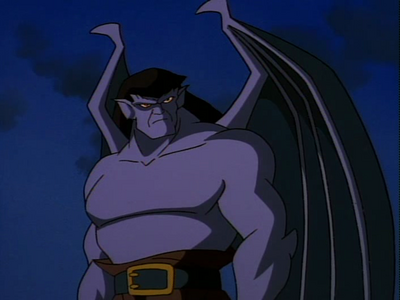
When The Amazing Spider-Man was first announced, it felt like a new milestone in Hollywood shamelessness. Another movie five years after Spider-Man 3 and only ten years after that trilogy first hit theaters? The idea brought exasperation, not excitement. Superheroes are supposed to have a long time out when their films ran out of gas, not just come right back with a different cast and crew. Disappointing me must be met with consequences! So why did they reboot the series so soon? Well, there's a fairly simple explanation for that. The rights for the character were set to revert back to Marvel Studios in 2013 unless Sony made another Spidey film. Just think, ole Webhead would probably be joining the Avengers and Sony would be missing out on beautiful money!
The scenario actually presents a tough question to film critics - should a movie's annoying real-life origin influence the assessment of its content? All the bad reviews I've read don't make any secret that they intend to punish this one for jumping the gun. But is that really fair? Is it fair to the new director, Mark Webb? (Yeah, that's his name. Hopefully that wasn't the only reason he got picked!) How would I have felt about this movie if it were the one that came out in 2002? Let's face it, the timing of this compared to the Raimi trilogy will matter less the more time passes, and this movie turned out to be a lot better than you would expect from a premature reboot.
But let's talk about those other movies first. Sam Raimi is a devoted fan of the original Stan Lee/Steve Ditko comics of the 1960s and he brought that old-school cheesy sincerity to the material. That first movie was unapologetically corny and less than a year after the horrors of 9/11, that was just the kind of comfort people were looking for. Spider-Man 2 was even better and perfectly captured the pathos at the heart of the source material (this new film clearly wants that too, but it's not there yet). What's interesting is that while I feel it's the better film (not exactly a controversial stance, there goes precious hipster cred), I've seen it much less times than the first film despite owning both on DVD. I think the reason for that is that the anguish Peter Parker goes through in that movie is just too powerful, too raw. I've always felt a lot of empathy towards the character and parts of Spider-Man 2 are just painful. An odd compliment, but it is one.
Then came Spider-Man 3, one of those movie disappointments that is so crushing that it doesn't sink in right away. You're trying to convince yourself "no, it wasn't THAT bad" because the thought of your wasted anticipation is too awful...but it was that bad and it's not hard to figure out why things went so wrong. There was just too much STUFF and too many conflicting agendas. The Green Goblin/Osborn dynasty story arc was in full swing and Harry Osborn needed to cause trouble with his dad's goblin gear. Raimi wanted The Sandman, another classic Lee-Ditko adversary. The studio wanted Venom, Spider-Man's black-suited doppelganger who helped sell a lot of comics back in the 1990s. So rather than save one for a fourth movie (Venom would have been perfect for that), they tried to get them all in at once. Only Sandman emerged with anything closely resembling dignity and that was mostly because of Thomas Haden Church's solid performance. Harry Osborn's storyline was truncated and unsastifying. Venom was completely butchered. Topher Grace was completely miscast as Eddie Brock (seriously, that's almost as bad as Charlton Heston playing a Mexican in Touch of Evil. It's just that incomprehensible). And given Venom's origin, the movie also had to play out the famous "alien black costume" storyline. Raimi obviously had little regard for this arc and decided to just mess around instead - the scene where Parker adopts an emo combover, buys some cheap suits and proceeds to thrust his crotch at innocent bystanders is already infamous. Despite how much money that third film made, it was clear that the storytelling had hit a brick wall.
At this point, even people who have never read the comics are probably sick of Spider-Man's origin story. The new film is determined to do it justice and the results are hit or miss. One thing I like is the addition of Peter Parker's missing parents to the storyline. In the comic, they were Cold War-era spies whose plane was shot down over enemy territory. That's obviously too dated for a contemporary movie, so The Amazing Spider-Man has them involved in some sort of high-risk scientific research. It isn't fully explained, so I'm thinking it will also play a role in the sequel (based on early box office reports, that seems very likely).
One of the movie's strengths is the casting. It's easy to buy the lanky Andrew Garfield as a shy, bookish teen. Martin Sheen is awesome as Uncle Ben, so it's a shame that his actual demise is rushed and somewhat sloppy. It's nowhere near as wrenching as when Cliff Robertson bit the bullet. As for Aunt May, this time she's played by Sally Field, who does well with the little material she has. Parker's freelance photography gig at the Daily Bugle is completely excised, probably cause everyone knew nobody could top J.K. Simmons, who had audiences howling with laughter in Raimi's films with his performances as publisher J. Jonah Jameson.
The Stacy family is also given key roles this time around (okay, Gwen showed up in Spider-Man 3 but that might as well not have counted because it was a total waste). Emma Stone plays Gwen this time and brings her natural charm to the part. Denis Leary plays her father, police captain George Stacy. Mary Jane and Harry Osborn simply don't appear. However, Norman Osborn does...in a very brief cameo during the credits.
This suggests that this new series has paid close attention to how Christopher Nolan's Batman series handled that character's return to the screen. In your first movie, you start with villains who haven't yet gotten the proper screen treatment. For Batman Begins, that was The Scarecrow and Ra's Al Ghul. For The Amazing Spider-Man, it's The Lizard. He and his alter ego, Dr. Curt Connors, are played by Rhys Ivans. He's fine, but all I could think about was how badly Dylan Baker got screwed. He played Dr. Connors in the last two Spider-Man movies and had to have been told at some point he would get to be The Lizard. Owch.
I didn't love the movie's treatment of the character. His plight should have been compelling and something was just missing. I think it was his family. In the comics, Martha and Billy Connors had to live in fear of Curt becoming The Lizard again even though he thought the evil reptilian personality was repressed. The family became quite close with Spider-Man over the years, despite never learning who he really was. But that's the kind of rewarding continuity you just can't get when the movies keep starting themselves over.
Dedicated fans of the comic know that both George and Gwen Stacy are eventually killed. At the end of this film, George meets his heroic end at the hands of The Lizard (in the comics, it was Dr. Octopus). Those who are just getting introduced to Gwen Stacy in this movie are in for a brutal surprise in the sequel if the producers decide to go for it. Hopefully, Spidey-fans will behave as well as Game of Thrones viewers who have read the books and know about the shocking character deaths ahead on the TV series. They have shown remarkable restraint out of a selfless desire for the viewers to have the optimal experience. So...they'll have to be much more careful than I just was...but hey, there was a spoiler warning!
According to the Nolan formula, once the franchise is established the second film brings back the arch-enemy. But as important to the Spider-Man lore as he is, the Green Goblin is just not as compelling as The Joker. Not even close. But here are some predictions. The second film will be called either "The Spectacular Spider-Man" or "The Sensational Spider-Man." Some kind of twist will added to Norman Osborn's supervillain debut. Perhaps he'll adopt the identity of The Hobgoblin instead. Another villain may be added to spice things up more. Ben Kingsley as The Vulture? Bruce Campbell as Mysterio? (You know that would be awesome). The third film may even take another shot at Venom, the same way The Dark Knight Rises seems poised to make up for Bane's laughable last appearance in Batman and Robin.
But here's the thing...I had an important realization. With Batman, the "definitive" version of the character to me is the one in Batman: The Animated Series. Kevin Conroy's voice and Bruce Timm's design always comes to mind first when I imagine the character. So Christian Bale's silly growling in otherwise great movies isn't something worth getting too worked up over...I can watch those cartoons any time I want. With Spider-Man, the definitive version isn't Andrew Garfield, Tobey Maguire, or even Christopher Daniel Barnes's voice from the 90s cartoon. It's John Romita's drawing of Peter Parker. With that in mind, it probably doesn't matter what the movies do. And in this case, it's clear the people who helped create this new film did care about doing it well regardless of the money-grubbing Sony execs. I suppose that's about all you can ask for.
Saturday, June 2, 2012
Clone Saga Revisited, Part Nine
With the newest volume of the Clone Saga collections (Complete Ben Reilly Epic Book 4), we've now arrived at the point where Marvel has realized that the fans are unlikely to warm to the radical changes to the Spidey mythos regardless of the amount of manipulative tricks the writers pull. This particular collection has a lot of content I had never read before, suggesting that I've reached the point where I gave up on the comics back in the 90s. What I didn't realize then is that this is the point where the writers are starting to reverse course.
The massive, six-part "Blood Brothers" storyline is one of the most important stories in the Clone Saga. This is where the writers start to tear down everything they have tried to build for the last two years. If you recall from the "Web of Carnage" storyline, Ben Reilly's trusted friend Seward Trainer, who ran the test that concluded Reilly was the original Peter Parker, is acting very suspiciously. Peter suspects something is amiss, but Ben doesn't buy it and just assumes Peter is hoping to find new evidence that he's the real deal. Well, Peter is right. Trainer is working with a mysterious new villain named Gaunt and The Hobgoblin, who is now a cyborg or something. This is the Jason Macendale Hobgoblin, who was never as awesome as the Roderick Kingsley Hobgoblin who put Spidey through the wringer in the 80s, even though Marvel tried to make him cool with various silly gimmicks like this.
Gaunt is far more interesting because a lot of mystery is built around his identity. He taunts Spider-Man by saying "We've met before, but I'm not surprised you don't recognize me in this form." Who is this guy? Whoever he is, he's a serious threat because he's figured out that Ben has been the one wearing the Spidey suit and systematically starts to destroy his life. His apartment is ransacked, the Daily Grind coffeehouse where he works is torched, and even Peter and Mary Jane are targeted by a group of vicious mercenaries. Ben and Peter discover that all this madness is somehow linked to Osborn Industries, currently run by Liz Osborn's brother Mark Raxton (aka the former supervillain The Molten Man). Raxton is also out to figure out what's going on and this story ends with him, Ben and Peter (still without his powers) battling Gaunt and a horde of armed guards. Seward and Gaunt appear to die in an explosion, but the reader soon finds out they are still alive...and are being scolded by yet another mysterious villain.
Next is "Who did Spider-Man Murder?" which is the closest we're going to get to a resolution to the skeleton-in-the-smokestack subplot. Upon its initial discovery, both Spider-Men were concerned that this corpse undermined everything they thought they knew about their identities. A more immediate concern is that J. Jonah Jameson is so determined to solve this mystery that he's put a $100,000 reward out for anyone who can find out the whole story. This story is entertaining mostly because of the numerous C-list villains, like Beetle, Boomerang and the Shocker, who show up to try and grab that reward. Peter and Ben come up with a clever ruse to throw Jameson off the trail, but the actual truth about the skeleton is not revealed. I'm not sure if the writers even knew what was going on with that.
The next story, "It Begins with a Bang, not a Whimper," is a rare one-off tale where Ben hunts down The Hobgoblin and beats the ever-loving crap out of him for all the trouble he caused in "Blood Brothers." After that is some filler, a tale of Spider-Man and the Fantastic Four going to an alternate universe of something. It's sometimes funny but utterly ridiculous. Next up is "Ultimate Responsibility," starring Jessica Carradine. As we found out last time, she is the daughter of the Burglar who shot Uncle Ben and has become a love interest for Ben. In "Blood Brothers," she found out Ben was Spider-Man, who she blames for her father's death. Armed with a photo of Ben in the suit with his mask off, she has the power to completely expose Reilly to the public. But after she sees Spidey perform an amazing rescue of people in a burning building, she decides to give him the photo and give up her revenge and walks out of the mythos. Too bad, she was a fairly interesting character.
After that is the four-part "Redemption" mini-series, a sequel to "The Lost Years" that brings together Ben, Kaine and the long-missing Janine. Writer J.M. Dematteis returns and is reunitied with his team from the legendary "Kraven's Last Hunt" storyline - artist Mike Zeck and inker Bob McLeod. Zeck's depiction of Kaine is totally unique, other artists had tried to convey some handsomeness behind all the scars, but here he looks more like Lon Chaney in Phantom of the Opera. As for the story, it's as intense as you would expect from DeMatteis and finally gives a peaceful resolution to Kaine's storyline. After trying to destroy Ben for years, the two come to an understanding and he surrenders peacefully to the police. There are also some revelations about Janine - her real name is Elizabeth Tyne and she's been on the run for years after murdering her abusive father. Her relationship with Ben inspires her to find some closure and she also surrenders to the police. It's a bittersweet ending, but it is still satisfying to have some of those loose ends from Reilly's backstory finally resolved.
Next is a single issue story called "Toy Wars," where Spider-Man appears to have been shrunk to the size of a bug and must battle some malevolent toys. Veteran Spidey fans will be able to figure out pretty quickly which villain is behind this. The best part of this issue is the references to various popular 1990s toys and cartoons. Spidey fights Stretch Armstrong, Buzz Lightyear and Goliath from Gargoyles, among others. Then we have some filler where Spidey guest-stars in a Daredevil comic. The final story in this collection is "Above It All," which introduces the crime lord Fortunato. He doesn't seem connected to the Clone Saga at large, but it gives Ben and Peter something to deal with while the writers work out how they are going to resolve the saga once and for all. At the end of this one, Peter has a violent seizure and collapses. What's going on?
That's all for now, but I suspect the next Clone Saga collection (set for a July release) will be the last. That means this series, which has been going since 2010, will soon be wrapping up as well. Not only that, we have a new Spider-Man movie coming out within weeks! So expect lots of Spidey on this blog this summer.
The massive, six-part "Blood Brothers" storyline is one of the most important stories in the Clone Saga. This is where the writers start to tear down everything they have tried to build for the last two years. If you recall from the "Web of Carnage" storyline, Ben Reilly's trusted friend Seward Trainer, who ran the test that concluded Reilly was the original Peter Parker, is acting very suspiciously. Peter suspects something is amiss, but Ben doesn't buy it and just assumes Peter is hoping to find new evidence that he's the real deal. Well, Peter is right. Trainer is working with a mysterious new villain named Gaunt and The Hobgoblin, who is now a cyborg or something. This is the Jason Macendale Hobgoblin, who was never as awesome as the Roderick Kingsley Hobgoblin who put Spidey through the wringer in the 80s, even though Marvel tried to make him cool with various silly gimmicks like this.
Gaunt is far more interesting because a lot of mystery is built around his identity. He taunts Spider-Man by saying "We've met before, but I'm not surprised you don't recognize me in this form." Who is this guy? Whoever he is, he's a serious threat because he's figured out that Ben has been the one wearing the Spidey suit and systematically starts to destroy his life. His apartment is ransacked, the Daily Grind coffeehouse where he works is torched, and even Peter and Mary Jane are targeted by a group of vicious mercenaries. Ben and Peter discover that all this madness is somehow linked to Osborn Industries, currently run by Liz Osborn's brother Mark Raxton (aka the former supervillain The Molten Man). Raxton is also out to figure out what's going on and this story ends with him, Ben and Peter (still without his powers) battling Gaunt and a horde of armed guards. Seward and Gaunt appear to die in an explosion, but the reader soon finds out they are still alive...and are being scolded by yet another mysterious villain.
Next is "Who did Spider-Man Murder?" which is the closest we're going to get to a resolution to the skeleton-in-the-smokestack subplot. Upon its initial discovery, both Spider-Men were concerned that this corpse undermined everything they thought they knew about their identities. A more immediate concern is that J. Jonah Jameson is so determined to solve this mystery that he's put a $100,000 reward out for anyone who can find out the whole story. This story is entertaining mostly because of the numerous C-list villains, like Beetle, Boomerang and the Shocker, who show up to try and grab that reward. Peter and Ben come up with a clever ruse to throw Jameson off the trail, but the actual truth about the skeleton is not revealed. I'm not sure if the writers even knew what was going on with that.
The next story, "It Begins with a Bang, not a Whimper," is a rare one-off tale where Ben hunts down The Hobgoblin and beats the ever-loving crap out of him for all the trouble he caused in "Blood Brothers." After that is some filler, a tale of Spider-Man and the Fantastic Four going to an alternate universe of something. It's sometimes funny but utterly ridiculous. Next up is "Ultimate Responsibility," starring Jessica Carradine. As we found out last time, she is the daughter of the Burglar who shot Uncle Ben and has become a love interest for Ben. In "Blood Brothers," she found out Ben was Spider-Man, who she blames for her father's death. Armed with a photo of Ben in the suit with his mask off, she has the power to completely expose Reilly to the public. But after she sees Spidey perform an amazing rescue of people in a burning building, she decides to give him the photo and give up her revenge and walks out of the mythos. Too bad, she was a fairly interesting character.
After that is the four-part "Redemption" mini-series, a sequel to "The Lost Years" that brings together Ben, Kaine and the long-missing Janine. Writer J.M. Dematteis returns and is reunitied with his team from the legendary "Kraven's Last Hunt" storyline - artist Mike Zeck and inker Bob McLeod. Zeck's depiction of Kaine is totally unique, other artists had tried to convey some handsomeness behind all the scars, but here he looks more like Lon Chaney in Phantom of the Opera. As for the story, it's as intense as you would expect from DeMatteis and finally gives a peaceful resolution to Kaine's storyline. After trying to destroy Ben for years, the two come to an understanding and he surrenders peacefully to the police. There are also some revelations about Janine - her real name is Elizabeth Tyne and she's been on the run for years after murdering her abusive father. Her relationship with Ben inspires her to find some closure and she also surrenders to the police. It's a bittersweet ending, but it is still satisfying to have some of those loose ends from Reilly's backstory finally resolved.
Next is a single issue story called "Toy Wars," where Spider-Man appears to have been shrunk to the size of a bug and must battle some malevolent toys. Veteran Spidey fans will be able to figure out pretty quickly which villain is behind this. The best part of this issue is the references to various popular 1990s toys and cartoons. Spidey fights Stretch Armstrong, Buzz Lightyear and Goliath from Gargoyles, among others. Then we have some filler where Spidey guest-stars in a Daredevil comic. The final story in this collection is "Above It All," which introduces the crime lord Fortunato. He doesn't seem connected to the Clone Saga at large, but it gives Ben and Peter something to deal with while the writers work out how they are going to resolve the saga once and for all. At the end of this one, Peter has a violent seizure and collapses. What's going on?
That's all for now, but I suspect the next Clone Saga collection (set for a July release) will be the last. That means this series, which has been going since 2010, will soon be wrapping up as well. Not only that, we have a new Spider-Man movie coming out within weeks! So expect lots of Spidey on this blog this summer.
Subscribe to:
Posts (Atom)