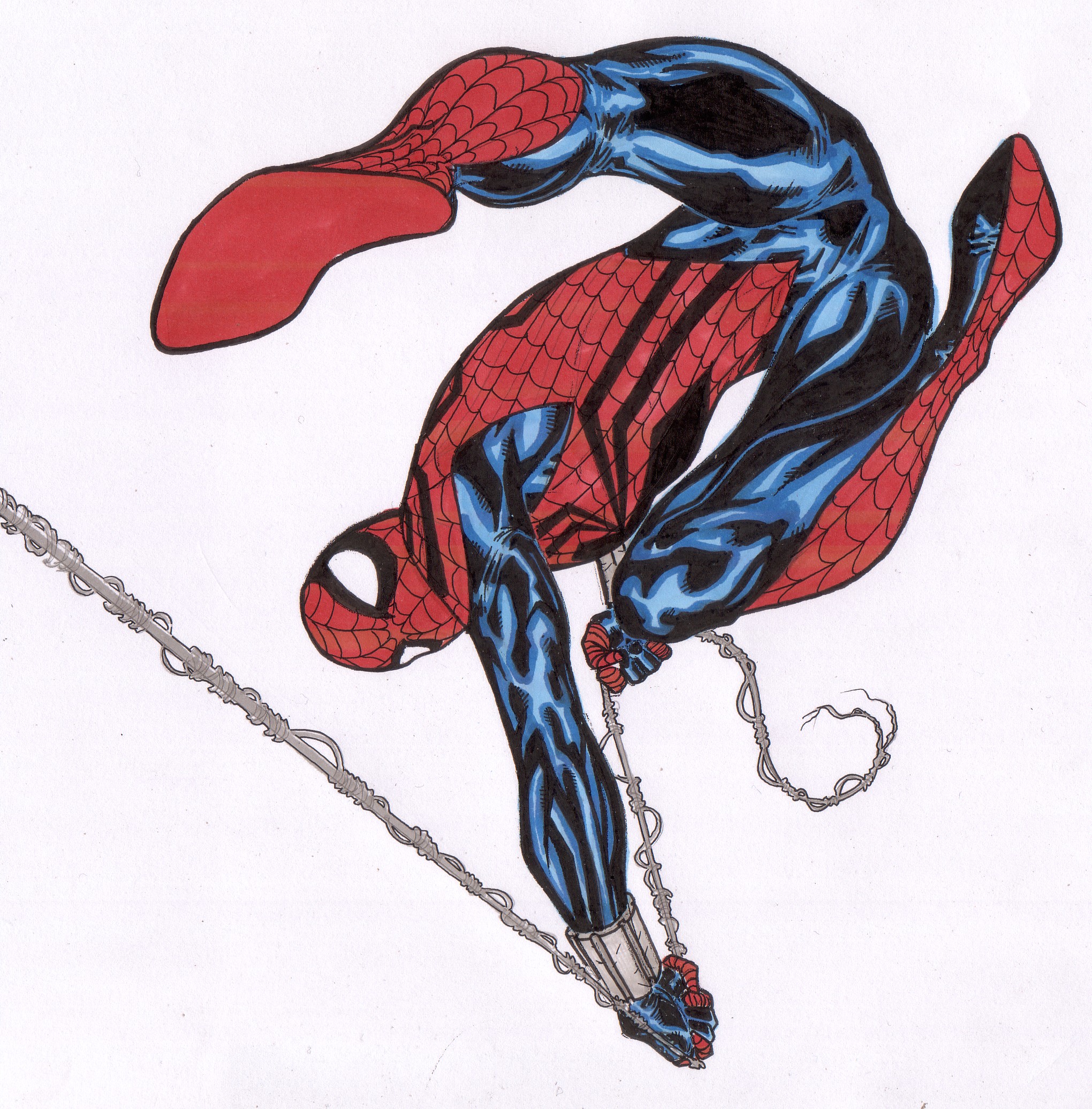
I was just about certain this tenth volume of the Clone Saga would be the last, but I've finished it and the storyline remains unresolved. The pieces seem to be in place, but the storyline keeps spinning its wheels. Like many of the past volumnes, there's a lot of filler here but that's not the chief reason. I suspect that Marvel made the decision to end the Clone Saga in No Adjective Spider-Man #75, which is still a few months off from the comics in this installment.
The stories are less tightly connected than they have been, with only subplots tying the various comics together. In the early issues of this collection, Ben as Spider-Man fights a handful of old-timey villains like Dragon Man, the Will O'The Wisp and Dr. Jonas Harrow. He's also in the middle of an ongoing gang war between Hammerhead, the mysterious Fortunato, The Rose and the wacky Delilah, an assassin who speaks in large, multi-colored letters. It's weird. But what of Peter Parker, who collapsed at the end of the last volume and suffers from a mysterious ailment? He's rushed to the hospital and the doctors aren't sure what to do about his deteriorating physical state. Even Dr. Curt Connors flies in from Florida to lend a hand, but he's just as stumped.
One of these issues actually ends with Peter Parker flat-lining and apparently dead. This was brutal. Fans at the time thought, "it finally happened. Peter Parker is dead. Now Ben is Spider-Man and that's the end of it." A comic released one week later revealed that wasn't the case at all. Parker springs back to life almost immediately, and he has his Spidey powers back. So they weren't trying to get rid of Peter...they were undoing the revelation at the end of Spider-Man: The Final Adventure (mere months afterwards, by the way). Not long after that, The Lizard is sighted on a nearby rooftop. No surprise, right? After all, Dr. Connors was in town. But wait, Peter is talking with Dr. Connors at the same time Ben is battling with The Lizard outside! How is that possible?
It's a genuinely gripping cliffhanger, but it will be some time before it's resolved in this collection. There's a massive filler story where Spider-Man fights The Scorption with the help of Nick Cage and Iron Fist. Then there's a god-awful team-up with Spider-Man and the Avengers that involves a lot of time travel chicanery. It's very confusing and very dull. After that is a fun story pitting Spider-Man against The Looter, an egomaniac who has stolen equipment from various B-list villains like The Shocker, The Ringer and The Trapster, and made his own armor suit that uses all of them.
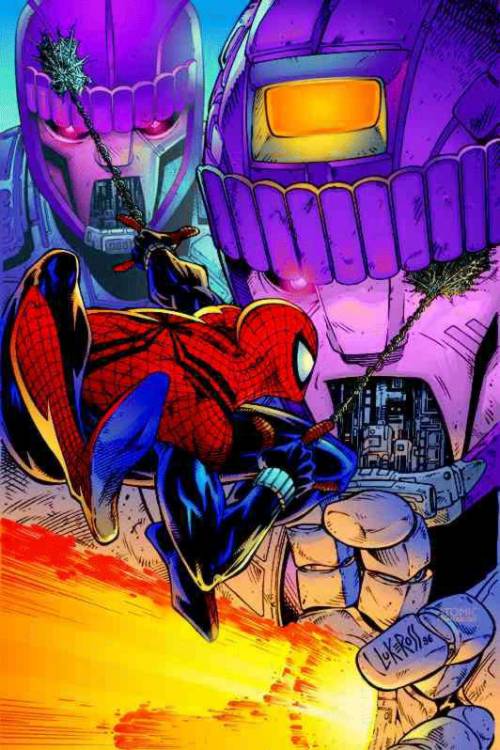
After that, the entire Clone Saga is derailed by the massive "Onslaught" event that was going on in all the Marvel comics at that time. Spidey was only on the periphery of this gimmick, but there are still a few issues featuring him battling Sentinels, the giant robots that usually menace the X-Men. It makes very little sense out of the context of the entire storyline, but seeing Ben in an underdog battle against such fearsome enemies is pretty damn epic.
At the end of Onslaught, The Avengers and The Fantasic Four were all presumed dead. There's an issue devoted mostly to Spider-Man coming to terms with their deaths, but given that they were all resurrected not long after this, the whole thing rings a little hollow. The event also woke up a mass of evil bees named Swarm that Ben has to deal with for a couple of issues. Yeah, I don't know. Don't ask. Honestly, the Peter Parker subplots are far more interesting at this point. The Daily Bugle has a round of layoffs, meaning that Peter is demoted from his full-time position back to freelance. Not good when a baby's on the way. What follows is a beautiful scene where Mary Jane reveals she wants to name the baby May, after Peter's aunt. She also has a nice zinger - "This is the 90s. Job security is as dead as disco." You haven't seen ANYTHING yet, Parkers. What if I were to tell them that these days the 90s are regarded as a time of prosperity? Yeah, our standards have come down a bit.
So, remember that plotline about The Lizard? Next, we finally get back to it. The story shifts to the point of view of Dr. Connors, and we learn that this new Lizard was created during a botched attempt to cure the good doctor of this tendency to become evil and scaly every so often. The creature follows him all the way back to his home in Florida. To save his family, Connors willingly allows his lizard personality to regain control. Spidey arrives just in time to see the original Lizard curb stomb the new one. After an intense battle, Connors regains control. This story is flat-out excellent and a highlight of this particular volume.
In the midst of these somewhat standalone tales, we've seen glimpses of some of the most important players of the Clone Saga, such as Scrier, Judas Traveler (oy vey) and the mysterious Gaunt. Should be wrapping up soon, but this volume ends with an odd distraction - a tale set in Spider-Man's past featuring a lot of characters who are now dead - George and Gwen Stacy, Norman and Harry Osborn, Aunt May and Kraven the Hunter. The high point is the art, which was done in part by John Romita, Sr, who may be the definitive Spider-Man artist. Still, in a collection full of odd detours, this is the most random. Perhaps we'll get our resolution next time?
Friday, July 27, 2012
Thursday, July 12, 2012
To The Moon
For anyone who was involved in the RPG Maker community in the mid to late 2000s, there was a strong sense of "hometown boy done good" (a unique online version at least) when Kan Gao (aka Reives) moved up to the commerical game scene with To The Moon. It was a very exciting demonstration of what this longtime hobby could lead to with enough dedication and hard work. The whole "indie" game world barely existed in 2005 when Mark (ArtBane) and I started Master of the Wind, but by the time we were done in 2011...wow. Similar to what's happening in the books industry, an entire infrastructure is rising up to meet the needs of people who have artistic ambitions with their games and want an avenue to get into the game world that doesn't include toiling away on some money-grubbing Facebook app. I had planned to play the game as soon as I could after its debut, but it got a little lost in the constant flood of movies, games and books I spend my time with (first world problems, yo) and I didn't get to it until recently.
Years ago, I got introduced to Reives's work with Quintessence: The Blighted Venom, an episodic project that was even more brazen than MotW in terms of heavy story content. However, it was the highly impressive mood and atmosphere of Quintessence that made it stand out. His command of lighting, great music (which he composed himself) and various cinematic effects were miles ahead of most of the other projects on that forum. He also had a knack for maintaining interest in the game by doling out little production tidbits and fanart regularly. This was something I never really mastered during MotW's long periods of inactivity...or perhaps I just didn't want to, since self-promotion has always made me a little nervous. I was highly impressed by how visually polished the game was, although the story's heavy reliance on well-worn anime tropes was evident and my response to the narrative wasn't hugely positive. However, that was probably just growing pains because the next Reives project was a tiny 15-minute piece of surreal genius called The Mirror Lied.
So now we've got To The Moon, which has enhanced the strong elements of the creator's previous work and noticeably beefed up the elements which may have been weaker. I played all four hours of this in one sitting. A synopsis - In the not so distant future, two doctors from a memory-altering agency are called in to tweak the life story of a dying old man named Johnny. Before slipping into a coma, he told his caretakers he wished he had gone to the moon...although he can't quite remember why. While playing it, I thought of Eternal Sunshine of the Spotless Mind, Inception, Millennium Actress and Pixar's Up. In terms of looking for potential inspiration, it's hard to beat that top-notch list of movies.
The two doctors, Eva Rosalene and Neil Watts, spend an awful lot of time bickering and insulting one another. Sometimes this is amusing, other times it gets old and it's especially unwelcome in some of the more intense scenes from Johnny's life story. The constant sardonic commentary sometimes risks taking an otherwise beautiful scene and reducing it to an episode of Mystery Science Theater 3000. However, the fact that this bothered me reflects well on the rest of the story. To go into too much detail could compromise the sense of discovery, but suffice it to say that the story of Johnny and his wife River is full of surprising turns and has a moving, down-to-Earth sensibility while at the same time creates some beautifully poetic moments. The resonant ending left me with conflicting feelings about how the characters ultimately resolved their work and will likely leave many players pondering the weighty matters of life.
Clearly story plays an important role, but what of the gameplay? Well, there isn't all that much. You wander around scenes in Johnny's past looking for items that will unlock the next memory. These sequences typically end with a sleek little tile puzzle that's good fun. It gets toned down even further as the game goes on and sometimes you can partially unlock memories just by walking around. It didn't bother me at all, in fact it was what I expected! I wasn't sure how other gamers unfamiliar with Reives's past work would take it, but the overall positive reception of To The Moon suggests that most players were appreciative of the tight focus on narrative. And why not? It's not like there's a shortage of games where you can shoot things, battle monsters to get your levels up, or stalk conspirators in Renaissance-era Italy with a concealed knife at the ready. This is a unique, highly personal vision and this sort of thing is what the video game world needs if there are any hopes of the medium being considered art.
It almost goes without saying that the game's aesthetic elements are beautifully presented. It's also impossible to overstate the importance of the music, composed by Reives with an assist from Plants vs. Zombies composer Laura Shigihara, another longtime RPG Maker friend. The score goes a long way towards sustaining the melancholy mood that made this so memorable. From my point of view, the work coming out of Freebird Games has improved so steadily with each release that it is a huge inspiration. I'll be looking forward to whatever comes next.
The game is here and I highly suggest The Mirror Lied as a warm-up.
Years ago, I got introduced to Reives's work with Quintessence: The Blighted Venom, an episodic project that was even more brazen than MotW in terms of heavy story content. However, it was the highly impressive mood and atmosphere of Quintessence that made it stand out. His command of lighting, great music (which he composed himself) and various cinematic effects were miles ahead of most of the other projects on that forum. He also had a knack for maintaining interest in the game by doling out little production tidbits and fanart regularly. This was something I never really mastered during MotW's long periods of inactivity...or perhaps I just didn't want to, since self-promotion has always made me a little nervous. I was highly impressed by how visually polished the game was, although the story's heavy reliance on well-worn anime tropes was evident and my response to the narrative wasn't hugely positive. However, that was probably just growing pains because the next Reives project was a tiny 15-minute piece of surreal genius called The Mirror Lied.
So now we've got To The Moon, which has enhanced the strong elements of the creator's previous work and noticeably beefed up the elements which may have been weaker. I played all four hours of this in one sitting. A synopsis - In the not so distant future, two doctors from a memory-altering agency are called in to tweak the life story of a dying old man named Johnny. Before slipping into a coma, he told his caretakers he wished he had gone to the moon...although he can't quite remember why. While playing it, I thought of Eternal Sunshine of the Spotless Mind, Inception, Millennium Actress and Pixar's Up. In terms of looking for potential inspiration, it's hard to beat that top-notch list of movies.
The two doctors, Eva Rosalene and Neil Watts, spend an awful lot of time bickering and insulting one another. Sometimes this is amusing, other times it gets old and it's especially unwelcome in some of the more intense scenes from Johnny's life story. The constant sardonic commentary sometimes risks taking an otherwise beautiful scene and reducing it to an episode of Mystery Science Theater 3000. However, the fact that this bothered me reflects well on the rest of the story. To go into too much detail could compromise the sense of discovery, but suffice it to say that the story of Johnny and his wife River is full of surprising turns and has a moving, down-to-Earth sensibility while at the same time creates some beautifully poetic moments. The resonant ending left me with conflicting feelings about how the characters ultimately resolved their work and will likely leave many players pondering the weighty matters of life.
Clearly story plays an important role, but what of the gameplay? Well, there isn't all that much. You wander around scenes in Johnny's past looking for items that will unlock the next memory. These sequences typically end with a sleek little tile puzzle that's good fun. It gets toned down even further as the game goes on and sometimes you can partially unlock memories just by walking around. It didn't bother me at all, in fact it was what I expected! I wasn't sure how other gamers unfamiliar with Reives's past work would take it, but the overall positive reception of To The Moon suggests that most players were appreciative of the tight focus on narrative. And why not? It's not like there's a shortage of games where you can shoot things, battle monsters to get your levels up, or stalk conspirators in Renaissance-era Italy with a concealed knife at the ready. This is a unique, highly personal vision and this sort of thing is what the video game world needs if there are any hopes of the medium being considered art.
It almost goes without saying that the game's aesthetic elements are beautifully presented. It's also impossible to overstate the importance of the music, composed by Reives with an assist from Plants vs. Zombies composer Laura Shigihara, another longtime RPG Maker friend. The score goes a long way towards sustaining the melancholy mood that made this so memorable. From my point of view, the work coming out of Freebird Games has improved so steadily with each release that it is a huge inspiration. I'll be looking forward to whatever comes next.
The game is here and I highly suggest The Mirror Lied as a warm-up.
Friday, July 6, 2012
New Decade, New Spider-Man
Spidey, what am I going to do with you? (Spoiler Warning for both the movies and the comics)
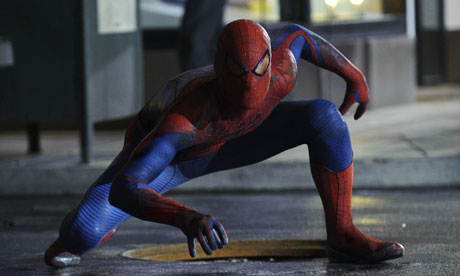
When The Amazing Spider-Man was first announced, it felt like a new milestone in Hollywood shamelessness. Another movie five years after Spider-Man 3 and only ten years after that trilogy first hit theaters? The idea brought exasperation, not excitement. Superheroes are supposed to have a long time out when their films ran out of gas, not just come right back with a different cast and crew. Disappointing me must be met with consequences! So why did they reboot the series so soon? Well, there's a fairly simple explanation for that. The rights for the character were set to revert back to Marvel Studios in 2013 unless Sony made another Spidey film. Just think, ole Webhead would probably be joining the Avengers and Sony would be missing out on beautiful money!
The scenario actually presents a tough question to film critics - should a movie's annoying real-life origin influence the assessment of its content? All the bad reviews I've read don't make any secret that they intend to punish this one for jumping the gun. But is that really fair? Is it fair to the new director, Mark Webb? (Yeah, that's his name. Hopefully that wasn't the only reason he got picked!) How would I have felt about this movie if it were the one that came out in 2002? Let's face it, the timing of this compared to the Raimi trilogy will matter less the more time passes, and this movie turned out to be a lot better than you would expect from a premature reboot.
But let's talk about those other movies first. Sam Raimi is a devoted fan of the original Stan Lee/Steve Ditko comics of the 1960s and he brought that old-school cheesy sincerity to the material. That first movie was unapologetically corny and less than a year after the horrors of 9/11, that was just the kind of comfort people were looking for. Spider-Man 2 was even better and perfectly captured the pathos at the heart of the source material (this new film clearly wants that too, but it's not there yet). What's interesting is that while I feel it's the better film (not exactly a controversial stance, there goes precious hipster cred), I've seen it much less times than the first film despite owning both on DVD. I think the reason for that is that the anguish Peter Parker goes through in that movie is just too powerful, too raw. I've always felt a lot of empathy towards the character and parts of Spider-Man 2 are just painful. An odd compliment, but it is one.
Then came Spider-Man 3, one of those movie disappointments that is so crushing that it doesn't sink in right away. You're trying to convince yourself "no, it wasn't THAT bad" because the thought of your wasted anticipation is too awful...but it was that bad and it's not hard to figure out why things went so wrong. There was just too much STUFF and too many conflicting agendas. The Green Goblin/Osborn dynasty story arc was in full swing and Harry Osborn needed to cause trouble with his dad's goblin gear. Raimi wanted The Sandman, another classic Lee-Ditko adversary. The studio wanted Venom, Spider-Man's black-suited doppelganger who helped sell a lot of comics back in the 1990s. So rather than save one for a fourth movie (Venom would have been perfect for that), they tried to get them all in at once. Only Sandman emerged with anything closely resembling dignity and that was mostly because of Thomas Haden Church's solid performance. Harry Osborn's storyline was truncated and unsastifying. Venom was completely butchered. Topher Grace was completely miscast as Eddie Brock (seriously, that's almost as bad as Charlton Heston playing a Mexican in Touch of Evil. It's just that incomprehensible). And given Venom's origin, the movie also had to play out the famous "alien black costume" storyline. Raimi obviously had little regard for this arc and decided to just mess around instead - the scene where Parker adopts an emo combover, buys some cheap suits and proceeds to thrust his crotch at innocent bystanders is already infamous. Despite how much money that third film made, it was clear that the storytelling had hit a brick wall.
At this point, even people who have never read the comics are probably sick of Spider-Man's origin story. The new film is determined to do it justice and the results are hit or miss. One thing I like is the addition of Peter Parker's missing parents to the storyline. In the comic, they were Cold War-era spies whose plane was shot down over enemy territory. That's obviously too dated for a contemporary movie, so The Amazing Spider-Man has them involved in some sort of high-risk scientific research. It isn't fully explained, so I'm thinking it will also play a role in the sequel (based on early box office reports, that seems very likely).
One of the movie's strengths is the casting. It's easy to buy the lanky Andrew Garfield as a shy, bookish teen. Martin Sheen is awesome as Uncle Ben, so it's a shame that his actual demise is rushed and somewhat sloppy. It's nowhere near as wrenching as when Cliff Robertson bit the bullet. As for Aunt May, this time she's played by Sally Field, who does well with the little material she has. Parker's freelance photography gig at the Daily Bugle is completely excised, probably cause everyone knew nobody could top J.K. Simmons, who had audiences howling with laughter in Raimi's films with his performances as publisher J. Jonah Jameson.
The Stacy family is also given key roles this time around (okay, Gwen showed up in Spider-Man 3 but that might as well not have counted because it was a total waste). Emma Stone plays Gwen this time and brings her natural charm to the part. Denis Leary plays her father, police captain George Stacy. Mary Jane and Harry Osborn simply don't appear. However, Norman Osborn does...in a very brief cameo during the credits.
This suggests that this new series has paid close attention to how Christopher Nolan's Batman series handled that character's return to the screen. In your first movie, you start with villains who haven't yet gotten the proper screen treatment. For Batman Begins, that was The Scarecrow and Ra's Al Ghul. For The Amazing Spider-Man, it's The Lizard. He and his alter ego, Dr. Curt Connors, are played by Rhys Ivans. He's fine, but all I could think about was how badly Dylan Baker got screwed. He played Dr. Connors in the last two Spider-Man movies and had to have been told at some point he would get to be The Lizard. Owch.
I didn't love the movie's treatment of the character. His plight should have been compelling and something was just missing. I think it was his family. In the comics, Martha and Billy Connors had to live in fear of Curt becoming The Lizard again even though he thought the evil reptilian personality was repressed. The family became quite close with Spider-Man over the years, despite never learning who he really was. But that's the kind of rewarding continuity you just can't get when the movies keep starting themselves over.
Dedicated fans of the comic know that both George and Gwen Stacy are eventually killed. At the end of this film, George meets his heroic end at the hands of The Lizard (in the comics, it was Dr. Octopus). Those who are just getting introduced to Gwen Stacy in this movie are in for a brutal surprise in the sequel if the producers decide to go for it. Hopefully, Spidey-fans will behave as well as Game of Thrones viewers who have read the books and know about the shocking character deaths ahead on the TV series. They have shown remarkable restraint out of a selfless desire for the viewers to have the optimal experience. So...they'll have to be much more careful than I just was...but hey, there was a spoiler warning!
According to the Nolan formula, once the franchise is established the second film brings back the arch-enemy. But as important to the Spider-Man lore as he is, the Green Goblin is just not as compelling as The Joker. Not even close. But here are some predictions. The second film will be called either "The Spectacular Spider-Man" or "The Sensational Spider-Man." Some kind of twist will added to Norman Osborn's supervillain debut. Perhaps he'll adopt the identity of The Hobgoblin instead. Another villain may be added to spice things up more. Ben Kingsley as The Vulture? Bruce Campbell as Mysterio? (You know that would be awesome). The third film may even take another shot at Venom, the same way The Dark Knight Rises seems poised to make up for Bane's laughable last appearance in Batman and Robin.
But here's the thing...I had an important realization. With Batman, the "definitive" version of the character to me is the one in Batman: The Animated Series. Kevin Conroy's voice and Bruce Timm's design always comes to mind first when I imagine the character. So Christian Bale's silly growling in otherwise great movies isn't something worth getting too worked up over...I can watch those cartoons any time I want. With Spider-Man, the definitive version isn't Andrew Garfield, Tobey Maguire, or even Christopher Daniel Barnes's voice from the 90s cartoon. It's John Romita's drawing of Peter Parker. With that in mind, it probably doesn't matter what the movies do. And in this case, it's clear the people who helped create this new film did care about doing it well regardless of the money-grubbing Sony execs. I suppose that's about all you can ask for.
When The Amazing Spider-Man was first announced, it felt like a new milestone in Hollywood shamelessness. Another movie five years after Spider-Man 3 and only ten years after that trilogy first hit theaters? The idea brought exasperation, not excitement. Superheroes are supposed to have a long time out when their films ran out of gas, not just come right back with a different cast and crew. Disappointing me must be met with consequences! So why did they reboot the series so soon? Well, there's a fairly simple explanation for that. The rights for the character were set to revert back to Marvel Studios in 2013 unless Sony made another Spidey film. Just think, ole Webhead would probably be joining the Avengers and Sony would be missing out on beautiful money!
The scenario actually presents a tough question to film critics - should a movie's annoying real-life origin influence the assessment of its content? All the bad reviews I've read don't make any secret that they intend to punish this one for jumping the gun. But is that really fair? Is it fair to the new director, Mark Webb? (Yeah, that's his name. Hopefully that wasn't the only reason he got picked!) How would I have felt about this movie if it were the one that came out in 2002? Let's face it, the timing of this compared to the Raimi trilogy will matter less the more time passes, and this movie turned out to be a lot better than you would expect from a premature reboot.
But let's talk about those other movies first. Sam Raimi is a devoted fan of the original Stan Lee/Steve Ditko comics of the 1960s and he brought that old-school cheesy sincerity to the material. That first movie was unapologetically corny and less than a year after the horrors of 9/11, that was just the kind of comfort people were looking for. Spider-Man 2 was even better and perfectly captured the pathos at the heart of the source material (this new film clearly wants that too, but it's not there yet). What's interesting is that while I feel it's the better film (not exactly a controversial stance, there goes precious hipster cred), I've seen it much less times than the first film despite owning both on DVD. I think the reason for that is that the anguish Peter Parker goes through in that movie is just too powerful, too raw. I've always felt a lot of empathy towards the character and parts of Spider-Man 2 are just painful. An odd compliment, but it is one.
Then came Spider-Man 3, one of those movie disappointments that is so crushing that it doesn't sink in right away. You're trying to convince yourself "no, it wasn't THAT bad" because the thought of your wasted anticipation is too awful...but it was that bad and it's not hard to figure out why things went so wrong. There was just too much STUFF and too many conflicting agendas. The Green Goblin/Osborn dynasty story arc was in full swing and Harry Osborn needed to cause trouble with his dad's goblin gear. Raimi wanted The Sandman, another classic Lee-Ditko adversary. The studio wanted Venom, Spider-Man's black-suited doppelganger who helped sell a lot of comics back in the 1990s. So rather than save one for a fourth movie (Venom would have been perfect for that), they tried to get them all in at once. Only Sandman emerged with anything closely resembling dignity and that was mostly because of Thomas Haden Church's solid performance. Harry Osborn's storyline was truncated and unsastifying. Venom was completely butchered. Topher Grace was completely miscast as Eddie Brock (seriously, that's almost as bad as Charlton Heston playing a Mexican in Touch of Evil. It's just that incomprehensible). And given Venom's origin, the movie also had to play out the famous "alien black costume" storyline. Raimi obviously had little regard for this arc and decided to just mess around instead - the scene where Parker adopts an emo combover, buys some cheap suits and proceeds to thrust his crotch at innocent bystanders is already infamous. Despite how much money that third film made, it was clear that the storytelling had hit a brick wall.
At this point, even people who have never read the comics are probably sick of Spider-Man's origin story. The new film is determined to do it justice and the results are hit or miss. One thing I like is the addition of Peter Parker's missing parents to the storyline. In the comic, they were Cold War-era spies whose plane was shot down over enemy territory. That's obviously too dated for a contemporary movie, so The Amazing Spider-Man has them involved in some sort of high-risk scientific research. It isn't fully explained, so I'm thinking it will also play a role in the sequel (based on early box office reports, that seems very likely).
One of the movie's strengths is the casting. It's easy to buy the lanky Andrew Garfield as a shy, bookish teen. Martin Sheen is awesome as Uncle Ben, so it's a shame that his actual demise is rushed and somewhat sloppy. It's nowhere near as wrenching as when Cliff Robertson bit the bullet. As for Aunt May, this time she's played by Sally Field, who does well with the little material she has. Parker's freelance photography gig at the Daily Bugle is completely excised, probably cause everyone knew nobody could top J.K. Simmons, who had audiences howling with laughter in Raimi's films with his performances as publisher J. Jonah Jameson.
The Stacy family is also given key roles this time around (okay, Gwen showed up in Spider-Man 3 but that might as well not have counted because it was a total waste). Emma Stone plays Gwen this time and brings her natural charm to the part. Denis Leary plays her father, police captain George Stacy. Mary Jane and Harry Osborn simply don't appear. However, Norman Osborn does...in a very brief cameo during the credits.
This suggests that this new series has paid close attention to how Christopher Nolan's Batman series handled that character's return to the screen. In your first movie, you start with villains who haven't yet gotten the proper screen treatment. For Batman Begins, that was The Scarecrow and Ra's Al Ghul. For The Amazing Spider-Man, it's The Lizard. He and his alter ego, Dr. Curt Connors, are played by Rhys Ivans. He's fine, but all I could think about was how badly Dylan Baker got screwed. He played Dr. Connors in the last two Spider-Man movies and had to have been told at some point he would get to be The Lizard. Owch.
I didn't love the movie's treatment of the character. His plight should have been compelling and something was just missing. I think it was his family. In the comics, Martha and Billy Connors had to live in fear of Curt becoming The Lizard again even though he thought the evil reptilian personality was repressed. The family became quite close with Spider-Man over the years, despite never learning who he really was. But that's the kind of rewarding continuity you just can't get when the movies keep starting themselves over.
Dedicated fans of the comic know that both George and Gwen Stacy are eventually killed. At the end of this film, George meets his heroic end at the hands of The Lizard (in the comics, it was Dr. Octopus). Those who are just getting introduced to Gwen Stacy in this movie are in for a brutal surprise in the sequel if the producers decide to go for it. Hopefully, Spidey-fans will behave as well as Game of Thrones viewers who have read the books and know about the shocking character deaths ahead on the TV series. They have shown remarkable restraint out of a selfless desire for the viewers to have the optimal experience. So...they'll have to be much more careful than I just was...but hey, there was a spoiler warning!
According to the Nolan formula, once the franchise is established the second film brings back the arch-enemy. But as important to the Spider-Man lore as he is, the Green Goblin is just not as compelling as The Joker. Not even close. But here are some predictions. The second film will be called either "The Spectacular Spider-Man" or "The Sensational Spider-Man." Some kind of twist will added to Norman Osborn's supervillain debut. Perhaps he'll adopt the identity of The Hobgoblin instead. Another villain may be added to spice things up more. Ben Kingsley as The Vulture? Bruce Campbell as Mysterio? (You know that would be awesome). The third film may even take another shot at Venom, the same way The Dark Knight Rises seems poised to make up for Bane's laughable last appearance in Batman and Robin.
But here's the thing...I had an important realization. With Batman, the "definitive" version of the character to me is the one in Batman: The Animated Series. Kevin Conroy's voice and Bruce Timm's design always comes to mind first when I imagine the character. So Christian Bale's silly growling in otherwise great movies isn't something worth getting too worked up over...I can watch those cartoons any time I want. With Spider-Man, the definitive version isn't Andrew Garfield, Tobey Maguire, or even Christopher Daniel Barnes's voice from the 90s cartoon. It's John Romita's drawing of Peter Parker. With that in mind, it probably doesn't matter what the movies do. And in this case, it's clear the people who helped create this new film did care about doing it well regardless of the money-grubbing Sony execs. I suppose that's about all you can ask for.
Saturday, June 2, 2012
Clone Saga Revisited, Part Nine
With the newest volume of the Clone Saga collections (Complete Ben Reilly Epic Book 4), we've now arrived at the point where Marvel has realized that the fans are unlikely to warm to the radical changes to the Spidey mythos regardless of the amount of manipulative tricks the writers pull. This particular collection has a lot of content I had never read before, suggesting that I've reached the point where I gave up on the comics back in the 90s. What I didn't realize then is that this is the point where the writers are starting to reverse course.
The massive, six-part "Blood Brothers" storyline is one of the most important stories in the Clone Saga. This is where the writers start to tear down everything they have tried to build for the last two years. If you recall from the "Web of Carnage" storyline, Ben Reilly's trusted friend Seward Trainer, who ran the test that concluded Reilly was the original Peter Parker, is acting very suspiciously. Peter suspects something is amiss, but Ben doesn't buy it and just assumes Peter is hoping to find new evidence that he's the real deal. Well, Peter is right. Trainer is working with a mysterious new villain named Gaunt and The Hobgoblin, who is now a cyborg or something. This is the Jason Macendale Hobgoblin, who was never as awesome as the Roderick Kingsley Hobgoblin who put Spidey through the wringer in the 80s, even though Marvel tried to make him cool with various silly gimmicks like this.
Gaunt is far more interesting because a lot of mystery is built around his identity. He taunts Spider-Man by saying "We've met before, but I'm not surprised you don't recognize me in this form." Who is this guy? Whoever he is, he's a serious threat because he's figured out that Ben has been the one wearing the Spidey suit and systematically starts to destroy his life. His apartment is ransacked, the Daily Grind coffeehouse where he works is torched, and even Peter and Mary Jane are targeted by a group of vicious mercenaries. Ben and Peter discover that all this madness is somehow linked to Osborn Industries, currently run by Liz Osborn's brother Mark Raxton (aka the former supervillain The Molten Man). Raxton is also out to figure out what's going on and this story ends with him, Ben and Peter (still without his powers) battling Gaunt and a horde of armed guards. Seward and Gaunt appear to die in an explosion, but the reader soon finds out they are still alive...and are being scolded by yet another mysterious villain.
Next is "Who did Spider-Man Murder?" which is the closest we're going to get to a resolution to the skeleton-in-the-smokestack subplot. Upon its initial discovery, both Spider-Men were concerned that this corpse undermined everything they thought they knew about their identities. A more immediate concern is that J. Jonah Jameson is so determined to solve this mystery that he's put a $100,000 reward out for anyone who can find out the whole story. This story is entertaining mostly because of the numerous C-list villains, like Beetle, Boomerang and the Shocker, who show up to try and grab that reward. Peter and Ben come up with a clever ruse to throw Jameson off the trail, but the actual truth about the skeleton is not revealed. I'm not sure if the writers even knew what was going on with that.
The next story, "It Begins with a Bang, not a Whimper," is a rare one-off tale where Ben hunts down The Hobgoblin and beats the ever-loving crap out of him for all the trouble he caused in "Blood Brothers." After that is some filler, a tale of Spider-Man and the Fantastic Four going to an alternate universe of something. It's sometimes funny but utterly ridiculous. Next up is "Ultimate Responsibility," starring Jessica Carradine. As we found out last time, she is the daughter of the Burglar who shot Uncle Ben and has become a love interest for Ben. In "Blood Brothers," she found out Ben was Spider-Man, who she blames for her father's death. Armed with a photo of Ben in the suit with his mask off, she has the power to completely expose Reilly to the public. But after she sees Spidey perform an amazing rescue of people in a burning building, she decides to give him the photo and give up her revenge and walks out of the mythos. Too bad, she was a fairly interesting character.
After that is the four-part "Redemption" mini-series, a sequel to "The Lost Years" that brings together Ben, Kaine and the long-missing Janine. Writer J.M. Dematteis returns and is reunitied with his team from the legendary "Kraven's Last Hunt" storyline - artist Mike Zeck and inker Bob McLeod. Zeck's depiction of Kaine is totally unique, other artists had tried to convey some handsomeness behind all the scars, but here he looks more like Lon Chaney in Phantom of the Opera. As for the story, it's as intense as you would expect from DeMatteis and finally gives a peaceful resolution to Kaine's storyline. After trying to destroy Ben for years, the two come to an understanding and he surrenders peacefully to the police. There are also some revelations about Janine - her real name is Elizabeth Tyne and she's been on the run for years after murdering her abusive father. Her relationship with Ben inspires her to find some closure and she also surrenders to the police. It's a bittersweet ending, but it is still satisfying to have some of those loose ends from Reilly's backstory finally resolved.
Next is a single issue story called "Toy Wars," where Spider-Man appears to have been shrunk to the size of a bug and must battle some malevolent toys. Veteran Spidey fans will be able to figure out pretty quickly which villain is behind this. The best part of this issue is the references to various popular 1990s toys and cartoons. Spidey fights Stretch Armstrong, Buzz Lightyear and Goliath from Gargoyles, among others. Then we have some filler where Spidey guest-stars in a Daredevil comic. The final story in this collection is "Above It All," which introduces the crime lord Fortunato. He doesn't seem connected to the Clone Saga at large, but it gives Ben and Peter something to deal with while the writers work out how they are going to resolve the saga once and for all. At the end of this one, Peter has a violent seizure and collapses. What's going on?
That's all for now, but I suspect the next Clone Saga collection (set for a July release) will be the last. That means this series, which has been going since 2010, will soon be wrapping up as well. Not only that, we have a new Spider-Man movie coming out within weeks! So expect lots of Spidey on this blog this summer.
The massive, six-part "Blood Brothers" storyline is one of the most important stories in the Clone Saga. This is where the writers start to tear down everything they have tried to build for the last two years. If you recall from the "Web of Carnage" storyline, Ben Reilly's trusted friend Seward Trainer, who ran the test that concluded Reilly was the original Peter Parker, is acting very suspiciously. Peter suspects something is amiss, but Ben doesn't buy it and just assumes Peter is hoping to find new evidence that he's the real deal. Well, Peter is right. Trainer is working with a mysterious new villain named Gaunt and The Hobgoblin, who is now a cyborg or something. This is the Jason Macendale Hobgoblin, who was never as awesome as the Roderick Kingsley Hobgoblin who put Spidey through the wringer in the 80s, even though Marvel tried to make him cool with various silly gimmicks like this.
Gaunt is far more interesting because a lot of mystery is built around his identity. He taunts Spider-Man by saying "We've met before, but I'm not surprised you don't recognize me in this form." Who is this guy? Whoever he is, he's a serious threat because he's figured out that Ben has been the one wearing the Spidey suit and systematically starts to destroy his life. His apartment is ransacked, the Daily Grind coffeehouse where he works is torched, and even Peter and Mary Jane are targeted by a group of vicious mercenaries. Ben and Peter discover that all this madness is somehow linked to Osborn Industries, currently run by Liz Osborn's brother Mark Raxton (aka the former supervillain The Molten Man). Raxton is also out to figure out what's going on and this story ends with him, Ben and Peter (still without his powers) battling Gaunt and a horde of armed guards. Seward and Gaunt appear to die in an explosion, but the reader soon finds out they are still alive...and are being scolded by yet another mysterious villain.
Next is "Who did Spider-Man Murder?" which is the closest we're going to get to a resolution to the skeleton-in-the-smokestack subplot. Upon its initial discovery, both Spider-Men were concerned that this corpse undermined everything they thought they knew about their identities. A more immediate concern is that J. Jonah Jameson is so determined to solve this mystery that he's put a $100,000 reward out for anyone who can find out the whole story. This story is entertaining mostly because of the numerous C-list villains, like Beetle, Boomerang and the Shocker, who show up to try and grab that reward. Peter and Ben come up with a clever ruse to throw Jameson off the trail, but the actual truth about the skeleton is not revealed. I'm not sure if the writers even knew what was going on with that.
The next story, "It Begins with a Bang, not a Whimper," is a rare one-off tale where Ben hunts down The Hobgoblin and beats the ever-loving crap out of him for all the trouble he caused in "Blood Brothers." After that is some filler, a tale of Spider-Man and the Fantastic Four going to an alternate universe of something. It's sometimes funny but utterly ridiculous. Next up is "Ultimate Responsibility," starring Jessica Carradine. As we found out last time, she is the daughter of the Burglar who shot Uncle Ben and has become a love interest for Ben. In "Blood Brothers," she found out Ben was Spider-Man, who she blames for her father's death. Armed with a photo of Ben in the suit with his mask off, she has the power to completely expose Reilly to the public. But after she sees Spidey perform an amazing rescue of people in a burning building, she decides to give him the photo and give up her revenge and walks out of the mythos. Too bad, she was a fairly interesting character.
After that is the four-part "Redemption" mini-series, a sequel to "The Lost Years" that brings together Ben, Kaine and the long-missing Janine. Writer J.M. Dematteis returns and is reunitied with his team from the legendary "Kraven's Last Hunt" storyline - artist Mike Zeck and inker Bob McLeod. Zeck's depiction of Kaine is totally unique, other artists had tried to convey some handsomeness behind all the scars, but here he looks more like Lon Chaney in Phantom of the Opera. As for the story, it's as intense as you would expect from DeMatteis and finally gives a peaceful resolution to Kaine's storyline. After trying to destroy Ben for years, the two come to an understanding and he surrenders peacefully to the police. There are also some revelations about Janine - her real name is Elizabeth Tyne and she's been on the run for years after murdering her abusive father. Her relationship with Ben inspires her to find some closure and she also surrenders to the police. It's a bittersweet ending, but it is still satisfying to have some of those loose ends from Reilly's backstory finally resolved.
Next is a single issue story called "Toy Wars," where Spider-Man appears to have been shrunk to the size of a bug and must battle some malevolent toys. Veteran Spidey fans will be able to figure out pretty quickly which villain is behind this. The best part of this issue is the references to various popular 1990s toys and cartoons. Spidey fights Stretch Armstrong, Buzz Lightyear and Goliath from Gargoyles, among others. Then we have some filler where Spidey guest-stars in a Daredevil comic. The final story in this collection is "Above It All," which introduces the crime lord Fortunato. He doesn't seem connected to the Clone Saga at large, but it gives Ben and Peter something to deal with while the writers work out how they are going to resolve the saga once and for all. At the end of this one, Peter has a violent seizure and collapses. What's going on?
That's all for now, but I suspect the next Clone Saga collection (set for a July release) will be the last. That means this series, which has been going since 2010, will soon be wrapping up as well. Not only that, we have a new Spider-Man movie coming out within weeks! So expect lots of Spidey on this blog this summer.
Sunday, April 29, 2012
Casshan and Me
If the eight Spider-Man entries weren't a clue (and the next one of those is imminent), I've been on a bit of a nostalgia kick for the last couple of years. Some psychologist could probably come up with a theory about a need to try and make sense of my childhood, which wasn't typical, by revisiting the most significant entertainment for me at that time. I'm not really sure, but I do find it interesting to look back at these movies, TV shows or comics and see what impact they might have had on me as a writer.
The character Casshan (or Casshern) was first introduced to Japanese audiences in a 1970s anime series, but that wasn't the version I saw. In 1993, the story was reimagined as a four-part limited series called Casshan: Robot Hunter. The Sci-Fi Channel edited this series into a two-hour film and showed it on their "Saturday Anime" feature, a weekly treat that introduced a whole generation of American kids to the very different kind of cartoons that got made on the other side of the Pacific Ocean. I tuned into Saturday Anime often, but it was always mixed in with the more traditional cartoons I was into at the time. I'd usually flip back and forth when one went to commerical, but Casshan was the first one that really held my attention. I was about 11 or 12 and had never seen an animated story with this level of intense action and drama. It absolutely blew me away. It starred an android in a dorky/awesome outfit whose preferred combat move was a karate chop that could split a robot in half. He also had a robot dog that could breathe fire. What more could a kid ask for? My mother happened to walk in during a scene where Casshan shouted "Damn you!" to his nemesis, the Black King (Android BK-1). She expressed her surprise and I indignantly replied, "Mom, this isn't for kids."
Rewatching it so many years later was an emotional experience. That distinctive style of late 80s/early 90s anime feels iconic at this point and I even kept the cheesy English dubbing on because that was what I remembered. I was able to recall how magical this was for me as a child, but as an adult it's clear it's not quite a masterpiece. The storyline lifts shamlessly from Terminator, Star Wars and a little bit of Mega Man. Characterization is barely given any thought. The boobilicious outfit worn by Casshan's love interest is ridiculously impractical for a war zone. The environmentalist elements of the story make less sense the more you think about them - why would the Black King resort to using nuclear weapons if he's so concerned about preserving the planet?
However, those are the comments of a movie buff with thousands of films under his belt. Sometimes I feel like my younger self's reaction is the one that deserves more attention. Indeed there are moments of real drama within this two hours and the ending is grandiose and moving in a fashion that only anime can pull off. My firsthand knowledge of how powerful this film can be for a child gives it a special kind of value that can't be compromised by any standard cinematic/storytelling flaws.
The character has been revisited a few times now, first in 2004 with a bonkers live-action adaptation simply called Casshern. Then in 2008, a depressing and SUPER angsty reboot called Casshern: Sins discarded most of the canon. Seriously, I'm talking dangerous, potentially toxic Kingdom Hearts levels of emo. It didn't speak to me the way the original did, but it might for some kid out there who could stumble upon it...
Right around this time, I also got my first look at other anime shows out there, including Teknoman (which will probably gets its own entry after I rewatch that). A couple of years later came the one-two punch of Dragon Ball Z and Satoshi Kon's Perfect Blue. After that, there was no going back. But my fondness for anime, and perhaps for animation in general, can be traced right back to Casshan. Who says cartoons rot your brain?
The character Casshan (or Casshern) was first introduced to Japanese audiences in a 1970s anime series, but that wasn't the version I saw. In 1993, the story was reimagined as a four-part limited series called Casshan: Robot Hunter. The Sci-Fi Channel edited this series into a two-hour film and showed it on their "Saturday Anime" feature, a weekly treat that introduced a whole generation of American kids to the very different kind of cartoons that got made on the other side of the Pacific Ocean. I tuned into Saturday Anime often, but it was always mixed in with the more traditional cartoons I was into at the time. I'd usually flip back and forth when one went to commerical, but Casshan was the first one that really held my attention. I was about 11 or 12 and had never seen an animated story with this level of intense action and drama. It absolutely blew me away. It starred an android in a dorky/awesome outfit whose preferred combat move was a karate chop that could split a robot in half. He also had a robot dog that could breathe fire. What more could a kid ask for? My mother happened to walk in during a scene where Casshan shouted "Damn you!" to his nemesis, the Black King (Android BK-1). She expressed her surprise and I indignantly replied, "Mom, this isn't for kids."
Rewatching it so many years later was an emotional experience. That distinctive style of late 80s/early 90s anime feels iconic at this point and I even kept the cheesy English dubbing on because that was what I remembered. I was able to recall how magical this was for me as a child, but as an adult it's clear it's not quite a masterpiece. The storyline lifts shamlessly from Terminator, Star Wars and a little bit of Mega Man. Characterization is barely given any thought. The boobilicious outfit worn by Casshan's love interest is ridiculously impractical for a war zone. The environmentalist elements of the story make less sense the more you think about them - why would the Black King resort to using nuclear weapons if he's so concerned about preserving the planet?
However, those are the comments of a movie buff with thousands of films under his belt. Sometimes I feel like my younger self's reaction is the one that deserves more attention. Indeed there are moments of real drama within this two hours and the ending is grandiose and moving in a fashion that only anime can pull off. My firsthand knowledge of how powerful this film can be for a child gives it a special kind of value that can't be compromised by any standard cinematic/storytelling flaws.
The character has been revisited a few times now, first in 2004 with a bonkers live-action adaptation simply called Casshern. Then in 2008, a depressing and SUPER angsty reboot called Casshern: Sins discarded most of the canon. Seriously, I'm talking dangerous, potentially toxic Kingdom Hearts levels of emo. It didn't speak to me the way the original did, but it might for some kid out there who could stumble upon it...
Right around this time, I also got my first look at other anime shows out there, including Teknoman (which will probably gets its own entry after I rewatch that). A couple of years later came the one-two punch of Dragon Ball Z and Satoshi Kon's Perfect Blue. After that, there was no going back. But my fondness for anime, and perhaps for animation in general, can be traced right back to Casshan. Who says cartoons rot your brain?
Friday, April 13, 2012
Some Press for The World Beyond
So I found myself on the other side of the journalism process when I sat down with my hometown paper (and former employer) to talk about the book. It was a lengthy and sometimes rambling chat, but the final product did a nice job introducing people to the concept and themes. It's not the easiest book to sum up for me, let alone someone who's not the author! I grew up in one town covered by the Town Times and worked there for several years during and shortly after college. I moved on when I got full-time work elsewhere, but it was nice that it was there for me when I needed a venue to try and make people aware this book exists.
If you want to see it as it appeared in the paper, here is Part 1 and Part 2. I've also transcribed it below to give this blog entry more of a reason to exist.
_______________
Local author combines media, reality television and music influences in new book
by Stephanie Wilcox
Rob Glidden has a background in journalism and a fascination with the reality television craze. These two things propelled him to write a futuristic novel about how a print journalist with nothing to lose finds the truth behind The World Beyond, a reality television show owned by a huge media conglomerate. Town Times recently sat down with Glidden, who was raised in Durham and currently resides in Cromwell, to talk about his new book.
How would you describe your book, The World Beyond, and who would be interested in reading it?
It's The Truman Show meets All the President's Men. If you're interested in issues with media, journalism and manipulation of the truth, you'd find this interesting.
How long did it take you to write The World Beyond?
Only two months for the first draft. The second draft was four or five months worth of editing...a lot changed there. I added stuff and beefed up some characters. The third draft was mostly fixing mistakes. I have an annoying habit of leaving out words so I read the whole book out loud.
What is your writing routine?
Afternoons when I had a few hours to work. As a journalist, I don't have a 9 to 5 job; my schedule is different week to week and I have little pockets of time. I [also] worked (on the book) on the weekends, trying to get about 1,500 words a day.
In the book, you mention the influence that music had on the development of this book. Tell me about that.
I think the book is metal. Metal inspired it. I listened to it while writing. I had a soundtrack that corresponded to characters, and certain bands are certain characters and their voices. (Metal) has always been a disreputable genre...it is angry sounding, anti-war, but it's very genuine music. It encourages you to say so if something's wrong.
In the book, you say that some of the ideas were stewing in your head for a while. How long were you mentally working on this book?
The story came in parts. The reality show fantasy adventure had been in my head for like 10 years. Reality shows got big when I as in high school - put people on an island and see how they argue. I remember being skeeved out even then. The way peoples' past anguish is packaged for television unnerves me. These are real tragedies and (reality television) is only worse now. I wanted to tell a story about that and take it further. Imagine your life as if it was television or entertainment. I thought, what if I had some adventure and it was televised and they gave me enhanced behaviors. That would be cool (to write); I can do that. I always wanted to (write a book) and I'm not getting any younger.
You use different mediums of communication to unveil the plot. That was very clever and effective storytelling. How did you know that would work for this novel?
The most fun part of the writing process was working with the different mediums of communication. The style is called epistolary; it means told through documents such as reviews, news articles, transcripts from interviews and blogs. There is an emphasis on plot-driven shows [now]. I think The Sopranos brought this along, and now Lost and others have followed. So I was trying to come up with real people and use multiple voices. I am a member of a lot of internet forums for various interests, like music or video games, so I know the way these people talk. I wanted to convey how the outside world was reacting to the show. (In the book) we only see the show from the viewer's perspective.
The main character, a veteran journalist, agrees that "good news doesn't sell." How much of this book is about the common perception of journalism?
As a journalist, I don't care if I get it first, I just want to get it right. Drew (the main character) discovers how [important] journalism really is. In the beginning he's ready to give up. He's laid off and doesn't think he's relevant or has any power. But the big media company controls everything except little newspapers...and he realizes he is the only one in a position to do what reporters are supposed to do. He rediscovers why journalism matters.
Do you have any other pieces in the works?
I thought about a sequel. I know what it would be about. And I picked out the music for it. But I don't want the same thing again, so I'm not sure.
Where can people find the book?
The paperback and e-book are both available on Amazon (For the e-book, search inside the Kindle store on Amazon). You can also find the paperback on CreateSpace, the self-publishing site I used to publish The World Beyond.
________________
That's that. If I'm fortunate enough to get more press in the future, I'll share it here.
If you want to see it as it appeared in the paper, here is Part 1 and Part 2. I've also transcribed it below to give this blog entry more of a reason to exist.
_______________
Local author combines media, reality television and music influences in new book
by Stephanie Wilcox
Rob Glidden has a background in journalism and a fascination with the reality television craze. These two things propelled him to write a futuristic novel about how a print journalist with nothing to lose finds the truth behind The World Beyond, a reality television show owned by a huge media conglomerate. Town Times recently sat down with Glidden, who was raised in Durham and currently resides in Cromwell, to talk about his new book.
How would you describe your book, The World Beyond, and who would be interested in reading it?
It's The Truman Show meets All the President's Men. If you're interested in issues with media, journalism and manipulation of the truth, you'd find this interesting.
How long did it take you to write The World Beyond?
Only two months for the first draft. The second draft was four or five months worth of editing...a lot changed there. I added stuff and beefed up some characters. The third draft was mostly fixing mistakes. I have an annoying habit of leaving out words so I read the whole book out loud.
What is your writing routine?
Afternoons when I had a few hours to work. As a journalist, I don't have a 9 to 5 job; my schedule is different week to week and I have little pockets of time. I [also] worked (on the book) on the weekends, trying to get about 1,500 words a day.
In the book, you mention the influence that music had on the development of this book. Tell me about that.
I think the book is metal. Metal inspired it. I listened to it while writing. I had a soundtrack that corresponded to characters, and certain bands are certain characters and their voices. (Metal) has always been a disreputable genre...it is angry sounding, anti-war, but it's very genuine music. It encourages you to say so if something's wrong.
In the book, you say that some of the ideas were stewing in your head for a while. How long were you mentally working on this book?
The story came in parts. The reality show fantasy adventure had been in my head for like 10 years. Reality shows got big when I as in high school - put people on an island and see how they argue. I remember being skeeved out even then. The way peoples' past anguish is packaged for television unnerves me. These are real tragedies and (reality television) is only worse now. I wanted to tell a story about that and take it further. Imagine your life as if it was television or entertainment. I thought, what if I had some adventure and it was televised and they gave me enhanced behaviors. That would be cool (to write); I can do that. I always wanted to (write a book) and I'm not getting any younger.
You use different mediums of communication to unveil the plot. That was very clever and effective storytelling. How did you know that would work for this novel?
The most fun part of the writing process was working with the different mediums of communication. The style is called epistolary; it means told through documents such as reviews, news articles, transcripts from interviews and blogs. There is an emphasis on plot-driven shows [now]. I think The Sopranos brought this along, and now Lost and others have followed. So I was trying to come up with real people and use multiple voices. I am a member of a lot of internet forums for various interests, like music or video games, so I know the way these people talk. I wanted to convey how the outside world was reacting to the show. (In the book) we only see the show from the viewer's perspective.
The main character, a veteran journalist, agrees that "good news doesn't sell." How much of this book is about the common perception of journalism?
As a journalist, I don't care if I get it first, I just want to get it right. Drew (the main character) discovers how [important] journalism really is. In the beginning he's ready to give up. He's laid off and doesn't think he's relevant or has any power. But the big media company controls everything except little newspapers...and he realizes he is the only one in a position to do what reporters are supposed to do. He rediscovers why journalism matters.
Do you have any other pieces in the works?
I thought about a sequel. I know what it would be about. And I picked out the music for it. But I don't want the same thing again, so I'm not sure.
Where can people find the book?
The paperback and e-book are both available on Amazon (For the e-book, search inside the Kindle store on Amazon). You can also find the paperback on CreateSpace, the self-publishing site I used to publish The World Beyond.
________________
That's that. If I'm fortunate enough to get more press in the future, I'll share it here.
Tuesday, April 10, 2012
Guest Blogging at NPPM
My brother has started a new music blog called "Neo Post-Progressivecore Music Thoughts" (NPPM) and I thought it would be fun to somtimes throw some stuff on there as a "guest blogger." Given that I spent last summer reviewing 15 albums worth of Iron Maiden material, I definitely have a lot to say about that topic. I don't anticipate cross-posting here so on the off chance you do check this blog regularly, add NPPM (link over to the right) to your routine and you'll be able to keep track.
The first entry is basically about the unsettling realization I had while listening to some new Steel Panther material - their parody of hair metal misogyny was uncomfortably close to real statements being made in the current presidential primary. Not all of my stuff there will be so political - I'd like to write about the process of choosing music for Master of the Wind and also review some albums every so often. I got a new album from one of my favorite bands way early (and legally) but I shouldn't say much until the formal release date...
Finally, here's a handy link to NPPM.
Tuesday, April 3, 2012
The World Beyond
I'm not very comfortable with self-promotion. Most of the world is just fine and dandy with it, but I always feel like it's opening me up to some sort of trouble. However, when I spend a year on a book and another six months converting it to an E-reader format, the ideal outcome is that people read it.
First, some links. The paperback version can be found here. The newly-completed Kindle version can be found here.
During an interview for a local newspaper (which may also wind up here if there's any interest), I was asked "So why should people read The World Beyond?" I don't do so well with that question. My gut response is "Well, you don't have to if you don't want." That's not going to sell that many books, is it? But I can't help it, I'm not going to just sit here and be like "Read it cause I am brilliant, wa ha ha." If I were to offer up one of those crappy "X meets Y" marketing calculations, I suppose I could say it's The Truman Show meets All The President's Men. If you are interested in dystopian stories, journalism, issues of corporate power, epistolary storytelling and ample sarcasm, I think you might find it enjoyable.
I'm not going to rehash the entire storyline here, though I will reproduce the plot summary from the back of the book:
In the year 2044, nearly all news and entertainment is "under the umbrella" of the huge conglomerate World Media. A highly anticipated new reality show introduces three contestants who grew up in the same small town and tosses them into a huge virtual landscape. As the world reacts to this revolutionary show, Claire Lin does not believe her daughter signed on willingly. She teams up with Drew Stephenson, an embittered print journalist whose vanishing profession gives him nothing to lose. Together, they will slowly uncover the sinister truth behind "The World Beyond."
Some of the concepts in the book have been percolating in my head for a long time. The idea of people who are unwittingly starring in a reality show has been in my brain since I first became familiar with the genre around the turn of the century. Youngins might compare that element to The Hunger Games (though the stakes aren't quite as high) but my inspirations were older films like Series 7 or the aforementioned Truman Show. For a while, I wasn't sure what format to pursue. Should it be a game, like Master of the Wind? It would have been a game with an awful lot of non-playable content. Should it be a screenplay? Maybe, but then I basically have to depend on other people for it to be seen by the public. In the end, a simple book seemed like the most logical choice.
The journalism side of it is a more recent addition. I won't sugarcoat things - this job can be very disillusioning. You often hear that you have a great responsibility to the public who reads your work, but you wouldn't know it by how the industry treats you. You get paid like crap, the benefits are middling at best, and your readers typically ignore you unless you make an error. The ever-shrinking amount of media companies is also cause for great concern...perhaps "World Media" sounds fantastical at first glance, but in the time I wrote this book, two high-profile media consolidations occurred. First Comcast merged with NBC. I recall reading numerous blogs on The Huffington Post that were immensely critical of this merger and of media consolidation in general. Later that same week, AOL bought The Huffington Post. For some reason, media consolidation stopped being popular as a blogging topic on the site. It doesn't strike me as far-fetched that one day in the future, tiny local newspaper reporters like Drew Stephenson might be the only people who can investigate the potential crimes of a media congolmerate without having to worry about a conflict of interest.
Most of the famous dystopian stories deal with the idea of the government having too much power, and history has shown time and again that is indeed something to worry about. However, these days I worry more about the inverse - government having no power. I worry about corporations becoming so deregulated that they essentially exist outside the law. Does that sound ridiculous? I hope so, but if you don't think that's the endgame goal of companies like Goldman Sachs, Bank of America or Comcast, I have a bridge to sell you in Solest.
If that makes the book sound like a bleak and cynical experience, I should note that I also tried to treat all of this with a hint of black comedy. I tend to deal with upsetting elements of life by making sarcastic comments at their expense and some of that sensibility has found its way into the text. I attempted to tell parts of the story though various "documents" - Facebook conversations, message boards, interview transcripts, etc. These sections were extremely fun to write and it was great fun to try and imitate the overall tenor of the internet. It's probably still not harsh enough - I opted not to include any racial/homophobic slurs which cost those sections a bit of authenticity - but for anyone who knows me well, there is probably at least one in-joke in there for you.
So after writing the book and revising it extensively for another few months, it was time to see if I could bring it over to Kindle and other e-readers. How hard could it have been? Really damn hard, as it turned out. What a steep learning curve. I spent another six months nearly banging my head against the wall wondering why the page breaks weren't working, why certain paragraphs weren't indenting properly, and various other shenanigans. I suspect that if I do this again, it will go smoother, but it was way more of an undertaking than I expected. I hope it will be worth the effort - books seem to be going through something very similar to what the music industry experienced ten years ago.
The whole industry is changing. This also means that self-publishing has become a more viable option. I've heard enough horror stories about publishing companies (and I have one of my own, thanks to my ill-fated attempt at a nonfiction book a few years back) that I knew this would be the path I took. I'll have to overcome the stigma of self-published novels being poorly-spelled piles of incoherence, but that also gives a potential advantage of being a pleasant surprise. If anyone reads this and decides to check out the book afterwards, I hope that's what it is for you as well.
First, some links. The paperback version can be found here. The newly-completed Kindle version can be found here.
During an interview for a local newspaper (which may also wind up here if there's any interest), I was asked "So why should people read The World Beyond?" I don't do so well with that question. My gut response is "Well, you don't have to if you don't want." That's not going to sell that many books, is it? But I can't help it, I'm not going to just sit here and be like "Read it cause I am brilliant, wa ha ha." If I were to offer up one of those crappy "X meets Y" marketing calculations, I suppose I could say it's The Truman Show meets All The President's Men. If you are interested in dystopian stories, journalism, issues of corporate power, epistolary storytelling and ample sarcasm, I think you might find it enjoyable.
I'm not going to rehash the entire storyline here, though I will reproduce the plot summary from the back of the book:
In the year 2044, nearly all news and entertainment is "under the umbrella" of the huge conglomerate World Media. A highly anticipated new reality show introduces three contestants who grew up in the same small town and tosses them into a huge virtual landscape. As the world reacts to this revolutionary show, Claire Lin does not believe her daughter signed on willingly. She teams up with Drew Stephenson, an embittered print journalist whose vanishing profession gives him nothing to lose. Together, they will slowly uncover the sinister truth behind "The World Beyond."
Some of the concepts in the book have been percolating in my head for a long time. The idea of people who are unwittingly starring in a reality show has been in my brain since I first became familiar with the genre around the turn of the century. Youngins might compare that element to The Hunger Games (though the stakes aren't quite as high) but my inspirations were older films like Series 7 or the aforementioned Truman Show. For a while, I wasn't sure what format to pursue. Should it be a game, like Master of the Wind? It would have been a game with an awful lot of non-playable content. Should it be a screenplay? Maybe, but then I basically have to depend on other people for it to be seen by the public. In the end, a simple book seemed like the most logical choice.
The journalism side of it is a more recent addition. I won't sugarcoat things - this job can be very disillusioning. You often hear that you have a great responsibility to the public who reads your work, but you wouldn't know it by how the industry treats you. You get paid like crap, the benefits are middling at best, and your readers typically ignore you unless you make an error. The ever-shrinking amount of media companies is also cause for great concern...perhaps "World Media" sounds fantastical at first glance, but in the time I wrote this book, two high-profile media consolidations occurred. First Comcast merged with NBC. I recall reading numerous blogs on The Huffington Post that were immensely critical of this merger and of media consolidation in general. Later that same week, AOL bought The Huffington Post. For some reason, media consolidation stopped being popular as a blogging topic on the site. It doesn't strike me as far-fetched that one day in the future, tiny local newspaper reporters like Drew Stephenson might be the only people who can investigate the potential crimes of a media congolmerate without having to worry about a conflict of interest.
Most of the famous dystopian stories deal with the idea of the government having too much power, and history has shown time and again that is indeed something to worry about. However, these days I worry more about the inverse - government having no power. I worry about corporations becoming so deregulated that they essentially exist outside the law. Does that sound ridiculous? I hope so, but if you don't think that's the endgame goal of companies like Goldman Sachs, Bank of America or Comcast, I have a bridge to sell you in Solest.
If that makes the book sound like a bleak and cynical experience, I should note that I also tried to treat all of this with a hint of black comedy. I tend to deal with upsetting elements of life by making sarcastic comments at their expense and some of that sensibility has found its way into the text. I attempted to tell parts of the story though various "documents" - Facebook conversations, message boards, interview transcripts, etc. These sections were extremely fun to write and it was great fun to try and imitate the overall tenor of the internet. It's probably still not harsh enough - I opted not to include any racial/homophobic slurs which cost those sections a bit of authenticity - but for anyone who knows me well, there is probably at least one in-joke in there for you.
So after writing the book and revising it extensively for another few months, it was time to see if I could bring it over to Kindle and other e-readers. How hard could it have been? Really damn hard, as it turned out. What a steep learning curve. I spent another six months nearly banging my head against the wall wondering why the page breaks weren't working, why certain paragraphs weren't indenting properly, and various other shenanigans. I suspect that if I do this again, it will go smoother, but it was way more of an undertaking than I expected. I hope it will be worth the effort - books seem to be going through something very similar to what the music industry experienced ten years ago.
The whole industry is changing. This also means that self-publishing has become a more viable option. I've heard enough horror stories about publishing companies (and I have one of my own, thanks to my ill-fated attempt at a nonfiction book a few years back) that I knew this would be the path I took. I'll have to overcome the stigma of self-published novels being poorly-spelled piles of incoherence, but that also gives a potential advantage of being a pleasant surprise. If anyone reads this and decides to check out the book afterwards, I hope that's what it is for you as well.
Saturday, March 31, 2012
Clone Saga Revisited, Part Eight
It took a little while, but eventually the writers of the Spider-Man comics became comfortable with stories featuring Ben Reilly in the lead role. As a result, the stories in this volume of the Clone Saga collections (Complete Ben Reilly Epic, Book 3) are an improvement over some of the stuff we've seen recently. The problem was it didn't matter. Fans at the time were still livid about how Peter Parker had been pushed out and Ben pushed in...it wouldn't have mattered if the stories were on par with Watchmen because the readers were still having to put up with a massive change to the continuity that nobody had asked for. Most of us were still hanging in there, though at this point I remember buying fewer comics than usual each month.
With "Spider-Man: The Final Adventure," Marvel attempted to give Peter Parker a proper swan song. Written by Fabian Nicieza, this four-part limited series follows Peter and Mary Jane as they move to Portland, Oregon. Peter begins working at GARID, the same research facility that sponsored the radiation experiment that created Spider-Man. However, one of his experiments unintentionally creates a new supervillain, the monstrous Tendril. With Ben Reilly on the other side of the country, it's up to Peter to get back in the Spidey costume for one last hurrah. Needless to say, Mary Jane is extremely pissed off and flies back to New York in a huff. There she finds that Daily Bugle reporter Ken Ellis is trying to find proof of what he has suspected for some time - that Peter Parker is Spider-Man. The web-slinger's sudden appearance in Oregon at the same time that Peter happens to be there tips him off that he may have been on the right track.
Nicieza does an excellent job with this, but it was a thankless task. The story ends with Peter losing his powers after using radiation to defeat Tendril. (If you're wondering about the Ellis situation, it's Ben who manages to throw him off the trail). The narration is careful to hint that the loss of powers may not be forever, but the intent is to basically take Peter out of the running and compel readers to stop complaining and just accept Ben already. "See, now he can't be Spider-Man even if he wanted to!" It didn't achieve that goal.
Nicieza must have enjoyed writing in the Spider-Man universe, because he's back in the author's seat for a Ben Reilly story called "The Skull Jackets." A murder in Manhattan appears to implicate the Black Cat and the two of them team up to find the real culprit. As it turns out, working with his clone's ex-girlfriend proves to be an awkward experience for Ben. The next story is a team up between Spider-Man and the Silver Surfer, which sounds like more of the filler that's bogged down some of these Clone Saga collections. However, working in this story's favor was that Roger Stern was doing writing duty. Stern is my favorite Spider-Man writer of all time, he enthralled me as a child with the mystery surrounding the identity of The Hobgoblin (other writers eventually screwed it up). He makes this story enjoyable enough, but it won't blow your mind or anything.
We get back to the proper Clone Saga with "The Return of Kaine." If you recall, Kaine was the Jackal's failed first attempt at cloning Peter Parker, which resulted in the duplicate having bizarre versions of all of Spider-Man's powers. Kaine was presumed dead after getting impaled during "Maximum Clonage," but he's been successfully revived and is now an unwilling participant in the "great game," a high-stakes battle of mercenaries that Ben has dealt with in the past. Another strange plot twist gets introduced in this story - a charred skeleton wearing a Spider-Man costume is found in a smokestack, the same smokestack where the original 1970s Clone Saga concluded. This revelation threatens to undermine everything both Spider-Men believe about themselves. Kaine ends this story on better terms with Reilly but escapes justice. Meanwhile, Peter and Mary Jane have returned to New York.
Our old pal J. Jonah Jameson witnessed Reilly stealing the Spider-Man skeleton from the morgue and has called Peter back in to use his mad photography skills to find proof that can go on the front page. I don't think Jonah would appreciate the irony of all this if he knew the truth. It's interesting to see Peter back in the comics so soon after "the final advanture." He's still without his powers, but it seems that the writers were hoping that maybe fans would calm down a bit if they reintroduced him as a supporting character. In a fun single-issue story called "A Show of Force," Peter and Mary Jane reunite with Ben while the whole "Seward Trainer in an internet-induced coma" subplot is resolved. Seward's daughter, Lady Octopus, returns for another scuffle but Ben's had enough of her. He totally blows his stack and hands her a defeat she won't soon forget. It's pretty awesome.
After this is the "Web of Carnage" crossover, and there's a LOT going on here. First, genetic testing done by The Avengers reveals that the skeleton belongs to a clone of Spider-Man, possibly the original clone. Peter Parker begins to suspect that the original test conducted by Seward Trainer, the one that concluded that Peter was the clone and Ben the original, may have been compromised for some unknown reason. Ben trusts Seward implicity and rejects this notion. Meanwhile, his new girlfriend Jessica Carradine has a secret of her own. Her father was a burgular...as in The Burglar, the one that shot Uncle Ben. Years later, that burgular confronted Spider-Man again and was so frightened by his foe's righteous anger that he suffered a heart attack and died. So Jessica is no fan of Spider-Man, which could have some nasty ramifications for her relationship with Ben.
Oh yeah, Carnage's name is in the title so what's he up to? The Carnage alien symbiote (an offspring of Venom's symbiote) has separated from its host, Cletus Kasady, and now roams the streets bonding with people at random. During a battle, it actually bonds with Ben himself. That's right, Spider-Carnage! Once this happens, the story gets dark quickly. The symbiote is just as psychotic as Kasady himself and is constantly feeding thoughts of violence and murder to Ben, who manages to resist. Thanks to John Jameson (Jonah's son), the Carnage symbiote is separated from Ben but still manages to reestablish its bond with Kasady. Like they were going to get rid of Carnage after the money they made off him a few years earlier!
So things are starting to get very mysterious once again. All the revelations Marvel was using to try and establish a new status quo are suddenly in question. There was definitely something else big on the horizon.
With "Spider-Man: The Final Adventure," Marvel attempted to give Peter Parker a proper swan song. Written by Fabian Nicieza, this four-part limited series follows Peter and Mary Jane as they move to Portland, Oregon. Peter begins working at GARID, the same research facility that sponsored the radiation experiment that created Spider-Man. However, one of his experiments unintentionally creates a new supervillain, the monstrous Tendril. With Ben Reilly on the other side of the country, it's up to Peter to get back in the Spidey costume for one last hurrah. Needless to say, Mary Jane is extremely pissed off and flies back to New York in a huff. There she finds that Daily Bugle reporter Ken Ellis is trying to find proof of what he has suspected for some time - that Peter Parker is Spider-Man. The web-slinger's sudden appearance in Oregon at the same time that Peter happens to be there tips him off that he may have been on the right track.
Nicieza does an excellent job with this, but it was a thankless task. The story ends with Peter losing his powers after using radiation to defeat Tendril. (If you're wondering about the Ellis situation, it's Ben who manages to throw him off the trail). The narration is careful to hint that the loss of powers may not be forever, but the intent is to basically take Peter out of the running and compel readers to stop complaining and just accept Ben already. "See, now he can't be Spider-Man even if he wanted to!" It didn't achieve that goal.
Nicieza must have enjoyed writing in the Spider-Man universe, because he's back in the author's seat for a Ben Reilly story called "The Skull Jackets." A murder in Manhattan appears to implicate the Black Cat and the two of them team up to find the real culprit. As it turns out, working with his clone's ex-girlfriend proves to be an awkward experience for Ben. The next story is a team up between Spider-Man and the Silver Surfer, which sounds like more of the filler that's bogged down some of these Clone Saga collections. However, working in this story's favor was that Roger Stern was doing writing duty. Stern is my favorite Spider-Man writer of all time, he enthralled me as a child with the mystery surrounding the identity of The Hobgoblin (other writers eventually screwed it up). He makes this story enjoyable enough, but it won't blow your mind or anything.
We get back to the proper Clone Saga with "The Return of Kaine." If you recall, Kaine was the Jackal's failed first attempt at cloning Peter Parker, which resulted in the duplicate having bizarre versions of all of Spider-Man's powers. Kaine was presumed dead after getting impaled during "Maximum Clonage," but he's been successfully revived and is now an unwilling participant in the "great game," a high-stakes battle of mercenaries that Ben has dealt with in the past. Another strange plot twist gets introduced in this story - a charred skeleton wearing a Spider-Man costume is found in a smokestack, the same smokestack where the original 1970s Clone Saga concluded. This revelation threatens to undermine everything both Spider-Men believe about themselves. Kaine ends this story on better terms with Reilly but escapes justice. Meanwhile, Peter and Mary Jane have returned to New York.
Our old pal J. Jonah Jameson witnessed Reilly stealing the Spider-Man skeleton from the morgue and has called Peter back in to use his mad photography skills to find proof that can go on the front page. I don't think Jonah would appreciate the irony of all this if he knew the truth. It's interesting to see Peter back in the comics so soon after "the final advanture." He's still without his powers, but it seems that the writers were hoping that maybe fans would calm down a bit if they reintroduced him as a supporting character. In a fun single-issue story called "A Show of Force," Peter and Mary Jane reunite with Ben while the whole "Seward Trainer in an internet-induced coma" subplot is resolved. Seward's daughter, Lady Octopus, returns for another scuffle but Ben's had enough of her. He totally blows his stack and hands her a defeat she won't soon forget. It's pretty awesome.
After this is the "Web of Carnage" crossover, and there's a LOT going on here. First, genetic testing done by The Avengers reveals that the skeleton belongs to a clone of Spider-Man, possibly the original clone. Peter Parker begins to suspect that the original test conducted by Seward Trainer, the one that concluded that Peter was the clone and Ben the original, may have been compromised for some unknown reason. Ben trusts Seward implicity and rejects this notion. Meanwhile, his new girlfriend Jessica Carradine has a secret of her own. Her father was a burgular...as in The Burglar, the one that shot Uncle Ben. Years later, that burgular confronted Spider-Man again and was so frightened by his foe's righteous anger that he suffered a heart attack and died. So Jessica is no fan of Spider-Man, which could have some nasty ramifications for her relationship with Ben.
Oh yeah, Carnage's name is in the title so what's he up to? The Carnage alien symbiote (an offspring of Venom's symbiote) has separated from its host, Cletus Kasady, and now roams the streets bonding with people at random. During a battle, it actually bonds with Ben himself. That's right, Spider-Carnage! Once this happens, the story gets dark quickly. The symbiote is just as psychotic as Kasady himself and is constantly feeding thoughts of violence and murder to Ben, who manages to resist. Thanks to John Jameson (Jonah's son), the Carnage symbiote is separated from Ben but still manages to reestablish its bond with Kasady. Like they were going to get rid of Carnage after the money they made off him a few years earlier!
So things are starting to get very mysterious once again. All the revelations Marvel was using to try and establish a new status quo are suddenly in question. There was definitely something else big on the horizon.
Tuesday, March 13, 2012
Clone Saga Revisited, Part Seven
Despite all that complaining just now, there are a couple standalone stories in this volume (Complete Ben Reilly Epic Book 2, if you've been keeping track), but not many. "Blasts from the Past" is an interesting look at how awkward it is for Reilly when he meets other superheroes that were friends with Peter Parker, such as Silver Sable and the Human Torch. None of them know all the drama that's been going on, they just see the costume and wonder if it's the same man they know. The Torch catches on to the difference immediately and vows to expose the "phony" at some point in the future. "The Game of Life" is another standalone tale in which Reilly once again confronts vicious mercenaries competing in a high-stakes "game" of violence.
The New Warriors, who were showing up a lot during the Clone Saga, are also quite confused about all the switcheroos in the Spidey world. The Scarlet Spider was a tentative member of the group but then he vanished. In the three-part "Nightmare in Scarlet," they are forced to confront an evil version of their former ally, thanks to some wacky genetic technology left behind by Lady Octopus in the "Cyberwar" storyline. Ben, now back in the Spider-Man costume, joins them to stop the impostor but only Firestar seems to recognize his personality in the new outfit. After this is one more standalone, "Brother's Keeper." This is actually a pretty strong story if you're on board with its strident environmental commentary - Todd Dezago's dialogue for Ben is excellent and he comes off very well.
Once again, Marvel has been VERY thorough with these Clone Saga collections and this volume includes a two-issue miniseries called "Family Plot," where Spider-Man teamed up with the Punisher. Well, maybe "team up" is not the right word, since both Parker and Reilly can't stand this bloodthirsty excuse for a "hero." Nevertheless, they find themselves on the same side against Tombstone. For whatever reason, the Punisher (aka Frank Castle) is working for a mafia family. I have no idea what this is about, but it seems that all the superheroes were just going through some weird crap in the 90s.
Enough about Venom, let's get back to Reilly. His next adventure is the three part "Media Blizzard" crossover which pits him against longtime foe Mysterio. This story is very good - in fact, it's the kind of classic Spider-Man tale a lot of us fans were missing in the midst of this clone craziness. It's just a shame that our man Parker was out of the picture. Still, it's a good read with some good character development - Reilly gets to know a woman named Jessica who seems to have an obsession with photos of Spider-Man. Hmm...
The final issue in this volume is a Christmas special which resolves the problem between Reilly and the Torch. It turns out Johnny Storm had a tradition with the Parker Spider-Man of exchanging gifts at the Statue of Liberty, which we see in a flashback (Torch's gift to Parker is hilarious). Reilly stumbles onto the tradition by accident and the Torch gets an understanding of what's happened in the last year of comic time.
Marvel kept up their efforts to establish Ben as a new permanent Spider-Man and some of the Ben stories weren't bad at all. Still, fans were waiting for Peter to return...somehow.
Subscribe to:
Posts (Atom)